Tiffany D. Barnes - Böcker
Visar alla böcker från författaren Tiffany D. Barnes. Handla med fri frakt och snabb leverans.
8 produkter
8 produkter
Working Class Inclusion
Evaluations of Democratic Institutions in Latin America
Häftad, Engelska, 2025
349 kr
Skickas inom 7-10 vardagar
Latin American legislators, like legislators worldwide, are drawn from a narrow set of elites who are largely out of touch with average citizens. Despite comprising the vast majority of the labor force, working-class people represent a small slice of the legislature. Working Class Inclusion examines how the near exclusion of working-class citizens from legislatures affects citizens' evaluations of government. Combining surveys from across Latin America with novel data on legislators' class backgrounds and experiments from Argentina and Mexico, the book demonstrates voters want more workers in office, and when combined with policy representation, the presence of working-class legislators improves citizens' evaluations of government. Absent policy representation, however, workers are met with distrust and backlash. Chapters show citizens have many opportunities to learn about the presence, or absence, of workers; and the relationship between working-class representation and evaluations of government is strongest among citizens who are aware of legislators' class status.
Working Class Inclusion
Evaluations of Democratic Institutions in Latin America
Inbunden, Engelska, 2023
1 126 kr
Skickas inom 7-10 vardagar
Latin American legislators, like legislators worldwide, are drawn from a narrow set of elites who are largely out of touch with average citizens. Despite comprising the vast majority of the labor force, working-class people represent a small slice of the legislature. Working Class Inclusion examines how the near exclusion of working-class citizens from legislatures affects citizens' evaluations of government. Combining surveys from across Latin America with novel data on legislators' class backgrounds and experiments from Argentina and Mexico, the book demonstrates voters want more workers in office, and when combined with policy representation, the presence of working-class legislators improves citizens' evaluations of government. Absent policy representation, however, workers are met with distrust and backlash. Chapters show citizens have many opportunities to learn about the presence, or absence, of workers; and the relationship between working-class representation and evaluations of government is strongest among citizens who are aware of legislators' class status.
1 311 kr
Tillfälligt slut
In democracies, power is obtained via competition. Yet, as women gain access to parliaments in record numbers, worldwide collaboration appears to be on the rise. This is puzzling: why, if politicians can secure power through competition, would we observe collaboration in Congress? Using evidence from 200 interviews with politicians from Argentina and a novel dataset from 23 Argentine legislative chambers over an 18-year period, Gendering Legislative Behavior reexamines traditional notions of competitive democracy by evaluating patterns of collaboration among legislators. Although only the majority can secure power via competition, all legislators - particularly those who do not have power - can influence the policy-making process through collaboration. Tiffany D. Barnes argues that as women have limited access to formal and informal political power, they collaborate more than men to influence policy-making. Despite the benefits of collaboration, patterns of collaboration vary among women because different legislative contexts either facilitate or constrain women's collaboration.
The Representational Consequences of Electronic Voting Reform
Evidence from Argentina
Häftad, Engelska, 2023
216 kr
Skickas
Ballots and voting devices are fundamental tools in the electoral process. Despite their importance, scholars have paid little attention to the broader implications of voting procedures. In this Element, the authors contend that ballots have significant implications for democratic representation, as they affect the cost associated with voting for citizens and electioneering for elites. This Element explains how ballot designs affect the behavior of voters, the performance of candidates, and the strategies of parties. It shows how voting procedures structure the likelihood of vote splitting and ballot roll-off. This in turn has implications for candidates. Focusing on gender and experience, this Element shows how ballot form alters the salience of personal vote earning attributes. With respect to political parties, ballot structure can shift both the cost, strategies, and ultimately electoral fortunes of political parties. Finally, it discusses the profound implications ballot forms have for party campaigns and election outcomes.
385 kr
Skickas inom 7-10 vardagar
In democracies, power is obtained via competition. Yet, as women gain access to parliaments in record numbers, worldwide collaboration appears to be on the rise. This is puzzling: why, if politicians can secure power through competition, would we observe collaboration in Congress? Using evidence from 200 interviews with politicians from Argentina and a novel dataset from 23 Argentine legislative chambers over an 18-year period, Gendering Legislative Behavior reexamines traditional notions of competitive democracy by evaluating patterns of collaboration among legislators. Although only the majority can secure power via competition, all legislators - particularly those who do not have power - can influence the policy-making process through collaboration. Tiffany D. Barnes argues that as women have limited access to formal and informal political power, they collaborate more than men to influence policy-making. Despite the benefits of collaboration, patterns of collaboration vary among women because different legislative contexts either facilitate or constrain women's collaboration.
1 396 kr
Skickas inom 10-15 vardagar
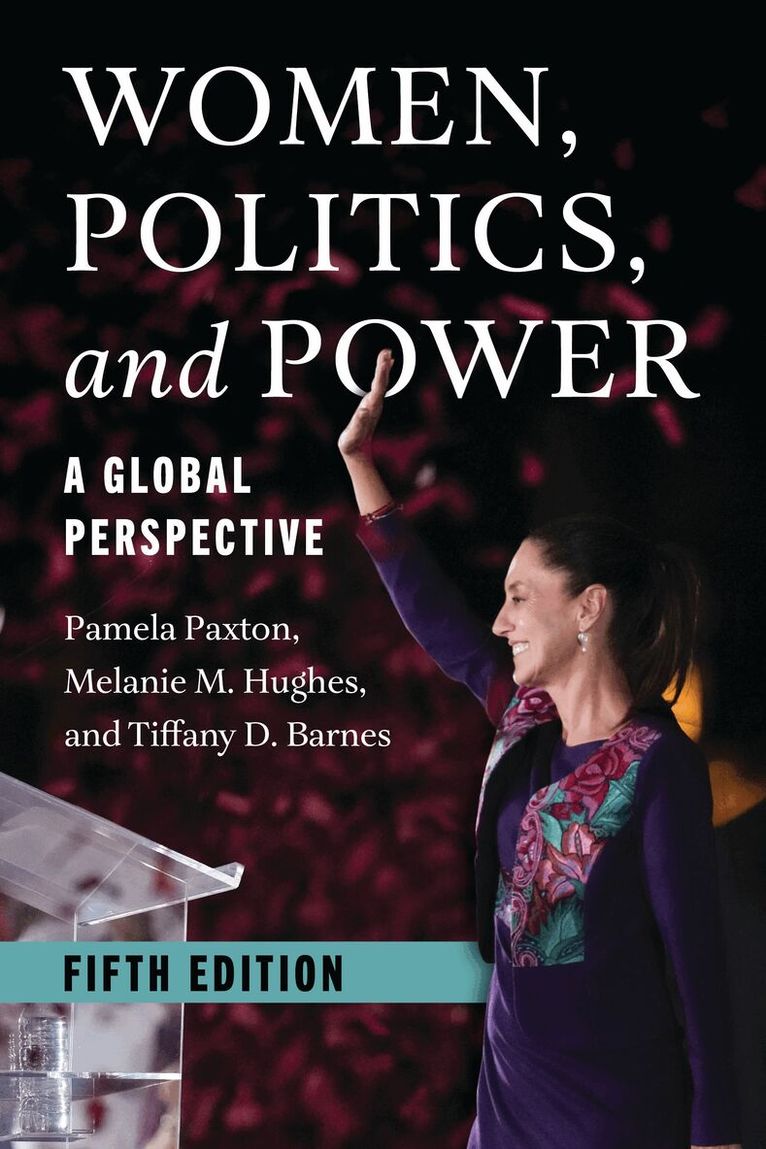
Women, Politics, and Power provides a clear and detailed introduction to women’s political participation and representation across all branches of government and a wide range of countries and regions. Using broad statistical overviews and detailed case-study accounts, authors Pamela Paxton, Melanie M. Hughes, and Tiffany D. Barnes document both historical trends and the contemporary state of women’s political strength across diverse countries. The text considers experiences of women from a range of marginalized groups, including racial, ethnic, and religious minorities; indigenous peoples; and those that face discrimination based on their sexual orientation and gender identity. Readers will learn about cultural, structural, political, and international influences on women’s access to political power, about the old and new barriers women continue to face like violence, and about the difference women make once in political office. Dedicated chapters on six geographic regions highlight distinct influences and patterns in different parts of the world. There is simply no other book that offers such a thorough and multidisciplinary synthesis of research on women’s political power around the world.The fifth edition includes the latest information available on women in politics around the world, including current events as they have unfolded across the globe. The newest thinking in the field is presented, including on violence against women in politics and intersectional approaches.
662 kr
Skickas inom 10-15 vardagar
Women, Politics, and Power provides a clear and detailed introduction to women’s political participation and representation across all branches of government and a wide range of countries and regions. Using broad statistical overviews and detailed case-study accounts, authors Pamela Paxton, Melanie M. Hughes, and Tiffany D. Barnes document both historical trends and the contemporary state of women’s political strength across diverse countries. The text considers experiences of women from a range of marginalized groups, including racial, ethnic, and religious minorities; indigenous peoples; and those that face discrimination based on their sexual orientation and gender identity. Readers will learn about cultural, structural, political, and international influences on women’s access to political power, about the old and new barriers women continue to face like violence, and about the difference women make once in political office. Dedicated chapters on six geographic regions highlight distinct influences and patterns in different parts of the world. There is simply no other book that offers such a thorough and multidisciplinary synthesis of research on women’s political power around the world.The fifth edition includes the latest information available on women in politics around the world, including current events as they have unfolded across the globe. The newest thinking in the field is presented, including on violence against women in politics and intersectional approaches.
3 781 kr
Skickas inom 7-10 vardagar
Providing an authoritative global overview of theoretical and empirical research in the field, this Handbook explores the complex relationship between gender and corruption in democracies. Through an analysis of the gendered dynamics of corruption across institutions, it advances understanding of both its causes and consequences.Expert authors examine core concepts in the study of corruption, identifying important areas where gender is often overlooked. They investigate key issues such as anti-corruption efforts, sextortion, clientelism, and the perception of corruption. Chapters detail the relationship between gender and corruption across branches of government and in a wide range of cultural contexts, including those beyond the West. The Handbook also assesses methodological challenges and ethical considerations for researchers and outlines innovative approaches and guidelines for studying corruption.The Handbook on Gender and Corruption in Democracies is a vital read for students and scholars of political science, regulation and governance, public administration and management, and gender politics. It is also an illuminating resource for policy-makers seeking to combat corruption and advance women’s representation and access to public services.