Tina Nabatchi – författare
1 973 kr
Skickas inom 5-8 vardagar
475 kr
Läs direkt efter köp
410 kr
Skickas inom 5-8 vardagar
458 kr
Läs direkt efter köp
911 kr
Skickas inom 5-8 vardagar
1 076 kr
Läs direkt efter köp
A comprehensive text on the theory and practice of public participation
Written by two leaders in the field, Public Participation for 21st Century Democracy explores the theory and practice of public participation in decision-making and problem-solving. It examines how public participation developed over time to include myriad thick, thin, and conventional opportunities, occurring in both face-to-face meetings and online settings. The book explores the use of participation in various arenas, including education, health, land use, and state and federal government. It offers a practical framework for thinking about how to engage citizens effectively, and clear explanations of participation scenarios, tactics, and designs. Finally, the book provides a sensible approach for reshaping our participation infrastructure to meet the needs of public officials and citizens.
The book is filled with illustrative examples of innovative participatory activities, and numerous sources for more information. This important text puts the spotlight on the need for long-term, cross-sector, participation planning, and provides guidance for leaders, citizens, activists, and others who are determined to improve the ways that participation and democracy function. Public Participation for 21st Century Democracy:
Helps students and practitioners understand the history, theory, and practice of public participation Contains a wealth of case studies that explore the application of public participation in different settings Covers vital issues such as education, health, land use, and state and federal government Has accompanying instructor resources, such as PowerPoint slides, discussion questions, sample assignments, case studies and research from www.participedia.net, and classroom activities.1 076 kr
Läs direkt efter köp
A comprehensive text on the theory and practice of public participation
Written by two leaders in the field, Public Participation for 21st Century Democracy explores the theory and practice of public participation in decision-making and problem-solving. It examines how public participation developed over time to include myriad thick, thin, and conventional opportunities, occurring in both face-to-face meetings and online settings. The book explores the use of participation in various arenas, including education, health, land use, and state and federal government. It offers a practical framework for thinking about how to engage citizens effectively, and clear explanations of participation scenarios, tactics, and designs. Finally, the book provides a sensible approach for reshaping our participation infrastructure to meet the needs of public officials and citizens.
The book is filled with illustrative examples of innovative participatory activities, and numerous sources for more information. This important text puts the spotlight on the need for long-term, cross-sector, participation planning, and provides guidance for leaders, citizens, activists, and others who are determined to improve the ways that participation and democracy function. Public Participation for 21st Century Democracy:
Helps students and practitioners understand the history, theory, and practice of public participation Contains a wealth of case studies that explore the application of public participation in different settings Covers vital issues such as education, health, land use, and state and federal government Has accompanying instructor resources, such as PowerPoint slides, discussion questions, sample assignments, case studies and research from www.participedia.net, and classroom activities.1 344 kr
Skickas inom 5-8 vardagar
458 kr
Skickas inom 5-8 vardagar
443 kr
Läs direkt efter köp
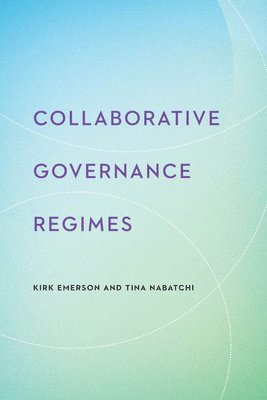
Whether the goal is building a local park or developing disaster response models, collaborative governance is changing the way public agencies at the local, regional, and national levels are working with each other and with key partners in the nonprofit and private sectors. While the academic literature has spawned numerous case studies and context- or policy-specific models for collaboration, the growth of these innovative collaborative governance systems has outpaced the scholarship needed to define it.
Collaborative Governance Regimes breaks new conceptual and practical ground by presenting an integrative framework for working across boundaries to solve shared problems, a typology for understanding variations among collaborative governance regimes, and an approach for assessing both process and productivity performance. This book draws on diverse literatures and uses rich case illustrations to inform scholars and practitioners about collaborative governance regimes and to provide guidance for designing, managing, and studying such endeavors in the future.
Collaborative Governance Regimes will be of special interest to scholars and researchers in public administration, public policy, and political science who want a framework for theory building, yet the book is also accessible enough for students and practitioners.
2 623 kr
Skickas inom 5-8 vardagar
27 kr
Läs direkt efter köp
This book asserts that there is a perennial need for social, evidence-based learning on what to aspire to and what works in public administration. Responding to this need, scholars from five continents present research that has been designed to do just that. Employing an array of frameworks and methods, they present studies of high-performing policies and programs and explore what makes them tick and what might be learned from how they were designed and delivered. Taken together, the 27 contributions make a powerful case for the added value of PPA as an intellectual and practical endeavour.
Laying out a future agenda for the field, this book is invaluable for students and scholars of public administration and management, public policy, regulation and governance. Theoretically grounded and conceptually innovative, it is also beneficial to policymakers seeking evidence for their belief that when done well, government does make an immensely positive contribution to society.