Tom Borrup - Böcker
Visar alla böcker från författaren Tom Borrup. Handla med fri frakt och snabb leverans.
8 produkter
8 produkter
3 386 kr
Skickas inom 10-15 vardagar
This Handbook is the first to explore the emergent field of ‘placemaking’ in terms of the recent research, teaching and learning, and practice agenda for the next few years. Offering valuable theoretical and practical insights from the leading scholars and practitioners in the field, it provides cutting-edge interdisciplinary research on the placemaking sector. Placemaking has seen a paradigmatic shift in urban design, planning, and policy to engage the community voice. This Handbook examines the development of placemaking, its emerging theories, and its future directions. The book is structured in seven distinct sections curated by experts in the areas concerned. Section One provides a glimpse at the history and key theories of placemaking and its interpretations by different community sectors. Section Two studies the transformative potential of placemaking practice through case studies on different places, methodologies, and theoretical frameworks. It also reveals placemaking’s potential to nurture a holistic community engagement, social justice, and human-centric urban environments. Section Three looks at the politics of placemaking to consider who is included and who is excluded from its practice and if the concept of placemaking needs to be reconstructed. Section Four deals with the scales and scopes of art-based placemaking, moving from the city to the neighborhood and further to the individual practice. It juxtaposes the voice of the practitioner and professional alongside that of the researcher and academic. Section Five tackles the socio-economic and environmental placemaking issues deemed pertinent to emerge more sustainable placemaking practices. Section Six emphasizes placemaking’s intersection with urban design and planning sectors and incudes case studies of generative planning practice. The final seventh section draws on the expertise of placemakers, researchers, and evaluators to present the key questions today, new methods and approaches to evaluation of placemaking in related fields, and notions for the future of evaluation practices. Each section opens with an introduction to help the reader navigate the text. This organization of the book considers the sectors that operate alongside the core placemaking practice.This seminal Handbook offers a timely contribution and international perspectives for the growing field of placemaking. It will be of interest to academics and students of placemaking, urban design, urban planning and policy, architecture, geography, cultural studies, and the arts.
498 kr
Skickas inom 10-15 vardagar
The Power of Culture in City Planning focuses on human diversity, strengths, needs, and ways of living together in geographic communities. The book turns attention to the anthropological definition of culture, encouraging planners in both urban and cultural planning to focus on characteristics of humanity in all their variety. It calls for a paradigm shift, re-positioning city planners’ "base maps" to start with a richer understanding of human cultures. Borrup argues for cultural master plans in parallel to transportation, housing, parks, and other specialized plans, while also changing the approach of city comprehensive planning to put people or "users" first rather than land "uses" as does the dominant practice.Cultural plans as currently conceived are not sufficient to help cities keep pace with dizzying impacts of globalization, immigration, and rapidly changing cultural interests. Cultural planners need to up their game, and enriching their own and city planners’ cultural competencies is only one step. Both planning practices have much to learn from one another and already overlap in more ways than most recognize. This book highlights some of the strengths of the lesser-known practice of cultural planning to help forge greater understanding and collaboration between the two practices, empowering city planners with new tools to bring about more equitable communities. This will be an important resource for students, teachers, and practitioners of city and cultural planning, as well as municipal policymakers of all stripes.
2 088 kr
Skickas inom 10-15 vardagar
The Power of Culture in City Planning focuses on human diversity, strengths, needs, and ways of living together in geographic communities. The book turns attention to the anthropological definition of culture, encouraging planners in both urban and cultural planning to focus on characteristics of humanity in all their variety. It calls for a paradigm shift, re-positioning city planners’ "base maps" to start with a richer understanding of human cultures. Borrup argues for cultural master plans in parallel to transportation, housing, parks, and other specialized plans, while also changing the approach of city comprehensive planning to put people or "users" first rather than land "uses" as does the dominant practice.Cultural plans as currently conceived are not sufficient to help cities keep pace with dizzying impacts of globalization, immigration, and rapidly changing cultural interests. Cultural planners need to up their game, and enriching their own and city planners’ cultural competencies is only one step. Both planning practices have much to learn from one another and already overlap in more ways than most recognize. This book highlights some of the strengths of the lesser-known practice of cultural planning to help forge greater understanding and collaboration between the two practices, empowering city planners with new tools to bring about more equitable communities. This will be an important resource for students, teachers, and practitioners of city and cultural planning, as well as municipal policymakers of all stripes.
677 kr
Skickas inom 10-15 vardagar
This Handbook is the first to explore the emergent field of ‘placemaking’ in terms of the recent research, teaching and learning, and practice agenda for the next few years. Offering valuable theoretical and practical insights from the leading scholars and practitioners in the field, it provides cutting-edge interdisciplinary research on the placemaking sector. Placemaking has seen a paradigmatic shift in urban design, planning, and policy to engage the community voice. This Handbook examines the development of placemaking, its emerging theories, and its future directions. The book is structured in seven distinct sections curated by experts in the areas concerned. Section One provides a glimpse at the history and key theories of placemaking and its interpretations by different community sectors. Section Two studies the transformative potential of placemaking practice through case studies on different places, methodologies, and theoretical frameworks. It also reveals placemaking’s potential to nurture a holistic community engagement, social justice, and human-centric urban environments. Section Three looks at the politics of placemaking to consider who is included and who is excluded from its practice and if the concept of placemaking needs to be reconstructed. Section Four deals with the scales and scopes of art-based placemaking, moving from the city to the neighborhood and further to the individual practice. It juxtaposes the voice of the practitioner and professional alongside that of the researcher and academic. Section Five tackles the socio-economic and environmental placemaking issues deemed pertinent to emerge more sustainable placemaking practices. Section Six emphasizes placemaking’s intersection with urban design and planning sectors and incudes case studies of generative planning practice. The final seventh section draws on the expertise of placemakers, researchers, and evaluators to present the key questions today, new methods and approaches to evaluation of placemaking in related fields, and notions for the future of evaluation practices. Each section opens with an introduction to help the reader navigate the text. This organization of the book considers the sectors that operate alongside the core placemaking practice.This seminal Handbook offers a timely contribution and international perspectives for the growing field of placemaking. It will be of interest to academics and students of placemaking, urban design, urban planning and policy, architecture, geography, cultural studies, and the arts.
Creative Community Builder's Handbook
How to Transform Communities Using Local Assets, Arts, and Culture
Häftad, Engelska, 2006
437 kr
Skickas inom 3-6 vardagar
Put the power of arts and culture to work in your community Part 1 of this unique guide distills research and emerging ideas behind culturally driven community development and explains key underlying principles. You'll understand the arts impact on community well-being and have the rationale for engaging others. Find inspiration and ideas from twenty case studies Part 2 gives you ten concrete strategies for building on the unique qualities of your own community. Each strategy is illustrated by two case studies taken from a variety of cities, small towns, and neighborhoods across the United States. You'll learn how people from all walks of life used culture and creativity as a glue to bind together people, ideas, enterprises, and institutions to make places more balanced and healthy. These examples are followed in Part 3 with six steps to assessing, planning, and implementing creative community building projects: 1. Assess Your Situation and Goals; 2. Identify and Recruit Effective Partners; 3. Map Values, Strengths, Assets, and History; 4. Focus on Your Key Asset, Vision, Identity, and Core Strategies; 5. Craft a Plan That Brings the Identity to Life; 6. Secure Funding, Policy Support, and Media Coverage. Detailed guidance, hands-on worksheets, and a hypothetical community sample walk you through the entire process. Each section includes additional resources as well as an appendix listing books, web sites, organizations, and research studies. By understanding the theoretical context (Part 1), learning from case studies (Part 2), and following the six steps (Part 3), you'll be able to build a more vibrant, creative, and equitable community.
584 kr
Skickas inom 10-15 vardagar
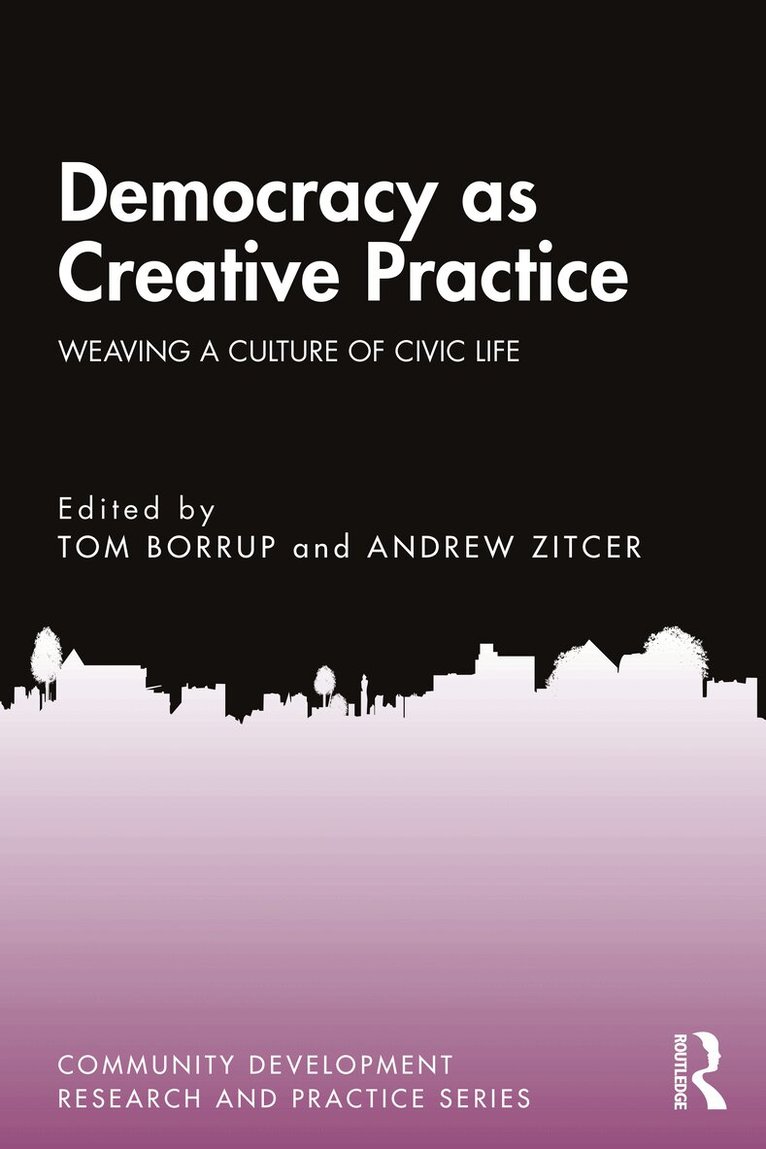
Democracy as Creative Practice: Weaving a Culture of Civic Life offers arts-based solutions to the threats to democracies around the world, practices that can foster more just and equitable societies. Chapter authors are artists, activists, curators, and teachers applying creative and cultural practices in deliberate efforts to build democratic ways of working and interacting in their communities in a range of countries including the United States, Australia, Portugal, Nepal, the United Kingdom, and Canada. The book demonstrates how creativity is integrated in place-based actions, aesthetic strategies, learning environments, and civic processes. As long-time champions and observers of community-based creative and cultural practices, editors Tom Borrup and Andrew Zitcer elucidate work that not only responds to sociopolitical conditions but advances practice. They call on artists, funders, cultural organizations, community groups, educational institutions, government, and others to engage in and support this work that fosters a culture of democracy.This book is intended for undergraduate and graduate students in the humanities and social sciences, activists, funders, and artists who seek to understand and effect change on local and global scales to preserve, extend, and improve practices of democracy.
2 166 kr
Skickas inom 10-15 vardagar
Democracy as Creative Practice: Weaving a Culture of Civic Life offers arts-based solutions to the threats to democracies around the world, practices that can foster more just and equitable societies. Chapter authors are artists, activists, curators, and teachers applying creative and cultural practices in deliberate efforts to build democratic ways of working and interacting in their communities in a range of countries including the United States, Australia, Portugal, Nepal, the United Kingdom, and Canada. The book demonstrates how creativity is integrated in place-based actions, aesthetic strategies, learning environments, and civic processes. As long-time champions and observers of community-based creative and cultural practices, editors Tom Borrup and Andrew Zitcer elucidate work that not only responds to sociopolitical conditions but advances practice. They call on artists, funders, cultural organizations, community groups, educational institutions, government, and others to engage in and support this work that fosters a culture of democracy.This book is intended for undergraduate and graduate students in the humanities and social sciences, activists, funders, and artists who seek to understand and effect change on local and global scales to preserve, extend, and improve practices of democracy.
Creative Community Builder's Handbook
How to Transform Communities Using Local Assets, Arts, and Culture
Inbunden, Engelska, 2006
470 kr
Skickas inom 3-6 vardagar
Put the power of arts and culture to work in your community Part 1 of this unique guide distills research and emerging ideas behind culturally driven community development and explains key underlying principles. You'll understand the arts impact on community well-being and have the rationale for engaging others. Find inspiration and ideas from twenty case studies Part 2 gives you ten concrete strategies for building on the unique qualities of your own community. Each strategy is illustrated by two case studies taken from a variety of cities, small towns, and neighborhoods across the United States. You'll learn how people from all walks of life used culture and creativity as a glue to bind together people, ideas, enterprises, and institutions to make places more balanced and healthy. These examples are followed in Part 3 with six steps to assessing, planning, and implementing creative community building projects: 1. Assess Your Situation and Goals; 2. Identify and Recruit Effective Partners; 3. Map Values, Strengths, Assets, and History; 4. Focus on Your Key Asset, Vision, Identity, and Core Strategies; 5. Craft a Plan That Brings the Identity to Life; 6. Secure Funding, Policy Support, and Media Coverage. Detailed guidance, hands-on worksheets, and a hypothetical community sample walk you through the entire process. Each section includes additional resources as well as an appendix listing books, web sites, organizations, and research studies. By understanding the theoretical context (Part 1), learning from case studies (Part 2), and following the six steps (Part 3), you'll be able to build a more vibrant, creative, and equitable community.