Tudor Georgescu - Böcker
Visar alla böcker från författaren Tudor Georgescu. Handla med fri frakt och snabb leverans.
3 produkter
3 produkter
2 246 kr
Skickas inom 10-15 vardagar
This edited volume arose from an international workshop convened in 2006 by Feldman and Turda with Tudor Georgescu, supported by Routledge, and the universities of Oxford, Brookes, Northampton and CEU (Budapest). As the field of fascist studies continues to integrate more fully into pan-European studies of the twentieth century, and given the increasing importance of secular ‘political religion’ as a taxonomic tool for understanding such revolutionary movements, this collection of essays considers the intersection between institutional Christian faiths, theology and congregations on the one hand, and fascist ideology on the other.In light of recent debates concerning the intersecting secularisation of religion and (usually Christian-based) the sacralisation of politics, "Clerical Fascism" in Interwar Europe approaches such conundrums from an alternative perspective: How, in Europe between the wars, did Christian clergy, laity and institutions respond to the rise of national fascist movements? In doing so, this volume provides case studies from the vast majority of European countries with analyses that are both original in intent and comprehensive in scope. In dealing with the relationship of various interwar fascist movements and their respective national religious institutions, this edited collection promises to significantly contribute to relevant academic historiographies; and as such, will appeal to a wide readership.This book was previously published as a special issue of Totalitarian Movements and Political Religions.
693 kr
Skickas inom 10-15 vardagar
This edited volume arose from an international workshop convened in 2006 by Feldman and Turda with Tudor Georgescu, supported by Routledge, and the universities of Oxford, Brookes, Northampton and CEU (Budapest). As the field of fascist studies continues to integrate more fully into pan-European studies of the twentieth century, and given the increasing importance of secular ‘political religion’ as a taxonomic tool for understanding such revolutionary movements, this collection of essays considers the intersection between institutional Christian faiths, theology and congregations on the one hand, and fascist ideology on the other.In light of recent debates concerning the intersecting secularisation of religion and (usually Christian-based) the sacralisation of politics, "Clerical Fascism" in Interwar Europe approaches such conundrums from an alternative perspective: How, in Europe between the wars, did Christian clergy, laity and institutions respond to the rise of national fascist movements? In doing so, this volume provides case studies from the vast majority of European countries with analyses that are both original in intent and comprehensive in scope. In dealing with the relationship of various interwar fascist movements and their respective national religious institutions, this edited collection promises to significantly contribute to relevant academic historiographies; and as such, will appeal to a wide readership.This book was previously published as a special issue of Totalitarian Movements and Political Religions.
1 714 kr
Skickas inom 10-15 vardagar
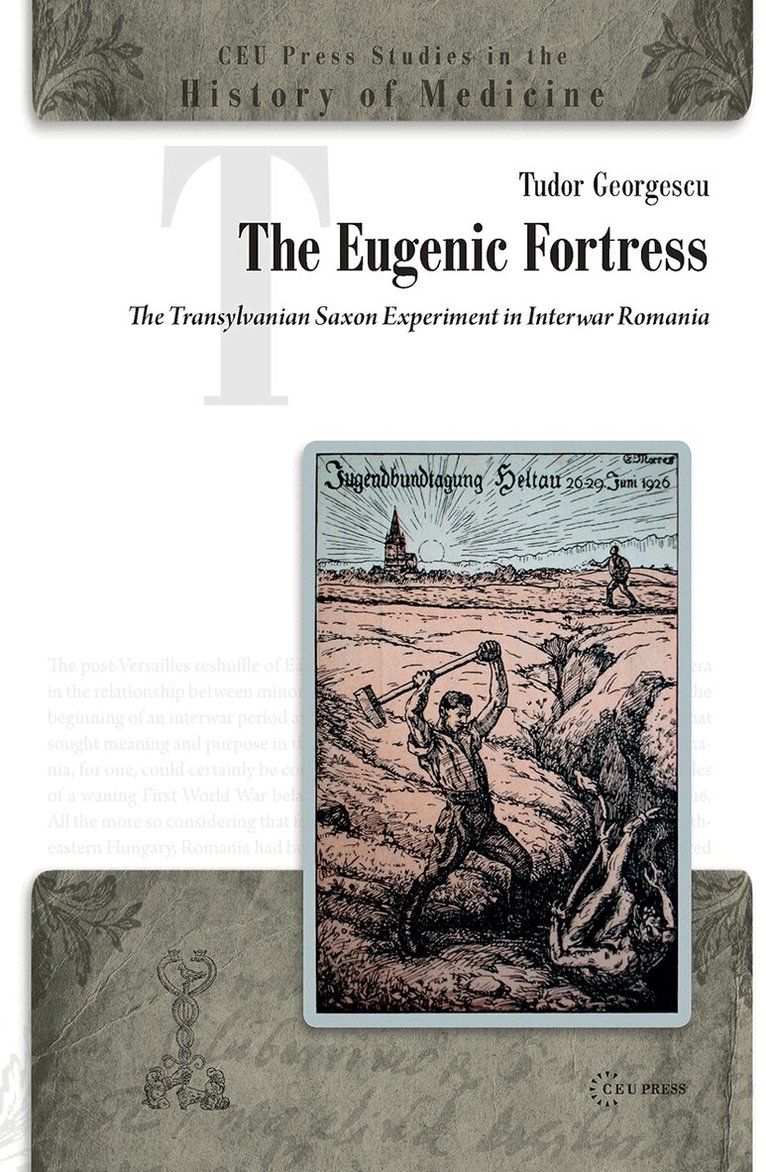
The ever growing library on the history of eugenics and fascism focuses largely on nation states, while this monograph asks why an ethnic minority, the Transylvanian Saxons, turned to eugenics as a means of self-empowerment in interwar Romania. The Eugenic Fortress investigates and unpacks the eugenic movement that emerged in the early twentieth century, and focuses on its conceptual and methodological evolution during the interwar period. Further on, the book analyzes the gradual process of politicisation and radicalisation at the hands of a second generation of Saxon eugenicists in conjunction with the rise of an equally indigenous fascist movement. The Saxon case study offers valuable insights into why an ethnic minority would seek to re-entrench itself behind the race-hygienic walls of a 'eugenic fortress', as well as the influence host and home nations had upon its design. Georgescu's work is ground breaking in the sense that the history of this uprooted community is usually handled with sensitivity and serious (and critical) research into Transylvanian Saxon involvement with Nazism has been energetically resisted.