Usha Sakthivel - Böcker
Visar alla böcker från författaren Usha Sakthivel. Handla med fri frakt och snabb leverans.
4 produkter
4 produkter
1 626 kr
Skickas inom 10-15 vardagar
This book vividly illustrates all the promising and potential machine learning (ML) and deep learning (DL) algorithms through a host of real-world and real-time business use cases. Machines and devices can be empowered to self-learn and exhibit intelligent behavior. Also, Big Data combined with real-time and runtime data can lead to personalized, prognostic, predictive, and prescriptive insights. This book examines the following topics: Cognitive machines and devices Cyber physical systems (CPS) The Internet of Things (IoT) and industrial use cases Industry 4.0 for smarter manufacturing Predictive and prescriptive insights for smarter systems Machine vision and intelligence Natural interfaces K-means clustering algorithm Support vector machine (SVM) algorithm A priori algorithms Linear and logistic regression Applied Learning Algorithms for Intelligent IoT clearly articulates ML and DL algorithms that can be used to unearth predictive and prescriptive insights out of Big Data. Transforming raw data into information and relevant knowledge is gaining prominence with the availability of data processing and mining, analytics algorithms, platforms, frameworks, and other accelerators discussed in the book. Now, with the emergence of machine learning algorithms, the field of data analytics is bound to reach new heights.This book will serve as a comprehensive guide for AI researchers, faculty members, and IT professionals. Every chapter will discuss one ML algorithm, its origin, challenges, and benefits, as well as a sample industry use case for explaining the algorithm in detail. The book’s detailed and deeper dive into ML and DL algorithms using a practical use case can foster innovative research.
694 kr
Skickas inom 10-15 vardagar
This book vividly illustrates all the promising and potential machine learning (ML) and deep learning (DL) algorithms through a host of real-world and real-time business use cases. Machines and devices can be empowered to self-learn and exhibit intelligent behavior. Also, Big Data combined with real-time and runtime data can lead to personalized, prognostic, predictive, and prescriptive insights. This book examines the following topics: Cognitive machines and devices Cyber physical systems (CPS) The Internet of Things (IoT) and industrial use cases Industry 4.0 for smarter manufacturing Predictive and prescriptive insights for smarter systems Machine vision and intelligence Natural interfaces K-means clustering algorithm Support vector machine (SVM) algorithm A priori algorithms Linear and logistic regression Applied Learning Algorithms for Intelligent IoT clearly articulates ML and DL algorithms that can be used to unearth predictive and prescriptive insights out of Big Data. Transforming raw data into information and relevant knowledge is gaining prominence with the availability of data processing and mining, analytics algorithms, platforms, frameworks, and other accelerators discussed in the book. Now, with the emergence of machine learning algorithms, the field of data analytics is bound to reach new heights.This book will serve as a comprehensive guide for AI researchers, faculty members, and IT professionals. Every chapter will discuss one ML algorithm, its origin, challenges, and benefits, as well as a sample industry use case for explaining the algorithm in detail. The book’s detailed and deeper dive into ML and DL algorithms using a practical use case can foster innovative research.
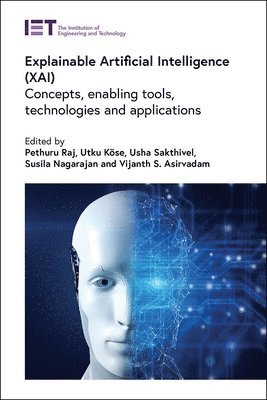
Explainable Artificial Intelligence (XAI)
Concepts, enabling tools, technologies and applications
Inbunden, Engelska, 2023
1 927 kr
Skickas inom 3-6 vardagar
The world is keen to leverage multi-faceted AI techniques and tools to deploy and deliver the next generation of business and IT applications. Resource-intensive gadgets, machines, instruments, appliances, and equipment spread across a variety of environments are empowered with AI competencies. Connected products are collectively or individually enabled to be intelligent in their operations, offering and output.AI is being touted as the next-generation technology to visualize and realize a bevy of intelligent systems, networks and environments. However, there are challenges associated with the huge adoption of AI methods. As we give full control to AI systems, we need to know how these AI models reach their decisions. Trust and transparency of AI systems are being seen as a critical challenge. Building knowledge graphs and linking them with AI systems are being recommended as a viable solution for overcoming this trust issue and the way forward to fulfil the ideals of explainable AI.The authors focus on explainable AI concepts, tools, frameworks and techniques. To make the working of AI more transparent, they introduce knowledge graphs (KG) to support the need for trust and transparency into the functioning of AI systems. They show how these technologies can be used towards explaining data fabric solutions and how intelligent applications can be used to greater effect in finance and healthcare.Explainable Artificial Intelligence (XAI): Concepts, enabling tools, technologies and applications is aimed primarily at industry and academic researchers, scientists, engineers, lecturers and advanced students in the fields of IT and computer science, soft computing, AI/ML/DL, data science, semantic web, knowledge engineering and IoT. It will also prove a useful resource for software, product and project managers and developers in these fields.
1 848 kr
Skickas inom 10-15 vardagar
This book explains the technologies and tools that underpin GNNs, offering a clear and practical guide to their industrial applications and use cases. AI engineers, data scientists, and researchers in AI and graph theory will find detailed insights into the latest trends and innovations driving this dynamic field. With practical chapters demonstrating how GNNs are reshaping various industry verticals—and how they complement advances in generative, agentic, and physical AI—this book is an essential resource for understanding and leveraging their potential.The neural network paradigm has surged in popularity for its ability to uncover hidden patterns within vast datasets. This transformative technology has spurred global innovations, particularly through the evolution of deep neural networks (DNNs). Convolutional neural networks (CNNs) have revolutionized computer vision, while recurrent neural networks (RNNs) and their advanced variants have automated natural language processing tasks such as speech recognition, translation, and content generation.Traditional DNNs primarily handle Euclidean data, yet many real-world problems involve non-Euclidean data—complex relationships and interactions naturally represented as graphs. This challenge has driven the rise of graph neural networks (GNNs), an approach that extends deep learning into new domains.GNNs are powerful models designed to work with graph-structured data, where nodes represent individual data points and edges denote the relationships between them. Several variants have emerged:Graph Convolutional Networks (GCNs): These networks learn from a node’s local neighborhood by aggregating information from adjacent nodes, updating the node’s representation in the process.Graph Attentional Networks (GATs): By incorporating attention mechanisms, GATs focus on the most relevant neighbors during aggregation, enhancing model performance.Graph Recurrent Networks (GRNs): These networks combine principles from RNNs with graph structures to capture dynamic relationships within the data.GNNs are applied in a variety of advanced use cases, including node classification, link prediction, graph clustering, anomaly detection, recommendation systems, and also in natural language processing and computer vision. They help forecast traffic patterns, analyze molecular structures, verify programs, predict social influence, model electronic health records, and map brain networks.