Valentino Gasparini – författare
Visar alla böcker från författaren . Handla med fri frakt och snabb leverans.
7 produkter
7 produkter
Inbunden, Engelska, 2020
1 692 kr
Skickas inom 5-8 vardagar
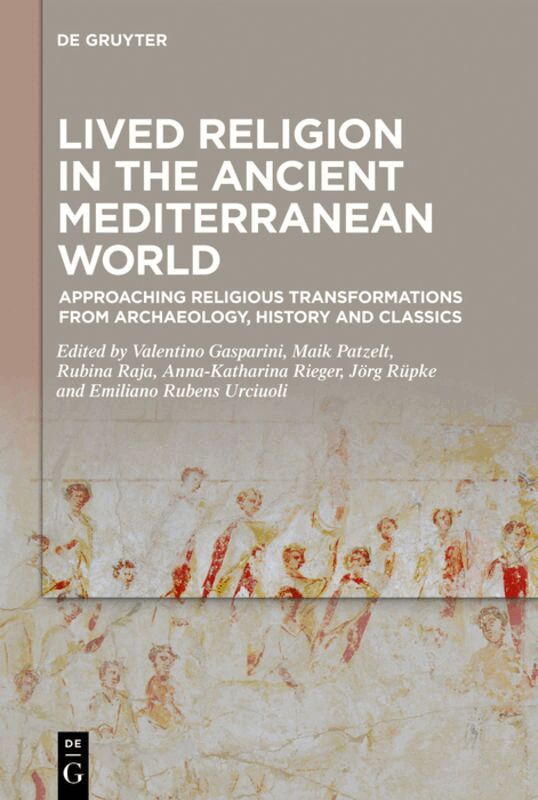
The Lived Ancient Religion project has radically changed perspectives on ancient religions and their supposedly personal or public character. This volume applies and further develops these methodological tools, new perspectives and new questions. The religious transformations of the Roman Imperial period appear in new light and more nuances by comparative confrontation and the integration of many disciplines. The contributions are written by specialists from a variety of disciplinary contexts (Jewish Studies, Theology, Classics, Early Christian Studies) dealing with the history of religion of the Mediterranean, West-Asian, and European area from the (late) Hellenistic period to the (early) Middle Ages and shaped by their intensive exchange. From the point of view of their respective fields of research, the contributors engage with discourses on agency, embodiment, appropriation and experience. They present innovative research in four fields also of theoretical debate, which are “Experiencing the Religious”, “Switching the Code”, „A Thing Called Body“ and “Commemorating the Moment”.
Inbunden, Engelska, 2026
1 633 kr
Kommande
Do we really need a new book about religion in Pompeii and Herculaneum? At least seven main scientific volumes were integrally dedicated – only during the last 25 years – to this topic, and reams and reams have been devoted to the subject by popularizing literature since the 18th century. Nonetheless, the answer to this question still remains positive. The always restless field-work on the Vesuvian sites and the even more intense intellectual “rumination” on their history is still providing abundant food for thought and contributing to a massive bibliographical production. This new book, which collects and expand on ideas developed by the author during two decades, casts an original (at times even provocative) and updated look on the local pre-Roman and Roman religious praxis by tackling it through the paradigm of “urban religion”, that is focusing on the negotiation between “lived” and “civic” religion and on the tension between individual creativity and institutionalized cultic practices.
Inbunden, Engelska, 2025
1 594 kr
Skickas inom 5-8 vardagar
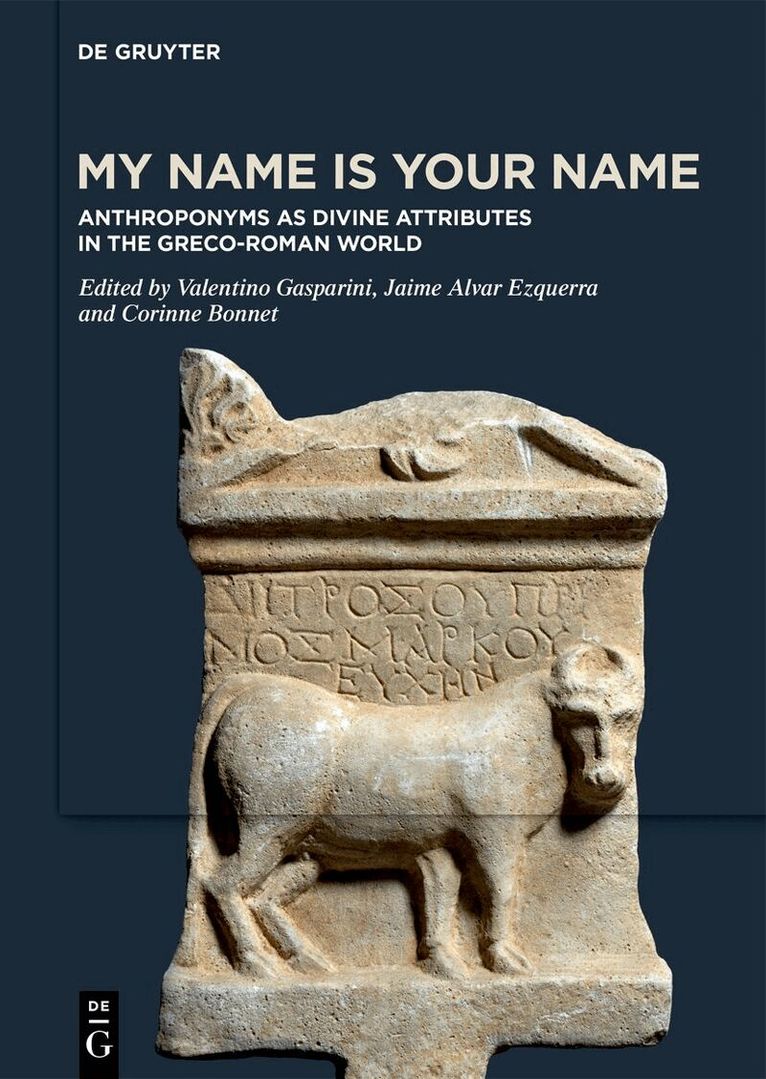
Divine epithets serve a variety of purposes, with the most frequent being those related to the locations and functions of the gods. Epithets derived from individual names, however, have received less attention. While few studies have focused on the Greek world, research on the Latin-speaking Mediterranean is still sporadic. Such “anthropophoric” onomastic attributes have often been interpreted as related to the name of a cult founder. Yet, such a practice rather suggests various forms of relationships between the god and the individual (or group) whose name shapes the epithet. These dynamics of “individualisation” of a deity require further exploration. This collective book provides, for the first time, a detailed catalog of 398 Greek and Latin occurrences from the broad circum-Mediterranean area (including Greece, Anatolia, the Levant, North Africa, the Iberian peninsula, Central Europe, Italy, and Rome), related to 45 divinities and 191 different epithets. Multiple case studies ranging from the 5th or 4th century BCE to the 4th century CE, examined through different chronological, geographical, and thematic perspectives, offer valuable insights into local and regional strategies of religious appropriation.
E-bok
PDF, Engelska, 20251 385 kr
Läs direkt efter köp
Divine epithets serve a variety of purposes, with the most frequent being those related to the locations and functions of the gods. Epithets derived from individual names, however, have received less attention. While few studies have focused on the Greek world, research on the Latin-speaking Mediterranean is still sporadic. Such "e;anthropophoric"e; onomastic attributes have often been interpreted as related to the name of a cult founder. Yet, such a practice rather suggests various forms of relationships between the god and the individual (or group) whose name shapes the epithet. These dynamics of "e;individualisation"e; of a deity require further exploration. This collective book provides, for the first time, a detailed catalog of 398 Greek and Latin occurrences from the broad circum-Mediterranean area (including Greece, Anatolia, the Levant, North Africa, the Iberian peninsula, Central Europe, Italy, and Rome), related to 45 divinities and 191 different epithets. Multiple case studies ranging from the 5th or 4th century BCE to the 4th century CE, examined through different chronological, geographical, and thematic perspectives, offer valuable insights into local and regional strategies of religious appropriation.
1 385 kr
Läs direkt efter köp
Divine epithets serve a variety of purposes, with the most frequent being those related to the locations and functions of the gods. Epithets derived from individual names, however, have received less attention. While few studies have focused on the Greek world, research on the Latin-speaking Mediterranean is still sporadic. Such "e;anthropophoric"e; onomastic attributes have often been interpreted as related to the name of a cult founder. Yet, such a practice rather suggests various forms of relationships between the god and the individual (or group) whose name shapes the epithet. These dynamics of "e;individualisation"e; of a deity require further exploration. This collective book provides, for the first time, a detailed catalog of 398 Greek and Latin occurrences from the broad circum-Mediterranean area (including Greece, Anatolia, the Levant, North Africa, the Iberian peninsula, Central Europe, Italy, and Rome), related to 45 divinities and 191 different epithets. Multiple case studies ranging from the 5th or 4th century BCE to the 4th century CE, examined through different chronological, geographical, and thematic perspectives, offer valuable insights into local and regional strategies of religious appropriation.
E-bok
PDF, Engelska, 2013713 kr
Läs direkt efter köp
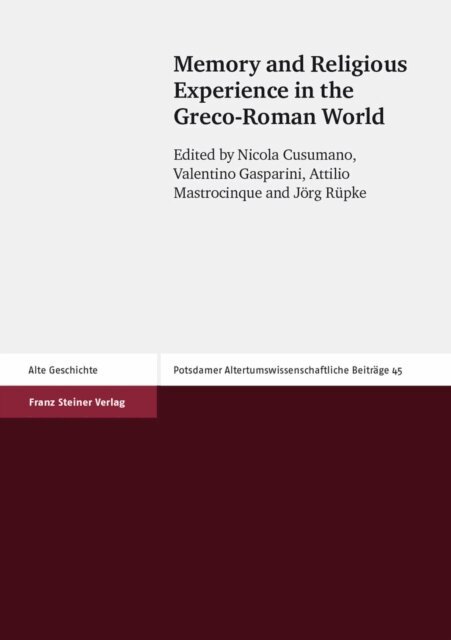
The concepts of memory and experience have stimulated interest in a wide range of recent cultural studies. In the history of scholarship on religion in Mediterranean antiquity, scholars have focused on the emotional dimension of both terms by employing the concepts of 'Christianity' and its derivative, 'oriental religion'. Only recently analyses in this field started focusing on interaction and individual experience. Research initiatives at Palermo and Erfurt have taken up this lead and brought together a group of scholars testing such approaches for new perspectives on the history of religion in the Greek and Roman world. This volume reviews the cognitive and emotional dimensions of such experiences in their diverse local, social, and ritual contexts. Memory likewise opens a window onto the interaction of individual and society. Contributions address the individual processes of memorialization and remembrance. They analyse the collective evocation of memories and their shaping of individual memory.
E-bok
PDF, Franska, 20161 248 kr
Läs direkt efter köp
Filippo Coarelli ha rappresentato una figura di primo piano nel panorama mondiale dell'archeologia e della storia delle religioni nel corso delle ultime due generazioni. La sua fecondita e testimoniata, a partire dal 1961, da non meno di 450 contributi di alto contenuto. In occasione della celebrazione dei suoi 80 anni, 160 amici, sodali e colleghi si sono riuniti per rendergli omaggio. Questo volume racchiude una selezione di 52 contributi (in lingua italiana, francese, inglese e spagnola) che spaziano dall'eta arcaica a quella tardo-antica, dal Vicino Oriente alla penisola Iberica, trovando nella religione il punto d'incontro di una virtuale conversazione con il Nostro sull'uomo antico. Se il tema comune e quello dei culti greco-romani, l'approccio dei singoli autori mostra tutta la ricchezza e la varieta degli interessi dell'onorando, indagando questioni relative all'archeologia del paesaggio, ai tempi e agli spazi del sacro, agli attori di culto, al rapporto fra iconografia e preferenze religiose, alle pratiche funerarie, e al ruolo del mito e del sacro nella ricezione dell'antico.