Vitruvius – författare
Visar alla böcker från författaren Vitruvius. Handla med fri frakt och snabb leverans.
22 produkter
22 produkter
402 kr
Skickas inom 5-8 vardagar
Vitruvius skrift ger oss en inblick i antikens synsätt och en förklaring till den grund arkitekturen och byggnadskonsten står på. Trots att Vitruvius avslutade sin bok ca 10 f Kr. för mer än 2000 år sedan, är texten levande och begriplig, den talar till oss så att vi förstår. Vi överraskas av att han introducerar begrepp och kunskap som vi idag använder oss av utan att kanske förstå bakgrunden till. Han beskriver hur man konstruerar bostadshus, lantgårdar och tempel liksom stora projekt som badanläggningar, hamnar och städer. Johan Mårtelius, professor och arkitekturhistoriker, introducerar Vitruvius och har granskat utgåvan.
152 kr
Skickas
In De architectura (c.40 BC), Vitruvius discusses in ten encyclopedic chapters aspects of Roman architecture, engineering and city planning. Vitruvius also included a section on human proportions. Because it is the only antique treatise on architecture to have survived, De architectura has been an invaluable source of information for scholars. The rediscovery of Vitruvius during the Renaissance greatly fuelled the revival of classicism during that and subsequent periods. Numerous architectural treatises were based in part or inspired by Vitruvius, beginning with Leon Battista Alberti's De re aedificatoria (1485).
223 kr
Skickas
The oldest and most influential book ever written on architecture, this volume served as a guide to Bramante, Michelangelo, Palladio, Vignola, and countless others. It describes the classic principles of symmetry, harmony, and proportion as well as the ancients' methods, materials, and aesthetics. Authoritative translation by a distinguished Harvard professor.
407 kr
Skickas inom 7-10 vardagar
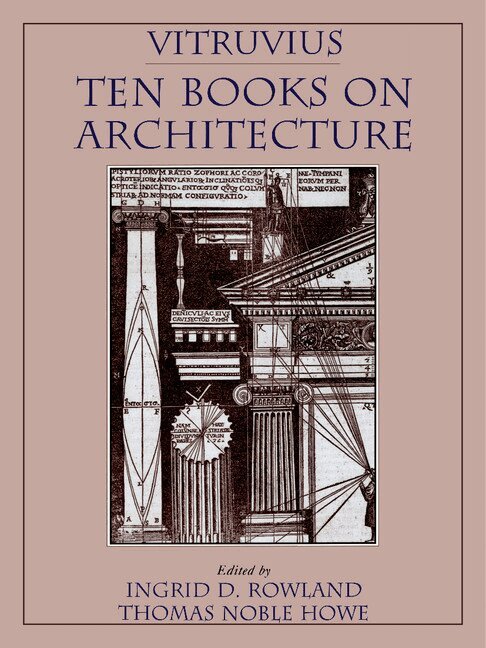
The only full treatise on architecture and its related arts to survive from classical antiquity, the De Architectura libri decem (Ten Books on Architecture) is the single most important work of architectural history in the Western world, having shaped humanist architecture and the image of the architect from the Renaissance to the present. This new, critical edition of Vitruvius' Ten Books of Architecture is the first to be published for an English-language audience in more than half a century. Expressing the range of Vitruvius' style, the translation, along with the critical commentary and illustrations, aims to shape a new image of the Vitruvius who emerges as an inventive and creative thinker, rather than the normative summarizer, as he was characterized in the Middle Ages and Renaissance.
348 kr
Skickas inom 5-8 vardagar
The Renaissance man avant la lettre.Vitruvius (Marcus V. Pollio), Roman architect and engineer, studied Greek philosophy and science and gained experience in the course of professional work. He was one of those appointed to be overseers of imperial artillery or military engines, and was architect of at least one unit of buildings for Augustus in the reconstruction of Rome. Late in life and in ill health he completed, sometime before 27 BC, De Architectura which, after its rediscovery in the fifteenth century, was influential enough to be studied by architects from the early Renaissance to recent times.In On Architecture Vitruvius adds to the tradition of Greek theory and practice the results of his own experience. The contents of this treatise in ten books are as follows. Book 1: Requirements for an architect; town planning; design, cities, aspects; temples. 2: Materials and their treatment. Greek systems. 3: Styles. Forms of Greek temples. Ionic. 4: Styles. Corinthian, Ionic, Doric; Tuscan; altars. 5: Other public buildings (fora, basilicae, theaters, colonnades, baths, harbors). 6: Sites and planning, especially of houses. 7: Construction of pavements, roads, mosaic floors, vaults. Decoration (stucco, wall painting, colors). 8: Hydraulic engineering; water supply; aqueducts. 9: Astronomy. Greek and Roman discoveries; signs of the zodiac, planets, moon phases, constellations, astrology, gnomon, sundials. 10: Machines for war and other purposes.
348 kr
Skickas inom 5-8 vardagar
The Renaissance man avant la lettre.Vitruvius (Marcus V. Pollio), Roman architect and engineer, studied Greek philosophy and science and gained experience in the course of professional work. He was one of those appointed to be overseers of imperial artillery or military engines, and was architect of at least one unit of buildings for Augustus in the reconstruction of Rome. Late in life and in ill health he completed, sometime before 27 BC, De Architectura which, after its rediscovery in the fifteenth century, was influential enough to be studied by architects from the early Renaissance to recent times.In On Architecture Vitruvius adds to the tradition of Greek theory and practice the results of his own experience. The contents of this treatise in ten books are as follows. Book 1: Requirements for an architect; town planning; design, cities, aspects; temples. 2: Materials and their treatment. Greek systems. 3: Styles. Forms of Greek temples. Ionic. 4: Styles. Corinthian, Ionic, Doric; Tuscan; altars. 5: Other public buildings (fora, basilicae, theaters, colonnades, baths, harbors). 6: Sites and planning, especially of houses. 7: Construction of pavements, roads, mosaic floors, vaults. Decoration (stucco, wall painting, colors). 8: Hydraulic engineering; water supply; aqueducts. 9: Astronomy. Greek and Roman discoveries; signs of the zodiac, planets, moon phases, constellations, astrology, gnomon, sundials. 10: Machines for war and other purposes.
150 kr
Skickas inom 5-8 vardagar
An entertaining and enlightening collection of ancient Roman writings about home design and decorationThe idea that our homes can communicate professional as well as personal identities may seem as new as the work-from-home revolution. But it was second nature to the ancient Romans, for whom the home was in many ways the center of public and private life. Roman authors saw infinite practical and symbolic value in houses, and they have much to say about them. How to Make a Home presents some of the best Roman writings on houses—from buying and selling to designing and decorating.Edited and elegantly translated by Marden Fitzpatrick Nichols, How to Make a Home gathers selections by Cicero, Vitruvius, Seneca, and others, with the original Latin or Greek on facing pages. These writings reveal the pleasures and pitfalls of the Roman practice of making one’s home a cornerstone of self-expression. While the ideal home enshrined Roman virtues and could make a career, lavish building projects could lead to financial ruin and moral condemnation. These authors memorably describe such travails as deceptive staging, decorators run amok, know-it-all owners, unsupervised contractors, and buyer’s remorse. Along the way, they also explain why simplicity is bliss, privacy is for nobodies, a neglected house is a sign of a neglected soul, and much more.A unique and charming introduction to Roman domestic architecture and its cultural significance, How to Make a Home reveals that the obsession with house and home has a long and fascinating history.
484 kr
Skickas inom 5-8 vardagar
344 kr
Skickas inom 5-8 vardagar
375 kr
Skickas inom 5-8 vardagar
238 kr
Skickas inom 5-8 vardagar
577 kr
Skickas inom 3-6 vardagar
747 kr
Skickas inom 3-6 vardagar
196 kr
Skickas inom 5-8 vardagar
412 kr
Skickas inom 5-8 vardagar
412 kr
Skickas inom 5-8 vardagar
301 kr
Skickas inom 5-8 vardagar
Architecture, Ou Art de Bien Bâtir de Marc Vitruve Pollion MIS de Latin En François (Éd.1618)
Häftad, Franska, 2012
318 kr
Skickas inom 5-8 vardagar
Architecture. Art de Bien Bâtir MIS de Latin En François Au Roy Très-Chrestien Henry II
Häftad, Franska, 2017
366 kr
Skickas inom 5-8 vardagar
1 690 kr
Skickas inom 5-8 vardagar
251 kr
Skickas inom 5-8 vardagar
154 kr
Skickas inom 5-8 vardagar