Vivienne Bozalek – författare
2 090 kr
Skickas inom 10-15 vardagar
2 151 kr
Skickas inom 10-15 vardagar
2 090 kr
Skickas inom 10-15 vardagar
571 kr
Skickas inom 10-15 vardagar
2 151 kr
Skickas inom 10-15 vardagar
560 kr
Skickas inom 10-15 vardagar
571 kr
Skickas inom 10-15 vardagar
588 kr
Skickas inom 10-15 vardagar
2 225 kr
Skickas inom 10-15 vardagar
662 kr
Läs direkt efter köp
Nancy Fraser and Participatory Parity provides a philosophical framework based on the work of Nancy Fraser, examining how her ideas can be used to analyse contemporary issues in higher education and reimagine higher education practices. Providing a forum for considering Fraser’s work in relation to participatory parity in higher education, the book shows how her political philosophy is relevant to higher education pedagogies, scholarship and practice.
The recent student protests in South Africa in 2015 and 2016 has created an impetus to think about how to do things differently in higher education in response to economic, cultural and political inequities. This South African experience is aptly used as a prime example of rethinking issues of coloniality and social injustice in higher education. The contributors’ use of Nancy Fraser’s theories provides their analyses and reflections with a particularly sharp lens and clear focus. The book also puts her work into conversation with other contemporary writers on social justice and explores the resonances and differentiations of the various approaches.
This book will be of great interest for academics, researchers and post-graduate students in the fields of social justice in education and educational policy.
662 kr
Läs direkt efter köp
Nancy Fraser and Participatory Parity provides a philosophical framework based on the work of Nancy Fraser, examining how her ideas can be used to analyse contemporary issues in higher education and reimagine higher education practices. Providing a forum for considering Fraser’s work in relation to participatory parity in higher education, the book shows how her political philosophy is relevant to higher education pedagogies, scholarship and practice.
The recent student protests in South Africa in 2015 and 2016 has created an impetus to think about how to do things differently in higher education in response to economic, cultural and political inequities. This South African experience is aptly used as a prime example of rethinking issues of coloniality and social injustice in higher education. The contributors’ use of Nancy Fraser’s theories provides their analyses and reflections with a particularly sharp lens and clear focus. The book also puts her work into conversation with other contemporary writers on social justice and explores the resonances and differentiations of the various approaches.
This book will be of great interest for academics, researchers and post-graduate students in the fields of social justice in education and educational policy.
662 kr
Läs direkt efter köp
This book makes an important contribution to ongoing debates about the epistemological, ethical, ontological and political implications of relational ethics in higher education. By furthering theoretical developments on the ethics of care and critical posthumanism, it speaks to contemporary concerns for more socially just possibilities and enriched understandings of higher education pedagogies.
The book considers how the political ethics of care and posthuman/new feminist materialist ethics can be diffracted through each other and how this can have value for thinking about higher education pedagogies. It includes ideas on ethics which push those boundaries that have previously served educational researchers and proposes new ways of conceptualising relational ethics. Chapters consider the entangled connections of the linguistic, social, material, ethical, political and biological in relation to higher education pedagogies.
This topical and transdisciplinary book will be of great interest for academics, researchers and postgraduate students in the fields of posthuman and care ethics, social justice in education, higher education, and educational theory and policy.
662 kr
Läs direkt efter köp
This book makes an important contribution to ongoing debates about the epistemological, ethical, ontological and political implications of relational ethics in higher education. By furthering theoretical developments on the ethics of care and critical posthumanism, it speaks to contemporary concerns for more socially just possibilities and enriched understandings of higher education pedagogies.
The book considers how the political ethics of care and posthuman/new feminist materialist ethics can be diffracted through each other and how this can have value for thinking about higher education pedagogies. It includes ideas on ethics which push those boundaries that have previously served educational researchers and proposes new ways of conceptualising relational ethics. Chapters consider the entangled connections of the linguistic, social, material, ethical, political and biological in relation to higher education pedagogies.
This topical and transdisciplinary book will be of great interest for academics, researchers and postgraduate students in the fields of posthuman and care ethics, social justice in education, higher education, and educational theory and policy.
702 kr
Läs direkt efter köp
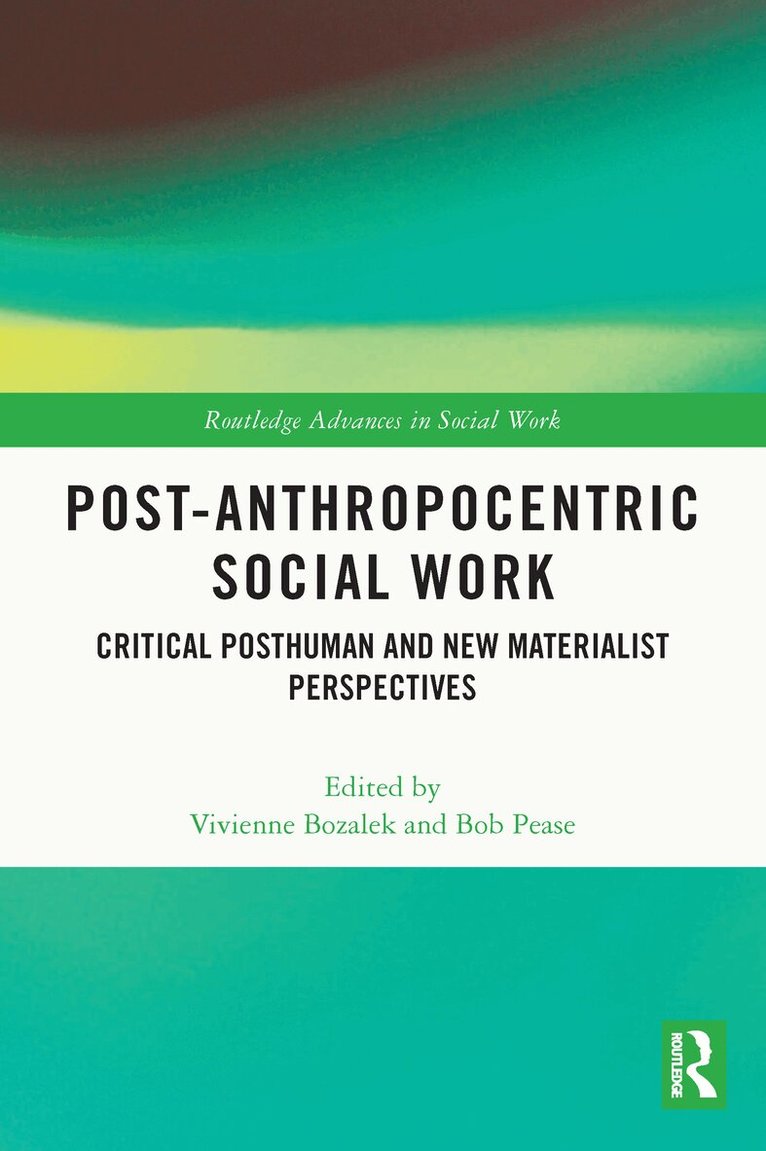
This book seeks to trouble taken-for-granted assumptions of anthropocentrism and humanism in social work - those which perpetuate human privilege and human exceptionalism. The edited collection provides a different imaginary for social work by introducing ways of thinking otherwise that challenge human exceptionalism.
Social work is at heart a liberal humanist project informed by a strong human rights framework. This edited collection draws on the literature on affect, feminist new materialism and critical posthumanism to critique the liberal framework, which includes human rights. Disrupting the anthropocentrism in social work which positions humans as an elite species at the centre of world history, this book develops an ethical sensibility that values entanglements of humans, non-human life and the natural environment.
The book provides new insights into environmental destruction, human-animal relations, gender inequality and male dominance, as well as indigenous and settler/colonial issues and critical and green social work. It will be of interest to all scholars and students of social work, community development, social policy and development studies more broadly.
702 kr
Läs direkt efter köp
This book seeks to trouble taken-for-granted assumptions of anthropocentrism and humanism in social work - those which perpetuate human privilege and human exceptionalism. The edited collection provides a different imaginary for social work by introducing ways of thinking otherwise that challenge human exceptionalism.
Social work is at heart a liberal humanist project informed by a strong human rights framework. This edited collection draws on the literature on affect, feminist new materialism and critical posthumanism to critique the liberal framework, which includes human rights. Disrupting the anthropocentrism in social work which positions humans as an elite species at the centre of world history, this book develops an ethical sensibility that values entanglements of humans, non-human life and the natural environment.
The book provides new insights into environmental destruction, human-animal relations, gender inequality and male dominance, as well as indigenous and settler/colonial issues and critical and green social work. It will be of interest to all scholars and students of social work, community development, social policy and development studies more broadly.
649 kr
Läs direkt efter köp
Higher Education Hauntologies considers how higher education might benefit from thinking about Derrida’s notion of hauntology and its implications for a justice-to-come. It contributes to the imperative to rethink the university across and with/in global geopolitical spaces and thus, has appeal for both Southern and international contexts.
The book includes ideas which push boundaries that previously served higher education teachers and scholars and proposes new imaginaries of higher education. Additionally, the collection makes a contribution to ongoing debates about the epistemological, ethical, ontological and political implications of hauntology in higher education policies and practices, particularly in line with contemporary concerns for more socially just possibilities and visions in higher education.
This book will be of great interest for academics, researchers and postgraduate students of posthumanism and new materialism who are looking for new perspectives to engage with, and for those who are concerned about a justice-to-come in education, higher education, and educational theory and policy.
649 kr
Läs direkt efter köp
Higher Education Hauntologies considers how higher education might benefit from thinking about Derrida’s notion of hauntology and its implications for a justice-to-come. It contributes to the imperative to rethink the university across and with/in global geopolitical spaces and thus, has appeal for both Southern and international contexts.
The book includes ideas which push boundaries that previously served higher education teachers and scholars and proposes new imaginaries of higher education. Additionally, the collection makes a contribution to ongoing debates about the epistemological, ethical, ontological and political implications of hauntology in higher education policies and practices, particularly in line with contemporary concerns for more socially just possibilities and visions in higher education.
This book will be of great interest for academics, researchers and postgraduate students of posthumanism and new materialism who are looking for new perspectives to engage with, and for those who are concerned about a justice-to-come in education, higher education, and educational theory and policy.
682 kr
Läs direkt efter köp
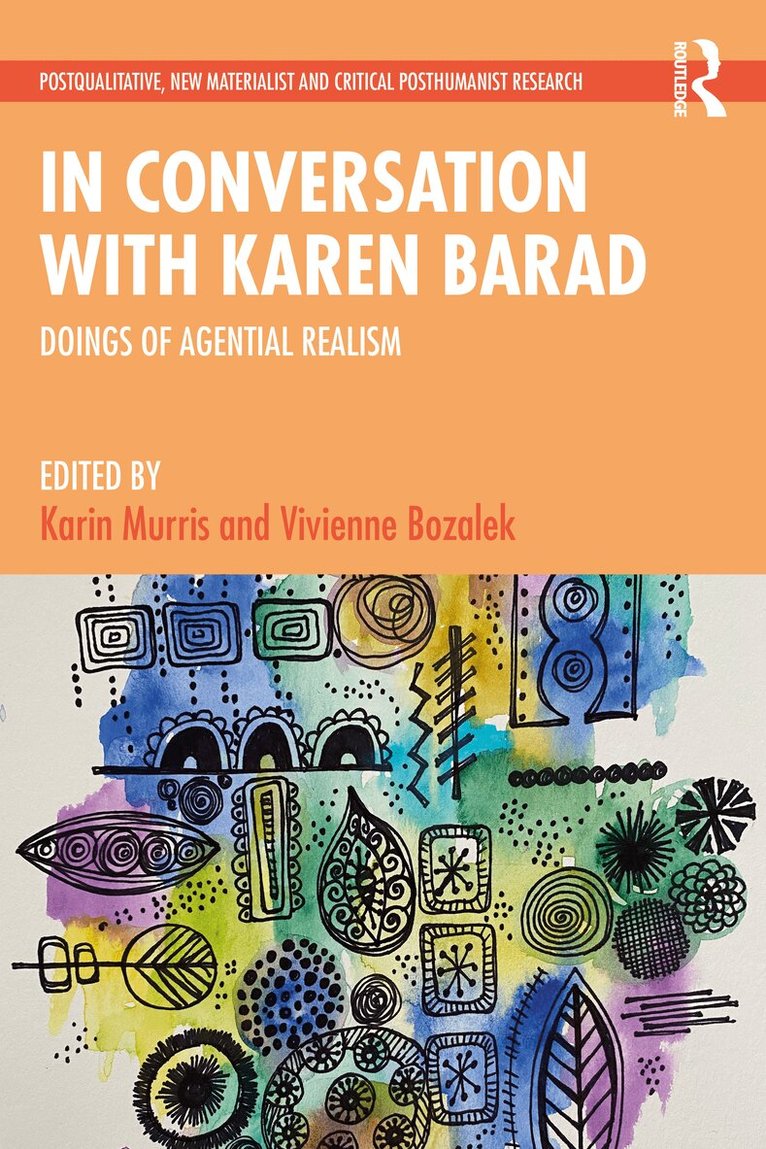
In Conversation with Karen Barad: Doings of Agential Realism is an accessible introduction to Karen Barad’s agential realist philosophy. The authors take on a unique approach to involve the readers in in/formal conversations between Karen, postgraduate and other researchers at a research event held in 2017 at Cape Town, South Africa.
It features chapters that have been contributed by seminar delegates and organisers, which put forth the continuing impact that Karen Barad has had on their empirical work, research writing and drawing practices. The text further discusses the ethical and political significance of Karen’s work, especially in the context of de/colonizing South African higher education. The chapters offer a series of worked posthumanist pedagogical examples and describe how a research seminar was organised differently and more in line with Baradian radical philosophy. At its heart, this book makes a methodological and pedagogical contribution to the surge in literature on agential realism, whilst simultaneously challenging dominant research binaries and arguing for a more egalitarian way of working together in knowledge-creation by troubling human and more-than-human hierarchies. The book’s uniqueness is further fortified through its description of in/formal conversations, which are diffracted through chapters, a doing of agential realism to reconfigure relationships between lecturer and student, expert and novice, supervisor and supervised, researcher and research participants. These radical conversations are dis/continuing.
This book will be invaluable for students and individuals interested in advancing their understanding of agential realism and Karen Barad’s influence at large, as well as students and scholars interested in postqualitative methods in all disciplines.
662 kr
Läs direkt efter köp
In Conversation with Karen Barad: Doings of Agential Realism is an accessible introduction to Karen Barad’s agential realist philosophy. The authors take on a unique approach to involve the readers in in/formal conversations between Karen, postgraduate and other researchers at a research event held in 2017 at Cape Town, South Africa.
It features chapters that have been contributed by seminar delegates and organisers, which put forth the continuing impact that Karen Barad has had on their empirical work, research writing and drawing practices. The text further discusses the ethical and political significance of Karen’s work, especially in the context of de/colonizing South African higher education. The chapters offer a series of worked posthumanist pedagogical examples and describe how a research seminar was organised differently and more in line with Baradian radical philosophy. At its heart, this book makes a methodological and pedagogical contribution to the surge in literature on agential realism, whilst simultaneously challenging dominant research binaries and arguing for a more egalitarian way of working together in knowledge-creation by troubling human and more-than-human hierarchies. The book’s uniqueness is further fortified through its description of in/formal conversations, which are diffracted through chapters, a doing of agential realism to reconfigure relationships between lecturer and student, expert and novice, supervisor and supervised, researcher and research participants. These radical conversations are dis/continuing.
This book will be invaluable for students and individuals interested in advancing their understanding of agential realism and Karen Barad’s influence at large, as well as students and scholars interested in postqualitative methods in all disciplines.
665 kr
Läs direkt efter köp
Hydrofeminist Thinking with Oceans brings together authors who are thinking in, with and through the spaces of ocean/s and beaches in South African contexts to make alternative knowledges towards a justice-to-come and flourishing at a planetary level. Primary scholarly locations for this work include feminist new materialist and post-humanist thinking, and specifically locates itself within hydrofeminist thinking.
Together with a foreword by Astrida Neimanis, the chapters in this book explore both land and water with oceans as powerfully political spaces, globally and locally entangled in the violences of settler colonialism, land dispossession, slavery, transnational labour exploitation, extractivism and omnicides. South Africa is a productive space to engage in such scholarship. While there is a growing body of literature that works within and across disciplines on the sea and bodies of water to think critically about the damages of centuries of colonisation and continued extractivist capitalism, there remains little work that explores this burgeoning thinking in global Southern, and more particularly South African contexts. South African histories of colonisation, slavery and more recently apartheid, which are saturated in the oceans, are only recently being explored through oceanic logics. This volume offers valuable Southern contributions and rich situated narratives to such hydrofeminist thinking. It also brings diverse and more marginal knowledges to bear on the project of generating imaginative alternatives to hegemonic colonial and patriarchal logics in the academy and elsewhere. While primarily located in a South African context, the volume speaks well to globalised concerns for justice and environmental challenges both in human societies and in relation to other species and planetary crises.
The chapters, which will be of interest to scholars, activists and other civil society stakeholders, share inspiring, rich examples of diverse scholarship, activism and art in these contexts, extending international scholarship that thinks in/on/with ocean/s, littoral zones and bodies of water. The book offers ethico-political perspectives on the role of research in ocean governance, policy development and collective decision-making for ecological justice. This book is suitable for students and scholars of post-qualitative, feminist, new materialist, embodied, arts-based and hydrofeminist methods in education, environmental humanities and the social sciences.
671 kr
Läs direkt efter köp
Hydrofeminist Thinking with Oceans brings together authors who are thinking in, with and through the spaces of ocean/s and beaches in South African contexts to make alternative knowledges towards a justice-to-come and flourishing at a planetary level. Primary scholarly locations for this work include feminist new materialist and post-humanist thinking, and specifically locates itself within hydrofeminist thinking.
Together with a foreword by Astrida Neimanis, the chapters in this book explore both land and water with oceans as powerfully political spaces, globally and locally entangled in the violences of settler colonialism, land dispossession, slavery, transnational labour exploitation, extractivism and omnicides. South Africa is a productive space to engage in such scholarship. While there is a growing body of literature that works within and across disciplines on the sea and bodies of water to think critically about the damages of centuries of colonisation and continued extractivist capitalism, there remains little work that explores this burgeoning thinking in global Southern, and more particularly South African contexts. South African histories of colonisation, slavery and more recently apartheid, which are saturated in the oceans, are only recently being explored through oceanic logics. This volume offers valuable Southern contributions and rich situated narratives to such hydrofeminist thinking. It also brings diverse and more marginal knowledges to bear on the project of generating imaginative alternatives to hegemonic colonial and patriarchal logics in the academy and elsewhere. While primarily located in a South African context, the volume speaks well to globalised concerns for justice and environmental challenges both in human societies and in relation to other species and planetary crises.
The chapters, which will be of interest to scholars, activists and other civil society stakeholders, share inspiring, rich examples of diverse scholarship, activism and art in these contexts, extending international scholarship that thinks in/on/with ocean/s, littoral zones and bodies of water. The book offers ethico-political perspectives on the role of research in ocean governance, policy development and collective decision-making for ecological justice. This book is suitable for students and scholars of post-qualitative, feminist, new materialist, embodied, arts-based and hydrofeminist methods in education, environmental humanities and the social sciences.
1 944 kr
Skickas inom 10-15 vardagar
549 kr
Skickas inom 10-15 vardagar
2 151 kr
Skickas inom 10-15 vardagar
574 kr
Skickas inom 10-15 vardagar
836 kr
Läs direkt efter köp
How can discerning critical hope enable us to develop innovative forms of teaching, learning and social practices that begin to address issues of marginalization, privilege and access across different contexts?
At this millennial point in history, questions of cynicism, despair and hope arise at every turn, especially within areas of research into social justice and the struggle for transformation in education. While a sense of fatalism and despair is easily recognizable, establishing compelling bases for hope is more difficult. This book addresses the absence of sustained analyses of hope that simultaneously recognize the hard edges of why we despair.
The volume posits the notion of critical hope not only as conceptual and theoretical, but also as an action-oriented response to despair. Our notion of critical hope is used in two ways: it is used firstly as a unitary concept which cannot be disaggregated into either hopefulness or criticality, and secondly, as an analytical concept, where critical hope is engaged and diversely theorized in ways that recognize aspects of individual and collective directions of critical hope. The book is divided into four sub-sections:
Critical Hope in Education
Critical Hope and a Critique of Neoliberalism
Critical Race Theory/Postcolonial Perspectives on Critical Hope
Philosophical Overviews of Critical Hope.
Education can be a purveyor of critical hope, but it also requires critical hope so that it, as a sector itself, can be transformative. With contributions from international experts in the field, the book will be of value to all academics and practitioners working in the field of education.
836 kr
Läs direkt efter köp
How can discerning critical hope enable us to develop innovative forms of teaching, learning and social practices that begin to address issues of marginalization, privilege and access across different contexts?
At this millennial point in history, questions of cynicism, despair and hope arise at every turn, especially within areas of research into social justice and the struggle for transformation in education. While a sense of fatalism and despair is easily recognizable, establishing compelling bases for hope is more difficult. This book addresses the absence of sustained analyses of hope that simultaneously recognize the hard edges of why we despair.
The volume posits the notion of critical hope not only as conceptual and theoretical, but also as an action-oriented response to despair. Our notion of critical hope is used in two ways: it is used firstly as a unitary concept which cannot be disaggregated into either hopefulness or criticality, and secondly, as an analytical concept, where critical hope is engaged and diversely theorized in ways that recognize aspects of individual and collective directions of critical hope. The book is divided into four sub-sections:
Critical Hope in Education
Critical Hope and a Critique of Neoliberalism
Critical Race Theory/Postcolonial Perspectives on Critical Hope
Philosophical Overviews of Critical Hope.
Education can be a purveyor of critical hope, but it also requires critical hope so that it, as a sector itself, can be transformative. With contributions from international experts in the field, the book will be of value to all academics and practitioners working in the field of education.
719 kr
Skickas inom 10-15 vardagar
1 889 kr
Skickas inom 10-15 vardagar
544 kr
Skickas inom 10-15 vardagar