Xavier Perez – författare
Visar alla böcker från författaren . Handla med fri frakt och snabb leverans.
5 produkter
5 produkter
Inbunden, Engelska, 2024
1 284 kr
Skickas inom 10-15 vardagar
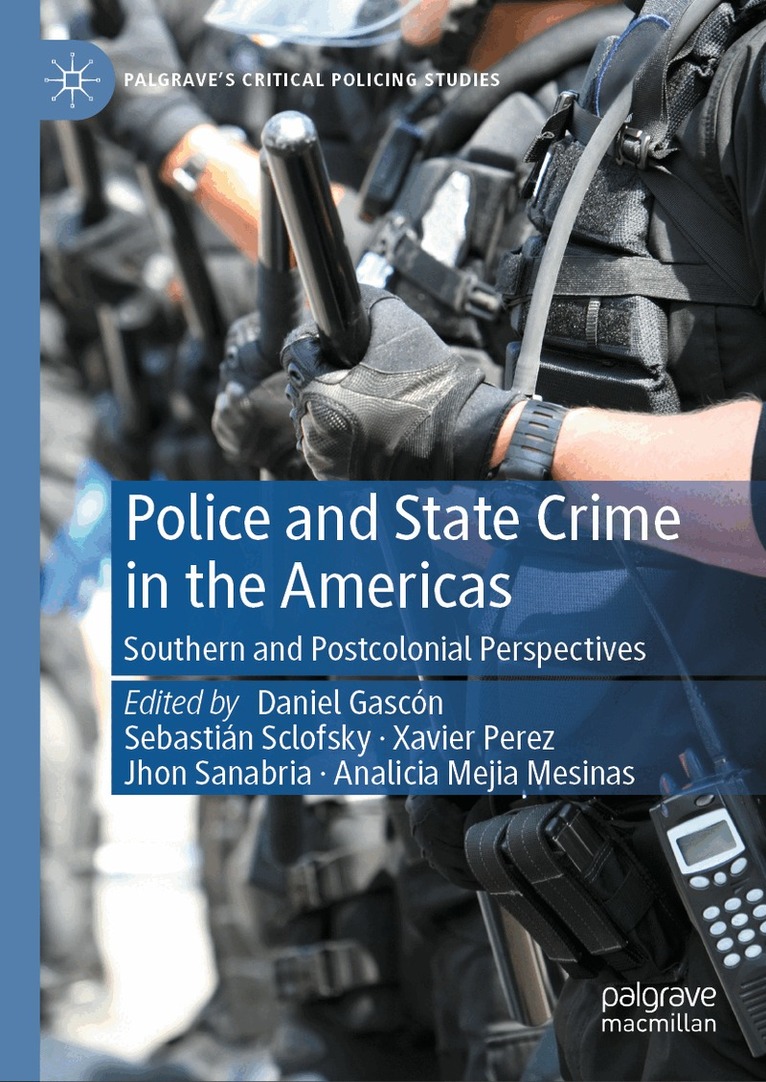
This book advances a much-needed “postcolonial” framework in analyzing the police. It seeks to deepen our understanding of the police role in maintaining Western global domination throughout the American region despite the violent end of colonial rule. Building on Chevigny's (1995) classic study, this book seeks to draw renewed attention to the role of police in perpetrating state violence and serving as the tip of the spear of state power. It seeks to understand the construction of marginality and the multiple and intersecting structures of colonial domination, before shining a light directly on the crimes of the state, in an attempt to hold criminal state organizations to account. It draws on interdisciplinary perspectives and methodologies that center marginalized and colonized experiences and allows for the development of countercolonial knowledge. It speaks to academics and students in criminology, sociology, political science, and law, as well as toethnic and area studies programs, such as Chicano/Latino and Latin American Studies, and to police administrators and policymakers.
E-bok
Engelska, 20241 733 kr
Läs direkt efter köp
This book advances a much-needed “postcolonial” framework in analyzing the police. It seeks to deepen our understanding of the police role in maintaining Western global domination throughout the American region despite the violent end of colonial rule. Building on Chevigny''s (1995) classic study, this book seeks to draw renewed attention to the role of police in perpetrating state violence and serving as the tip of the spear of state power. It seeks to understand the construction of marginality and the multiple and intersecting structures of colonial domination, before shining a light directly on the crimes of the state, in an attempt to hold criminal state organizations to account. It draws on interdisciplinary perspectives and methodologies that center marginalized and colonized experiences and allows for the development of countercolonial knowledge. It speaks to academics and students in criminology, sociology, political science, and law, as well as toethnic and area studies programs, such as Chicano/Latino and Latin American Studies, and to police administrators and policymakers.
Häftad, Engelska, 2025
1 284 kr
Skickas inom 10-15 vardagar
This book advances a much-needed “postcolonial” framework in analyzing the police. It seeks to deepen our understanding of the police role in maintaining Western global domination throughout the American region despite the violent end of colonial rule. Building on Chevigny's (1995) classic study, this book seeks to draw renewed attention to the role of police in perpetrating state violence and serving as the tip of the spear of state power. It seeks to understand the construction of marginality and the multiple and intersecting structures of colonial domination, before shining a light directly on the crimes of the state, in an attempt to hold criminal state organizations to account. It draws on interdisciplinary perspectives and methodologies that center marginalized and colonized experiences and allows for the development of countercolonial knowledge. It speaks to academics and students in criminology, sociology, political science, and law, as well as toethnic and area studies programs, such as Chicano/Latino and Latin American Studies, and to police administrators and policymakers.

E-bok
Spanska, 2022184 kr
Läs direkt efter köp
Este libro explora la presencia del deseo femenino que contienen las imágenes fílmicas del cine español producido durante el franquismo. El deseo aparece, en el marco filmográfico estudiado, como una fuente de resistencia simbólica y figurativa a las consignas represivas de la ideología censora. En la primera parte del libro se plantea una clasificación de los principales modelos de mujer que traspasaron los imaginarios cinematográficos durante las cuatro décadas del franquismo. El "cuerpo-hogar", la "mujer-patria", el "cuerpo místico", la "virgen casadera", el "cuerpo-espectáculo", la "mujer moderna" y "la mujer-monstruo" constituyen arquetipos cuyo examen pormenorizado permite descubrir las diferentes formas del deseo que la figuración femenina podía convocar, más allá de que la mujer se conformara con una vida doméstica, subordinada al marido o al orden patriarcal. En la segunda parte del libro se hace un recorrido por la filmografía de algunas de las principales actrices que encarnaron, matizaron e hicieron evolucionar dichos arquetipos: Aurora Bautista, Analía Gadé, Emma Penella, Josita Hernán, Lola Flores, Sara Montiel, Carmen Sevilla, Marisol, Concha Velasco, Geraldine Chaplin, Teresa Gimpera y Helga Liné. Todas ellas adoptaron, en su forma de actuar, una sugestiva poética de afirmación de los deseos femeninos. Siguiendo el mismo modelo de análisis de su anterior libro "El cuerpo erótico de la actriz durante los fascismos: España, Italia, Alemania (1939-1945)", Núria Bou y Xavier Pérez han convocado a un nutrido grupo de especialistas en cine español y estrellato fílmico para analizar la gestualidad, la fuerza expresiva de los cuerpos y las miradas de unas intérpretes que desbordaron, a veces de forma más visible, a veces de manera más sutil, las pautas de contención que el Régimen había exigido a las mujeres de la época.
Häftad, Engelska, 2023
771 kr
Tillfälligt slut