Xiaohua Tong - Böcker
Visar alla böcker från författaren Xiaohua Tong. Handla med fri frakt och snabb leverans.
3 produkter
3 produkter
1 900 kr
Skickas inom 10-15 vardagar
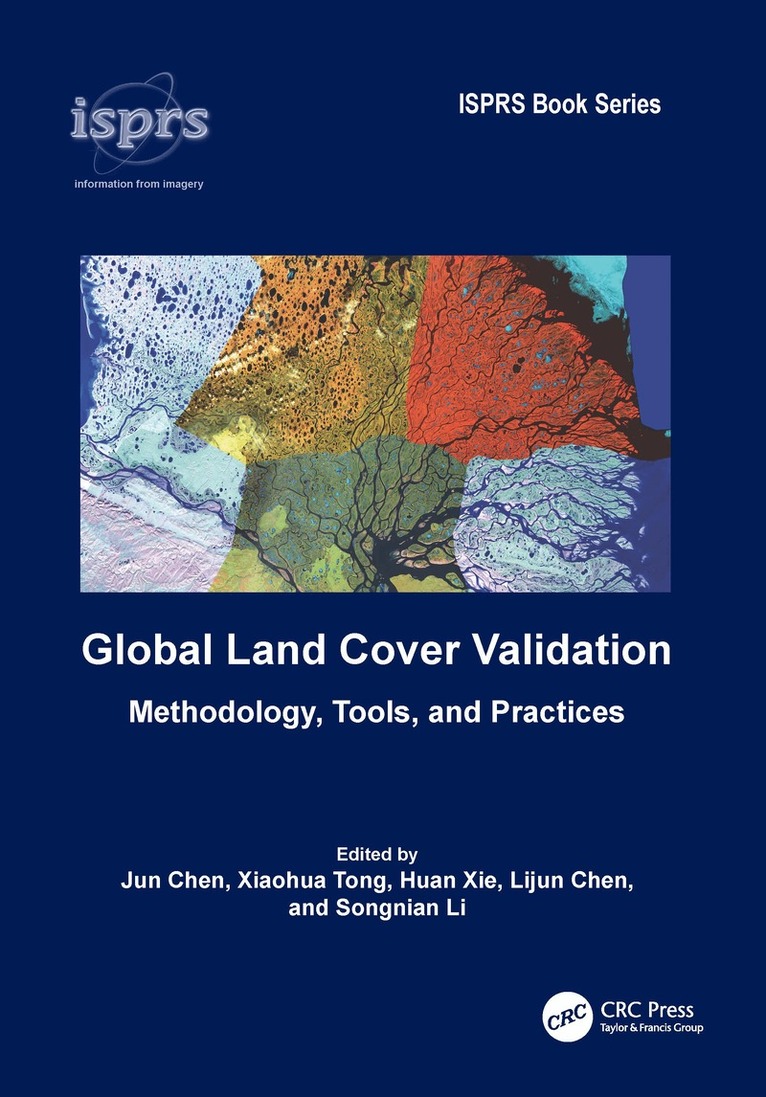
This book aims to summarize and report the major research achievements and validation results under the global land cover (GLC) initiative led by the Group Earth Observation (GEO). The first part of the book introduces the major tasks and challenges facing the validation of finer-resolution GLC maps and presents the concepts and overall framework of the GEO-led initiative. Chapters 2-5 provide systematic introductions to the major methodology of finer-resolution GLC map validation, including sampling design, reference data collection, sample labeling, and accuracy assessment. Chapter 6 introduces the online validation tools that have been developed, including their design, considerations, and functionalities. Chapter 7 presents the international validation practices and the results of validating GlobeLand30 at country, regional, and global scales. Future directions are also discussed in the Conclusion chapter.FeaturesPresents complete coverage of land cover validation, from concepts, methodology, and col laborative tools to applications.Details algorithms, techniques, and methods for land cover validation, including sampling, judgment, and accuracy assessment.Reviews some of the software tools that can be used for GLC validation and discusses the issues related to the design, usability, efficiency, and limitations of these tools.Highlights case studies of validation at global, regional, and national scales, which can serve as great references for researchers.Provides an extensive bibliography covering the whole scope of land cover validationGlobal Land Cover Validation: Methodology, Tools, and Practices serves as a reference for those engaged in land cover validation, especially at a global scale, including students, professionals, researchers, and general practitioners. It is also an excellent resource for professionals involved in sustainable development monitoring, environmental change studies, natural resource management, disaster assessment and mitigation, and many other applications.
2 118 kr
Skickas inom 10-15 vardagar
In four chapters and an introduction, this book systematically helps readers understand the development of the Geographical Sciences both in China and in the world during the past 30 years. Through data analysis of methodologies including CiteSpace, TDA, qualitative analysis, questionnaires, data mining and mathematical statistics, the book explains the evolution of research topics and their driving factors in the Geographical Sciences and its four branches, namely Physical Geography, Human Geography, Geographical Information Science and Environmental Geography. It also identifies the role of the Geographical Sciences in the analysis of strategic issues such as global change and terrestrial ecosystems, terrestrial water cycle and water resources, land change, global cryosphere evolution and land surface processes on the Tibetan Plateau, economic globalization and local responses, regional sustainable development, remote sensing modelling and parameter inversion, spatial analysis and simulation, and tempo-spatial processes and modelling of environmental pollutants. It then discusses research development and inadequacy of Chinese Geographical Sciences in the above-mentioned topics, as well as in the fields including Geomorphology and Quaternary environmental change, Ecohydrology, ecosystem services, the urbanization process and mechanism, medical and health geography, international rivers and transboundary environment and resources, detection and attribution of changes in land surface sensitive components, and uncertainty of spatial information and spatial analysis. It shows that the NSFC has driven the development in all these topics and fields. In addition, the book summarises trends of the Geographical Sciences in China and the research level in major countries of the world through an overview of geographical education in colleges and universities, the analysis of publications, citations and author networks of SCI/SSCI and CSCD indexed articles, and the description of Sino-USA, Sino-UK and Sino-German cooperation. This book serves as an important reference to anyone interested in geographical sciences and related fields.
2 118 kr
Skickas inom 10-15 vardagar
In four chapters and an introduction, this book systematically helps readers understand the development of the Geographical Sciences both in China and in the world during the past 30 years. Through data analysis of methodologies including CiteSpace, TDA, qualitative analysis, questionnaires, data mining and mathematical statistics, the book explains the evolution of research topics and their driving factors in the Geographical Sciences and its four branches, namely Physical Geography, Human Geography, Geographical Information Science and Environmental Geography. It also identifies the role of the Geographical Sciences in the analysis of strategic issues such as global change and terrestrial ecosystems, terrestrial water cycle and water resources, land change, global cryosphere evolution and land surface processes on the Tibetan Plateau, economic globalization and local responses, regional sustainable development, remote sensing modelling and parameter inversion, spatial analysis and simulation, and tempo-spatial processes and modelling of environmental pollutants. It then discusses research development and inadequacy of Chinese Geographical Sciences in the above-mentioned topics, as well as in the fields including Geomorphology and Quaternary environmental change, Ecohydrology, ecosystem services, the urbanization process and mechanism, medical and health geography, international rivers and transboundary environment and resources, detection and attribution of changes in land surface sensitive components, and uncertainty of spatial information and spatial analysis. It shows that the NSFC has driven the development in all these topics and fields. In addition, the book summarises trends of the Geographical Sciences in China and the research level in major countries of the world through an overview of geographical education in colleges and universities, the analysis of publications, citations and author networks of SCI/SSCI and CSCD indexed articles, and the description of Sino-USA, Sino-UK and Sino-German cooperation. This book serves as an important reference to anyone interested in geographical sciences and related fields.