Yang Lou – författare
Visar alla böcker från författaren Yang Lou. Handla med fri frakt och snabb leverans.
2 produkter
2 produkter
Del 34 - Emergence, Complexity and Computation
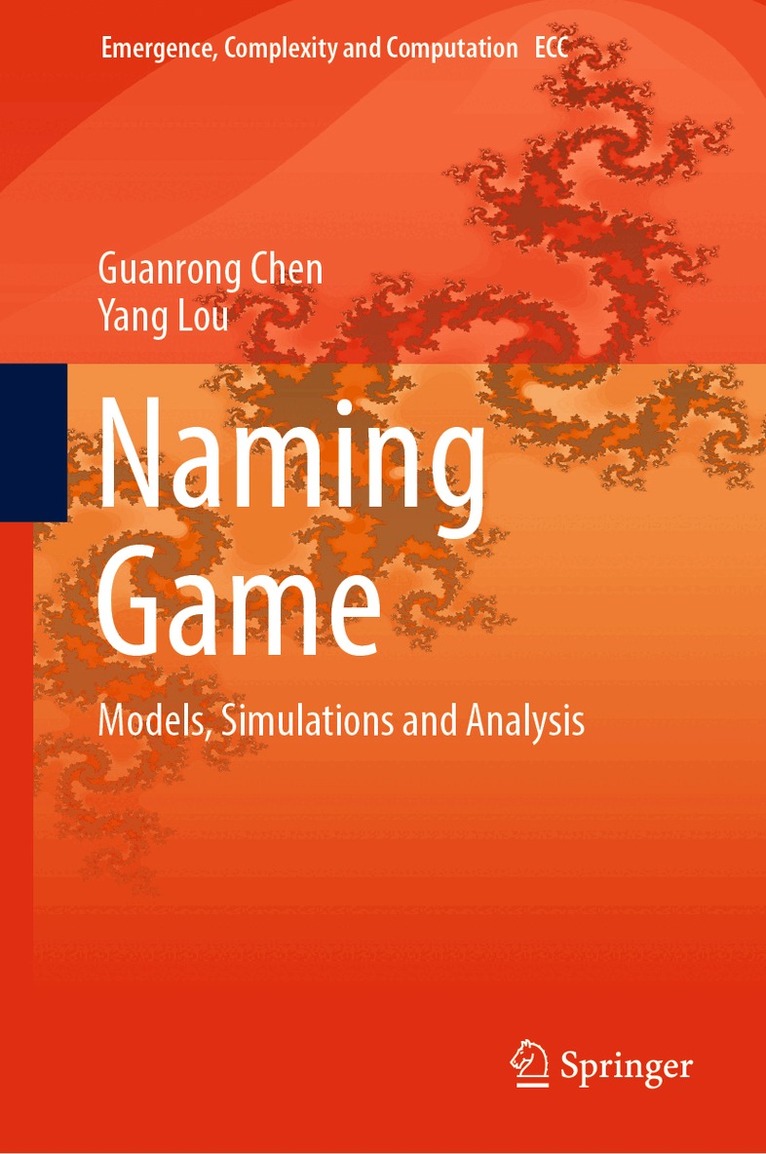
Naming Game
Models, Simulations and Analysis
Inbunden, Engelska, 2018
1 098 kr
Skickas inom 10-15 vardagar
This book provides a gradual introduction to the naming game, starting from the minimal naming game, where the agents have infinite memories (Chapter 2), before moving on to various new and advanced settings: the naming game with agents possessing finite-sized memories (Chapter 3); the naming game with group discussions (Chapter 4); the naming game with learning errors in communications (Chapter 5) ; the naming game on multi-community networks (Chapter 6) ; the naming game with multiple words or sentences (Chapter 7) ; and the naming game with multiple languages (Chapter 8). Presenting the authors’ own research findings and developments, the book provides a solid foundation for future advances. This self-study resource is intended for researchers, practitioners, graduate and undergraduate students in the fields of computer science, network science, linguistics, data engineering, statistical physics, social science and applied mathematics.
Del 2 - Ai, Memristors And Nonlinear Dynamics
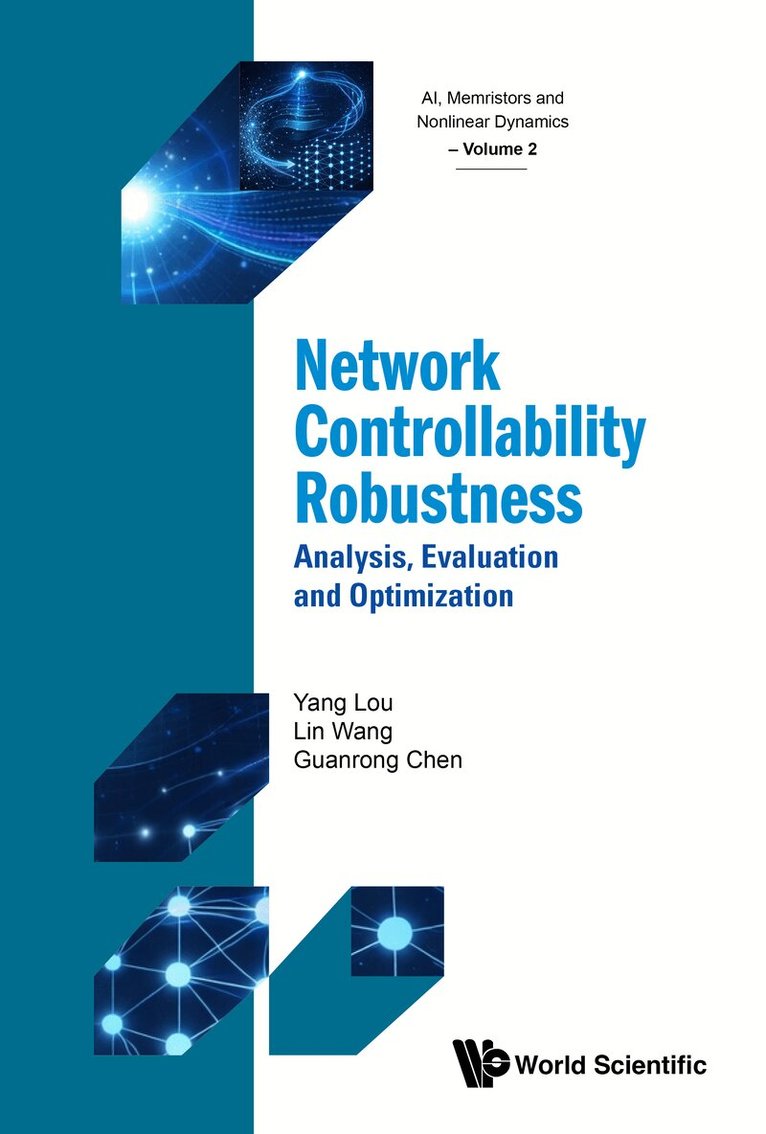
Network Controllability Robustness: Analysis, Evaluation And Optimization
Inbunden, Engelska, 2026
1 083 kr
Kommande
This book studies the important notion of controllability robustness for complex dynamical networks in the linear or linearized settings. Chapter 1 provides an overview of network controllability and controllability robustness, as well as some preliminaries and research problems. Chapter 2 introduces the basic concept and knowledge of network controllability, covering definitions, computational methods, and evaluation metrics. It explores key topological features of the controllability robustness. Chapter 3 analyzes the controllability robustness in complex networks, introducing key metrics, attack strategies, hierarchical attack methods, simulation criteria, and analytical models. Chapter 4 explores techniques for enhancing the controllability robustness, introducing robustness-oriented models, metaheuristic-based optimization, and an empirical necessary condition verified through extensive experiments. Chapter 5 examines data-driven approaches for evaluating the controllability robustness, focusing on input representation, model architecture, and output interpretation, from a machine learning-based approach. Chapter 6 introduces a framework for assessing and visualizing the controllability robustness enhancement potential, leveraging data-driven methods to deliver accurate predictions and interpretability at low computational cost. Finally, Chapter 7 reviews recent advancements, identifies key challenges, and outlines future directions in network controllability robustness studies.