Inbunden, Engelska, 2026
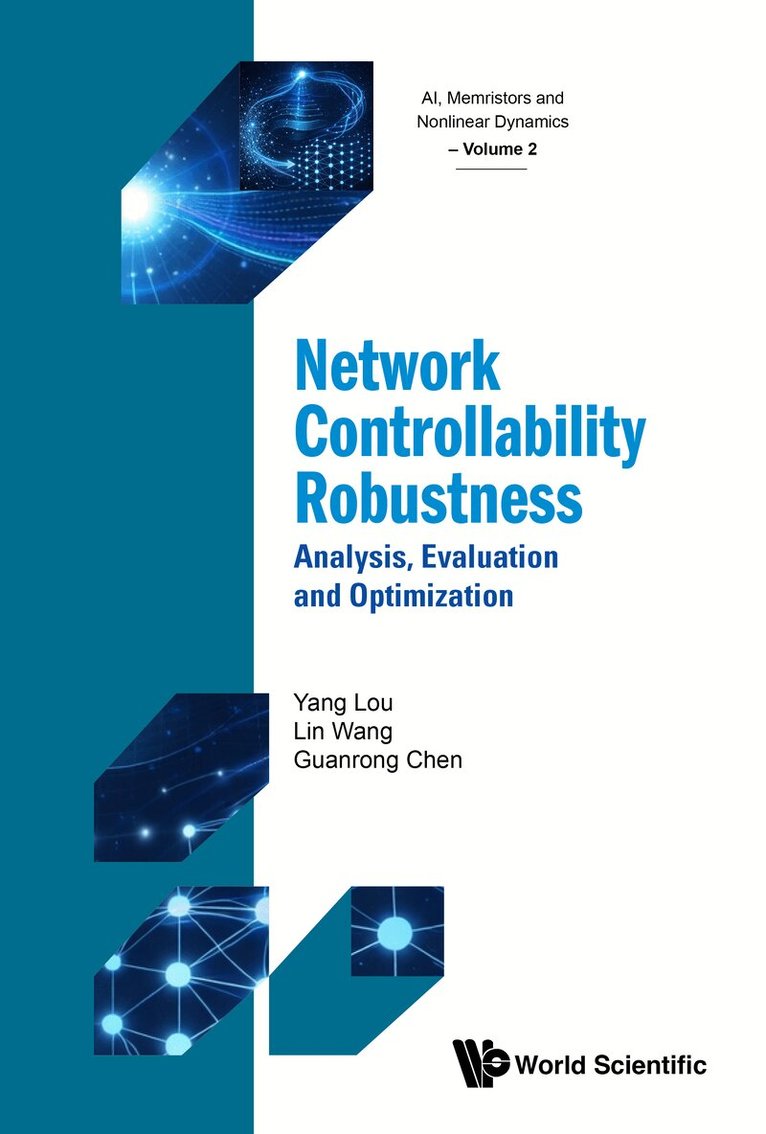
NETWORK CONTROLLABILITY ROBUSTNESS: ANALYSIS, EVALUATION AND OPTIMIZATION
Av Yang Lou, Lin Wang, Guanrong Chen
1295 kr
Beställningsvara. Skickas inom 3-6 vardagar. Fri frakt över 249 kr.
Beskrivning
This book studies the important notion of controllability robustness for complex dynamical networks in the linear or linearized settings. Chapter 1 provides an overview of network controllability and controllability robustness, as well as some preliminaries and research problems. Chapter 2 introduces the basic concept and knowledge of network controllability, covering definitions, computational methods, and evaluation metrics. It explores key topological features of the controllability robustness. Chapter 3 analyzes the controllability robustness in complex networks, introducing key metrics, attack strategies, hierarchical attack methods, simulation criteria, and analytical models. Chapter 4 explores techniques for enhancing the controllability robustness, introducing robustness-oriented models, metaheuristic-based optimization, and an empirical necessary condition verified through extensive experiments. Chapter 5 examines data-driven approaches for evaluating the controllability robustness, focusing on input representation, model architecture, and output interpretation, from a machine learning-based approach. Chapter 6 introduces a framework for assessing and visualizing the controllability robustness enhancement potential, leveraging data-driven methods to deliver accurate predictions and interpretability at low computational cost. Finally, Chapter 7 reviews recent advancements, identifies key challenges, and outlines future directions in network controllability robustness studies.
Produktinformation
- Utgivningsdatum: 2026-06-12
- Mått: 162 x 235 x 24 mm
- Vikt: 574 g
- Format: Inbunden
- Språk: Engelska
- Serie: AI, MEMRISTORS AND NONLINEAR DYNAMICS
- Antal sidor: 236
- Förlag: World Scientific Publishing Co Pte Ltd
- ISBN: 9789819833580
Utforska kategorier
Betyg & recensioner
0 recensioner
Inga recensioner tillgängliga.