Zhao Yang Dong - Böcker
Visar alla böcker från författaren Zhao Yang Dong. Handla med fri frakt och snabb leverans.
8 produkter
8 produkter
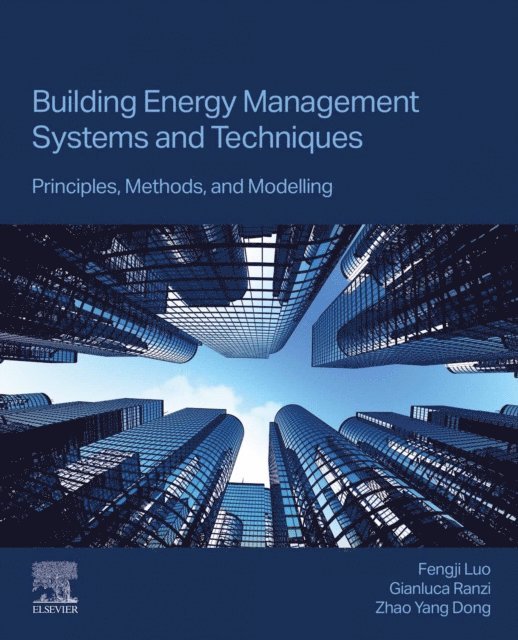
Building Energy Management Systems and Techniques
Principles, Methods, and Modelling
Häftad, Engelska, 2024
1 324 kr
Skickas inom 7-10 vardagar
Building Energy Management Systems and Techniques: Principles, Methods, and Modelling presents basic concepts, methodologies, modeling techniques, and fundamental design schemes of building energy management systems. Covering the latest developments and methodologies from academia and industry, the book brings together energy management, demand response, evolutionary computation, and fundamental programming.The authors explore the basic concepts related to building energy management systems and put them into the context of smart grids, demand response and demand-side management, internet of things, and distributed renewable energy. Advanced topics provide the reader with an understanding of various energy management scenarios and procedures for modern buildings in an automatic and highly renewable-penetrated building environment. This includes a range of energy management techniques for building-side energy resources such as battery energy storage systems, plug-in appliances, and HVAC systems. The fundamental principles of evolutionary computation are covered and applied to building energy management problems. The authors also introduce the paradigm of occupant-to-grid integration and its implementation through personalized recommendation technology to guide the occupants' choices on energy-related products and their energy usage behaviors, as well as to enhance the energy efficiency of buildings. The book includes several application examples throughout, illustrating for the reader the key aspects involved in the implementation of building energy management schemes.Building Energy Management Systems and Techniques is an invaluable resource for undergraduate and postgraduate students enrolled in courses related to energy-efficient building systems and smart grids and researchers working in the fields of smart grids, smart buildings/homes, and energy demand response. The book will be of use to professional electrical, civil, computing, and communications engineers, architects, and building energy consultants.Integrates the latest techniques in the building energy management paradigm, such as appliance scheduling, peer-to-peer energy trading, and occupant-to-grid integrationProvides extensive application examples to help readers understand the design principles of different building energy management systemsIncludes step-by-step guidance on the methods, modeling techniques, and applications presented in the book, including evolutionary computationsProvides pseudocodes and optimization algorithms for the application examples to enable the reader to gain insight into the modeling details
900 kr
Skickas inom 10-15 vardagar
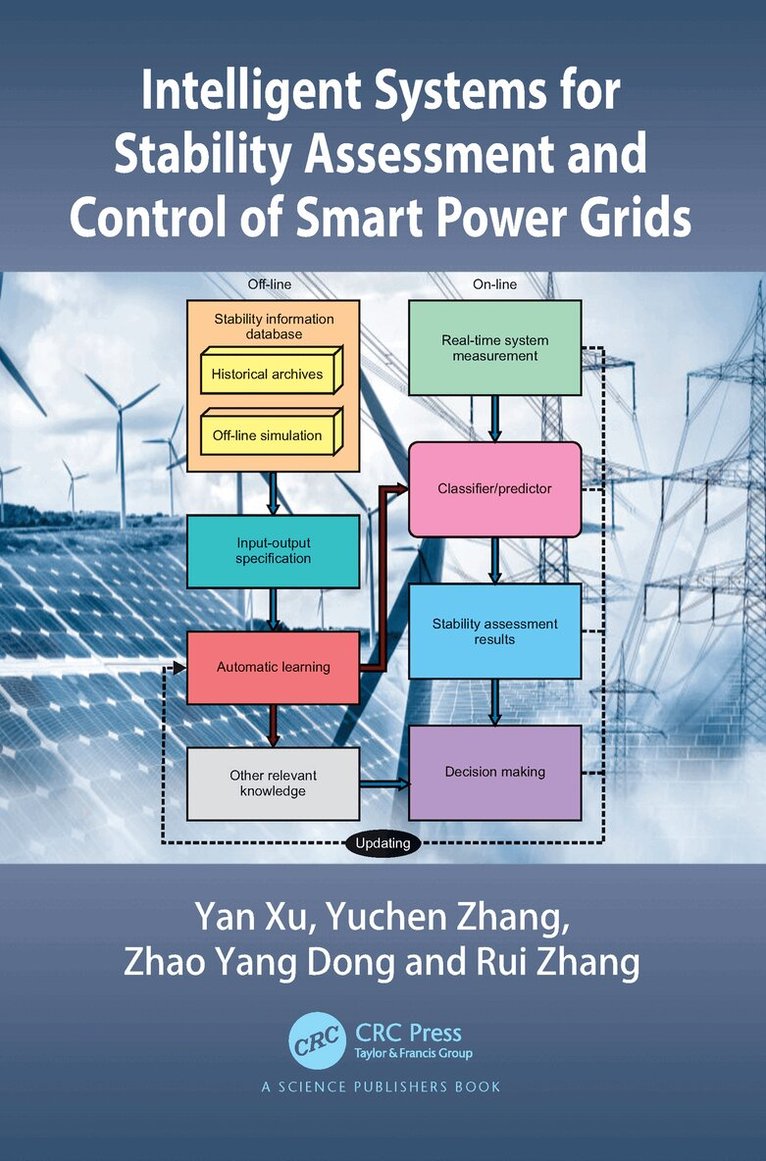
Power systems are evolving towards the Smart Grid paradigm, featured by large-scale integration of renewable energy resources, e.g. wind and solar power, deeper participation of demand side, and enhanced interaction with electric vehicles. While these emerging elements are inherently stochastic in nature, they are creating a challenge to the system’s stability and its control. In this context, conventional analysis tools are becoming less effective, and necessitate the use alternative tools that are able to deal with the high uncertainty and variability in the smart grid. Smart Grid initiatives have facilitated wide-spread deployment of advanced sensing and communication infrastructure, e.g. phasor measurement units at grid level and smart meters at household level, which collect tremendous amount of data in various time and space scales. How to fully utilize the data and extract useful knowledge from them, is of great importance and value to support the advanced stability assessment and control of the smart grid. The intelligent system strategy has been identified as an effective approach to meet the above needs. This book presents the cutting-edge intelligent system techniques and their applications for stability assessment and control of power systems. The major topics covered in this book are: Intelligent system design and algorithms for on-line stability assessment, which aims to use steady-state operating variables to achieve fast stability assessment for credible contingencies. Intelligent system design and algorithms for preventive stability control, which aims at transparent and interpretable decision-making on preventive control actions to manipulate system operating condition against possible contingencies. Intelligent system design and algorithms for real-time stability prediction, which aims to use synchronized measurements to foresee the stability status under an ongoing disturbance. Intelligent system design and algorithms for emergency stability control, which aims at fast decision-making on stability control actions at emergency stage where instability is propagating. Methodologies and algorithms for improving the robustness of intelligent systems against missing-data issues.This book is a reference and guide for researchers, students, and engineers who seek to study and design intelligent systems to resolve stability assessment and control problems in the smart grid age.
Intelligent Systems for Stability Assessment and Control of Smart Power Grids
Inbunden, Engelska, 2020
2 505 kr
Skickas inom 10-15 vardagar
Power systems are evolving towards the Smart Grid paradigm, featured by large-scale integration of renewable energy resources, e.g. wind and solar power, deeper participation of demand side, and enhanced interaction with electric vehicles. While these emerging elements are inherently stochastic in nature, they are creating a challenge to the system’s stability and its control. In this context, conventional analysis tools are becoming less effective, and necessitate the use alternative tools that are able to deal with the high uncertainty and variability in the smart grid. Smart Grid initiatives have facilitated wide-spread deployment of advanced sensing and communication infrastructure, e.g. phasor measurement units at grid level and smart meters at household level, which collect tremendous amount of data in various time and space scales. How to fully utilize the data and extract useful knowledge from them, is of great importance and value to support the advanced stability assessment and control of the smart grid. The intelligent system strategy has been identified as an effective approach to meet the above needs. This book presents the cutting-edge intelligent system techniques and their applications for stability assessment and control of power systems. The major topics covered in this book are: Intelligent system design and algorithms for on-line stability assessment, which aims to use steady-state operating variables to achieve fast stability assessment for credible contingencies. Intelligent system design and algorithms for preventive stability control, which aims at transparent and interpretable decision-making on preventive control actions to manipulate system operating condition against possible contingencies. Intelligent system design and algorithms for real-time stability prediction, which aims to use synchronized measurements to foresee the stability status under an ongoing disturbance. Intelligent system design and algorithms for emergency stability control, which aims at fast decision-making on stability control actions at emergency stage where instability is propagating. Methodologies and algorithms for improving the robustness of intelligent systems against missing-data issues.This book is a reference and guide for researchers, students, and engineers who seek to study and design intelligent systems to resolve stability assessment and control problems in the smart grid age.
209 kr
Skickas inom 10-15 vardagar
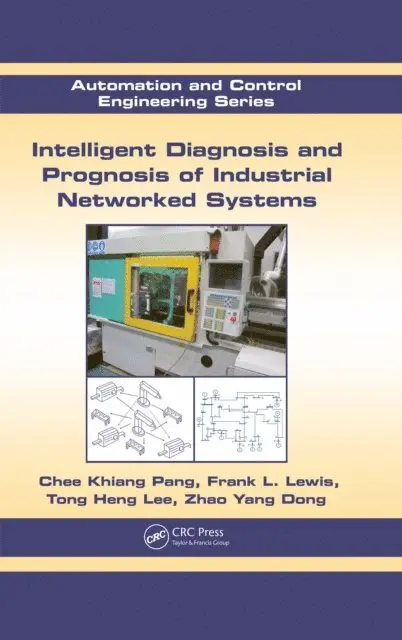
In an era of intense competition where plant operating efficiencies must be maximized, downtime due to machinery failure has become more costly. To cut operating costs and increase revenues, industries have an urgent need to predict fault progression and remaining lifespan of industrial machines, processes, and systems. An engineer who mounts an acoustic sensor onto a spindle motor wants to know when the ball bearings will wear out without having to halt the ongoing milling processes. A scientist working on sensor networks wants to know which sensors are redundant and can be pruned off to save operational and computational overheads. These scenarios illustrate a need for new and unified perspectives in system analysis and design for engineering applications.Intelligent Diagnosis and Prognosis of Industrial Networked Systems proposes linear mathematical tool sets that can be applied to realistic engineering systems. The book offers an overview of the fundamentals of vectors, matrices, and linear systems theory required for intelligent diagnosis and prognosis of industrial networked systems. Building on this theory, it then develops automated mathematical machineries and formal decision software tools for real-world applications.The book includes portable tool sets for many industrial applications, including:Forecasting machine tool wear in industrial cutting machinesReduction of sensors and features for industrial fault detection and isolation (FDI)Identification of critical resonant modes in mechatronic systems for system design of R&DProbabilistic small-signal stability in large-scale interconnected power systemsDiscrete event command and control for military applicationsThe book also proposes future directions for intelligent diagnosis and prognosis in energy-efficient manufacturing, life cycle assessment, and systems of systems architecture. Written in a concise and accessible style, it presents tools that are mathematically rigorous but not involved. Bridging academia, research, and industry, this reference supplies the know-how for engineers and managers making decisions about equipment maintenance, as well as researchers and students in the field.
533 kr
Skickas inom 10-15 vardagar
In an era of intense competition where plant operating efficiencies must be maximized, downtime due to machinery failure has become more costly. To cut operating costs and increase revenues, industries have an urgent need to predict fault progression and remaining lifespan of industrial machines, processes, and systems. An engineer who mounts an acoustic sensor onto a spindle motor wants to know when the ball bearings will wear out without having to halt the ongoing milling processes. A scientist working on sensor networks wants to know which sensors are redundant and can be pruned off to save operational and computational overheads. These scenarios illustrate a need for new and unified perspectives in system analysis and design for engineering applications.Intelligent Diagnosis and Prognosis of Industrial Networked Systems proposes linear mathematical tool sets that can be applied to realistic engineering systems. The book offers an overview of the fundamentals of vectors, matrices, and linear systems theory required for intelligent diagnosis and prognosis of industrial networked systems. Building on this theory, it then develops automated mathematical machineries and formal decision software tools for real-world applications.The book includes portable tool sets for many industrial applications, including:Forecasting machine tool wear in industrial cutting machinesReduction of sensors and features for industrial fault detection and isolation (FDI)Identification of critical resonant modes in mechatronic systems for system design of R&DProbabilistic small-signal stability in large-scale interconnected power systemsDiscrete event command and control for military applicationsThe book also proposes future directions for intelligent diagnosis and prognosis in energy-efficient manufacturing, life cycle assessment, and systems of systems architecture. Written in a concise and accessible style, it presents tools that are mathematically rigorous but not involved. Bridging academia, research, and industry, this reference supplies the know-how for engineers and managers making decisions about equipment maintenance, as well as researchers and students in the field.
1 910 kr
Skickas inom 10-15 vardagar
This book covers power systems cybersecurity. In order to enhance overall stability and security in wide-area cyber-physical power systems and defend against cyberattacks, new resilient operation, control, and protection methods are required.
1 910 kr
Skickas inom 10-15 vardagar
This book covers power systems cybersecurity. In order to enhance overall stability and security in wide-area cyber-physical power systems and defend against cyberattacks, new resilient operation, control, and protection methods are required.
Advanced Data Mining and Applications
First International Conference, ADMA 2005, Wuhan, China, July 22-24, 2005, Proceedings
Häftad, Engelska, 2005
1 096 kr
Skickas inom 10-15 vardagar
With the ever-growing power to generate, transmit and collect huge amounts of data, information overload is now an imminent problem to mankind. The overwhelming demand for information processing is not just about a better - derstanding of data, but also a better usage of data in a timely fashion. Data mining, or knowledge discovery from databases, is proposed to gain insight into aspects of dataand to help peoplemakeinformed,sensible, andbetter decisions. At present, growing attention has been paid to the study, development and - plication of data mining. As a result there is an urgent need for sophisticated techniques and tools that can handle new ?elds of data mining, e.g., spatialdata mining, biomedical data mining, and mining on high-speed and time-variant data streams. The knowledge of data mining should also be expanded to new applications. The1stInternationalConferenceonAdvancedDataMiningandApplications (ADMA 2005) aimed to bring together the experts on data mining throughout the world. It provided a leading international forum for the dissemination of original research results in advanced data mining techniques, applications, al- rithms, software and systems, and di?erent applied disciplines.The conference attracted 539 online submissions and 63 mailing submissions from 25 di?erent countriesandareas.Allfullpaperswerepeer reviewedbyatleastthreemembers of the Program Committee composed of international experts in data mining ?elds. A total number of 100 papers were accepted for the conference. Amongst them 25 papers were selected as regular papers and 75 papers were selected as short papers, yielding a combined acceptance rate of 17%.