• Fri frakt över 249 kr
  • •
  • Snabba leveranser
  • •
  • Billiga böcker
Kundservice

Du är på sajten för privatpersoner.

Företag, bibliotek eller offentlig verksamhet?

Du handlar på classic.bokus.com, där alla dina funktioner finns intakta.
Till classic.bokus.com
Bokus logotyp. Gå till startsidan.
  • Erbjudanden
  • Nyheter
  • Student
  • Topplistor
  • Barn & ungdom
  • Bokus Play
  • E-böcker
  • Pocketböcker
  • Spel & pussel

10% rabatt på allt med kod: NYSTART10 →

Sidfot

Mina sidor

    Hjälp

    • Kundservice
    • Vanliga frågor och svar
    • Frakt och leverans
    • Retur vid ångerrätt
    • Reklamera vara
    • Betalning
    • Köpvillkor
    • Allmänna villkor
    • Information om webbplatsens tillgänglighet

    Om Bokus

    • Om oss
    • Pressrum
    • För studenter
    • För företag
    • För bibliotek och offentlig verksamhet
    • För leverantörer
    • Hållbarhet

    Populärt

    • Aktuella erbjudanden
    • Presentkort
    • Studentlitteratur
    • Nya böcker
    • Topplistor
    • Signerade böcker
    • Engelska böcker

    Inspiration

    • Boktips
    • BookTok
    • Populära bokserier
    • Barnbokskaraktärer
    • Populära författare
    Logotyp för Bokus
    Följ oss på Facebook (extern länk)Följ oss på Instagram (extern länk)Följ oss på YouTube (extern länk)Följ oss på TikTok (extern länk)
    bokus @ CookiesAnpassa cookiesIntegritetspolicyKöpvillkor
    Till Citymail hemsida (extern länk)Till Budbee hemsida (extern länk)Till Postnord hemsida (extern länk)Till Schenker hemsida (extern länk)Till Early Bird hemsida (extern länk)Till Walleys hemsida (extern länk)
    1. Psykologi och pedagogik
    2. Pedagogik
    3. Undervisning i specifika ämnen

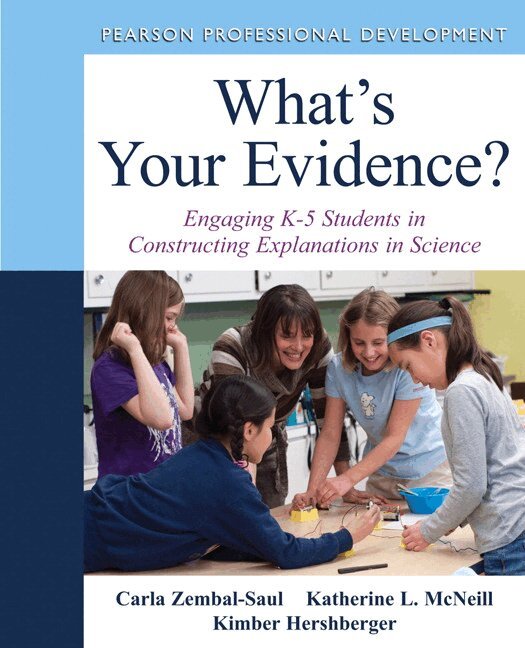
    What's Your Evidence?

    Engaging K-5 Children in Constructing Explanations in Science

    AvCarla Zembal-Saul,Katherine McNeill

    Pearson Education

    2012

    909 kr

    Tillfälligt slut

    Beskrivning

    By providing a variety of strategies, scenarios, student samples, classroom video clips from across all science content areas, rubrics, and guidelines this book provides teachers with the tools to successfully support young scientists to use evidence to construct scientific explanations.With the view that children are capable young scientists, authors encourage science teaching in ways that nurture students’ curiosity about how the natural world works including research-based approaches to support all K-5 children constructing scientific explanations via talk and writing. Grounded in NSF-funded research, this book/DVD provides K-5 teachers with a framework for explanation (Claim, Evidence, Reasoning) that they can use to organize everything from planning to instructional strategies and from scaffolds to assessment. Because the framework addresses not only having students learn scientific explanations but also construct them from evidence and evaluate them, it is considered to build upon the new NRC framework for K-12 science education, the national standards, and reform documents in science education, as well as national standards in literacy around argumentation and persuasion, including the Common Core Standards for English Language Arts (Common Core State Standards Initiative, 2010).The chapters guide teachers step by step through presenting the framework for students, identifying opportunities to incorporate scientific explanation into lessons, providing curricular scaffolds (that fade over time) to support all students including ELLs and students with special needs, developing scientific explanation assessment tasks, and using the information from assessment tasks to inform instruction.ABOUT THE VIDEOAll of the video clips associated with this text were filmed in elementary grade classrooms in central, rural Pennsylvania. None of the lessons were staged or scripted. The video was not professionally recorded or produced given that our aim was to be as non-intrusive as possible in the classrooms in which we were guests. Permissions were secured for all students and teachers appearing in the video clips. We hope those that view the videos are as grateful as we are that these teachers were willing to share their attempts to integrate scientific explanation into their science teaching practices, providing us with insights that would not be possible without these images. They are the true heroes of this work. - Carla L. Zembal-Saul, Katherine McNeill, and Kimber Hershberger

    Produktinformation

    • Märke:Pearson Education
    • Utgivningsdatum:2012-03-16
    • Höjd:100 x 100 x 100 mm
    • Vikt:100 g
    • Språk:Engelska
    • Antal sidor:192
    • Upplaga:1
    • Förlag:Pearson Education
    • EAN:9780132117265

    Utforska kategorier

    • Undervisning i specifika ämnen inom Psykologi och pedagogik
    • Lärarutbildning inom Psykologi och pedagogik

    Mer om författaren

    Carla Zembal-Saul is a Professor of science education in the College of Education at Penn State where she holds the Kahn Professorship in STEM Education and currently serves as head of the Department of Curriculum and Instruction. A former middle school science teacher, she has been involved in school-university partnership work for more than fifteen years, and most of her teaching, scholarship, and service take place in that context. Her research focuses on K-6 teacher learning as they engage in professional development aimed at supporting students in talking and writing evidence-based arguments in science. Examining classroom discourse is a fundamental aspect of Professor Zembal-Saul’s work and she employs video analysis as both a research tool and a pedagogical approach for working with teachers. She has published her research findings in numerous book chapters and articles in peer-reviewed journals, and she is active in professional organizations, including the National Association for Research in Science Teaching and the National Science Teachers Association. Carla Zembal-Saul earned her doctorate at the University of Michigan.Katherine L. McNeill is an Assistant Professor of science education at Boston College. A former middle school science teacher, she received her doctorate in science education from the University of Michigan. Her research focuses on how to support students with diverse backgrounds in engaging in scientific explanation and argumentation in both talk and writing. Her research has been generously funded by the National Science Foundation (NSF) and from this work, she has published a book on supporting middle school students, numerous book chapters, and articles in a variety of journals including the Journal of Research in Science Teaching, Science Education, The Journal of the Learning Sciences, and the International Journal of Science Education. In 2011, Professor McNeill received the Early Career Research Award from NARST. She has also conducted numerous workshops at the annual meeting of the National Science Teachers Association (NSTA) and for school districts including the Detroit Public Schools and the Boston Public Schools.Kimber Hershberger is currently a third grade teacher in the State College Area School District (SCASD) in Pennsylvania. She also serves as co-instructor for the science methods course and a mentor teacher for the Penn State – SCASD Professional Development School Partnership. Her involvement in a local professional learning community that focuses on incorporating content storyline and the CER framework in science teaching has been a highlight of her work. She holds degrees from Juniata College (B.S., elementary education) and Penn State University (M.Ed., science education). Kimber Hershberger has co-authored several articles for NSTA journals, including Science and Children and Science Scope. In addition, she has presented numerous times at the annual conference of the National Science Teachers Association, including sessions at the Research Dissemination Conference, about her work on how to scaffold students’ use of claims and evidence through science talks and journals. She loves visiting interesting places like the Galapagos Islands, India, Italy, and Japan and sharing her travel adventures with her students.

    Recensioner i media

    "I highly endorse this book and the practices it promotes for science explanations and discourse. As a learning tool for teachers, it will truly enhance the way they guide children to think, participate and talk like scientists." -from the Foreword by Donnan Stoicovy, Principal/Lead Learner, Park Forest Elementary School, State College, PA

    Innehållsförteckning

    • Chapter 1: Importance of Engaging K-5 Students in Scientific ExplanationIntroduction to engaging K-5 students in scientific explanationWhy teach children to construct scientific explanations?Scientific explanations in the classroomConnecting science and literacy through scientific explanationBenefits of engaging students in scientific explanationsUnderstanding science conceptsParticipating in scientific practicesUsing evidence to communicate convincinglyLearning about the nature of scienceBenefits of scientific explanation for teachersWhat to expect in elementary gradesCheck PointStudy Group QuestionsChapter 2: Framework for Explanation-Driven ScienceFramework for explanation-driven scienceClaimEvidenceReasoningRebuttalVideo Example – Introducing the instructional frameworkExamples of scientific explanationsLife science exampleEarth science examplePhysical science exampleIncreasing the complexity of the framework over timeVariation #1: Claim and evidenceVariation #2: Using multiple pieces evidenceVariation #3: Providing reasoningVariation #4: Including a rebuttalCheck PointStudy Group QuestionsChapter 3: Planning for Explanation-Driven ScienceCoherent Science content storylineEssential features for constructing scientific explanationsScientific dataScientific principlesLearning performances and examplesFirst grade: SoundSecond grade: State of matterThird and Fourth grade: Day/night and shadowsFifth grade: Water cycleComplexity of the learning taskOpenness of the questionCharacteristics of the data (type and amount)Check PointStudy Group QuestionsChapter 4: Integrating Scientific Explanation into Classroom InstructionInstruction sequence for constructing scientific explanationsAssessing prior knowledgeFraming the questionMaking predictionsCollecting, recording and interpreting dataConstructing scientific explanationsInstructional strategies for supporting the explanation building processIntroducing the framework for explanationUsing real world examples to introduce the frameworkKLEW(S) chartCritique a teacher exampleDebate a peer exampleTalk moves for scaffolding the construction of scientific explanationsCheck PointStudy Group QuestionsChapter 5: Designing Assessment Tasks and RubricsOverview of the development processStep 1: Identify and unpack the content standardFourth grade writing case – UnpackingThird grade podcast case – UnpackingStep 2: Selecting scientific explanation level of complexityFourth grade writing case – Level of complexityThird grade podcast case – Level of complexityStep 3: Create learning performancesFourth grade writing case – Learning performanceThird grade podcast case – Learning performanceStep 4: Write the assessment taskFourth grade writing case – Assessment taskThird grade podcast case – Assessment taskStep 5: Develop specific rubricFourth grade writing case – RubricThird grade podcast case – RubricUsing assessment data to inform instructionFourth grade writing case – ExamplesIncomplete evidence and incomplete reasoningIncomplete evidence and complete reasoningThird grade podcast case – ExampleAssessing informal science talkCheck PointStudy Group QuestionsChapter 6: Creating a Classroom Community of Young ScientistsNorms of participation in science learningActive listening and patterns of talkThe role of the scientific explanation frameworkA culture of constructive criticismCheck PointStudy Group Questions