• Fri frakt över 249 kr
  • •
  • Snabba leveranser
  • •
  • Billiga böcker
Kundservice

Du är på sajten för privatpersoner.

Företag, bibliotek eller offentlig verksamhet?

Du handlar på classic.bokus.com, där alla dina funktioner finns intakta.
Till classic.bokus.com
Bokus logotyp. Gå till startsidan.
  • Erbjudanden
  • Nyheter
  • Student
  • Topplistor
  • Barn & ungdom
  • Bokus Play
  • E-böcker
  • Pocketböcker
  • Spel & pussel

10% studentrabatt med kod TERM26

Sidfot

Mina sidor

    Hjälp

    • Kundservice
    • Vanliga frågor och svar
    • Frakt och leverans
    • Retur vid ångerrätt
    • Reklamera vara
    • Betalning
    • Köpvillkor
    • Allmänna villkor
    • Information om webbplatsens tillgänglighet

    Om Bokus

    • Om oss
    • Pressrum
    • För studenter
    • För företag
    • För bibliotek och offentlig verksamhet
    • För leverantörer
    • Hållbarhet

    Populärt

    • Aktuella erbjudanden
    • Presentkort
    • Studentlitteratur
    • Nya böcker
    • Topplistor
    • Signerade böcker
    • Engelska böcker

    Inspiration

    • Boktips
    • BookTok
    • Populära bokserier
    • Barnbokskaraktärer
    • Populära författare
    Logotyp för Bokus
    Följ oss på Facebook (extern länk)Följ oss på Instagram (extern länk)Följ oss på YouTube (extern länk)Följ oss på TikTok (extern länk)
    bokus @ CookiesAnpassa cookiesIntegritetspolicyKöpvillkor
    Till Citymail hemsida (extern länk)Till Budbee hemsida (extern länk)Till Postnord hemsida (extern länk)Till Schenker hemsida (extern länk)Till Early Bird hemsida (extern länk)Till Walleys hemsida (extern länk)
    1. Medicin
    2. Medicin: icke kliniska discipliner
    3. Fysiologi

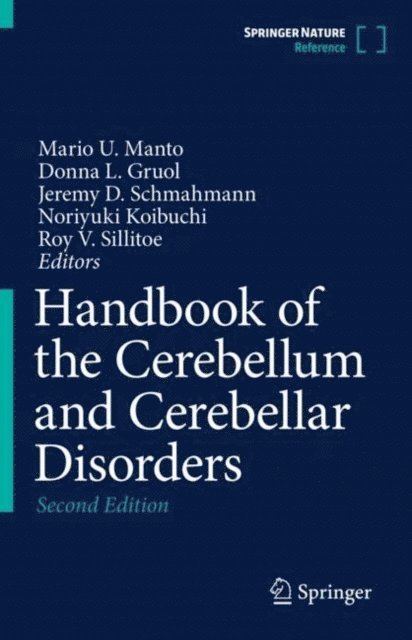
    Handbook of the Cerebellum and Cerebellar Disorders

    AvMario U. Manto,Donna L. Gruol

    Springer Nature Switzerland AG

    2021

    Del i serien Handbook of the Cerebellum and Cerebellar Disorders

    13 183 kr

    Beställningsvara. Skickas inom 10-15 vardagar. Fri frakt över 249 kr.

    Beskrivning

    Our knowledge of cerebellar functions and cerebellar disorders, called ataxias, is increasing considerably. Studies of the cerebellum are now a central focus in neuroscience. During the last four decades, many laboratories worldwide have dedicated their research activities to understanding the roles of the cerebellum in motor control, cognitive processes and biology of mental processes, behavioral symptoms, and emotion. It is now accepted that the cerebellum acts as a cognitive operator in learning, perception, and attention. Moreover, major improvements in our assessment of in vivo cerebellar architecture using imaging techniques have occurred. A typical example is the accurate description of cerebellar anatomy during fetal development with MRI, a progress which has direct impacts on patient care. These advances have been associated with discoveries of new clinical disorders, in particular in the field of genetic ataxias. More than 20 new genes have been identified these last 10 years. Only for dominant ataxias, more than 30 diseases have now been unravelled. The number of ataxic disorders will increase with aging, the cerebellum being the structure of the brain with the most important loss of neurons with age. More than 300 different cerebellar disorders are encountered during daily practice, but we are missing a single source of information explaining their pathogenesis. Despite the immense amount of knowledge acquired about the cerebellar circuitry these last years, a large book covering the neuroscience of the cerebellum is missing. The goal of this endeavour is to bring up to date information relevant for basic science and also for clinical activities. To reach this goal, the most renowned authors are gathered in a unique and in-depth book with a format of a handbook. We emphasize the connections between molecular findings, imaging features, behavioural/neuropsychological aspects, and clinical implications.

    Produktinformation

    • Märke:Springer Nature Switzerland AG
    • Utgivningsdatum:2021-12-05
    • Höjd:155 x 235 x undefined mm
    • Språk:Engelska
    • Serie:Handbook of the Cerebellum and Cerebellar Disorders
    • Antal sidor:2 737
    • Upplaga:2
    • Förlag:Springer Nature Switzerland AG
    • EAN:9783030238094

    Utforska kategorier

    • Fysiologi inom Medicin
    • Biovetenskap inom Naturvetenskap och teknik
    • Neurokirurgi inom Medicin

    Mer om författaren

    Prof. Mario U. Manto is a professor of neuroanatomy at the University of Mons, Belgium. He is the head of the Department of Neurology at the CHU-Charleroi. He is the founding editor of The Cerebellum (Springer Nature). He has published more than 10 books. He is co-founder of the Society for Research on the Cerebellum and Ataxias. He has received research grants from national and international agencies (NIH, European Commission).Donna L. Gruol PhD, is an associate professor in the Department Neuroscience at the Scripps Research Institute, La Jolla, California, and an adjunct associate professor in the Neuroscience Department at the University of California San Diego. She obtained a PhD in biology from the Illinois Institute of Technology and did post degree training in neuroscience at the University of Maryland Medical School, The National Institutes of Health, and The Salk Institute. Donna has been a member of several NIH grant review panels and has served on journal editorial boards and advisory committees. Her current research focuses on neuroimmune regulation of brain physiology and synaptic transmission and the role of the neuroimmune system in the actions of ethanol on the brain in preclinical models of alcohol use disorders.Dr. Jeremy D. Schmahmann is a professor of neurology at Harvard Medical School and a senior clinical neurologist at the Massachusetts General Hospital where he is founding director of the Ataxia Center, director of the Laboratory for Neuroanatomy and Cerebellar Neurobiology, and a founding member of the Cognitive Behavioral Neurology Unit. Dr. Schmahmann received his medical degree with distinction from the University of Cape Town, completed residency in the Neurological Unit of the Boston City Hospital, and did his postdoctoral fellowship with Professor Deepak Pandya in the Department of Anatomy and Neurobiology at Boston University School of Medicine. He is a fellow of the American Academy of Neurology, American Neurological Association, and American Neuropsychiatric Association; a member of the Medical and Scientific Research Advisory Board of the National Ataxia Foundation and the Clinical Research Consortium for the Study of Cerebellar Ataxias; the executive committee member of the Society for Research on the Cerebellum and Ataxias; and past president of the American Neuropsychiatric Association. Dr. Schmahmann’s clinical and research efforts focus on the anatomical substrates of intellect and emotion, and the anatomy, clinical neurology and basic science of the ataxias, and other cerebellar disorders. He was awarded the Norman Geschwind Prize in 2000 by the American Academy of Neurology and the Behavioral Neurology Society for his description of the cerebellar cognitive affective syndrome and its neurobiological and theoretical underpinnings.Dr. Noriyuki Koibuchi is a professor and director of integrative physiology atthe Gunma University Graduate School of Medicine, Maebashi, Japan. Dr. Koibuchi obtained MD degree from Gunma University School of Medicine, followed by a PhD degree from the Institute of Endocrinology, Gunma University. He completed a postdoctoral research fellowship in neurobiology and behavior at the Rockefeller University. Following a tenure as an assistant/associate professor at the Dokkyo University School of Medicine, and as a visiting assistant professor at the Brigham and Women’s Hospital and Harvard Medical School, he took up his current position xxii About the Editors in 2001. He has been serving as a council member in several societies, such as the Physiological Society in Japan, the Japan Endocrine Society, and the Japan Thyroid Association. He is also serving as an associate editor in several journals such as The Cerebellum and Frontiers in Endocrinology.Dr. Roy V. Sillitoe completed a PhD in neuroscience at the University of Calgary. He thenreceived postdoctoral training at the University of Oxford, New York University, and Memorial Sloan-Kettering Cancer Center. He is currently an investigator at Baylor College of Medicine and the Jan and Dan Duncan Neurological Research Institute at Texas Children’s Hospital in Houston, Texas. Dr. Sillitoe is also the co-director of the Development, Disease Models & Therapeutics Graduate Program at Baylor College of Medicine. The focus of his research is to understand how the cerebellum contributes to different diseases. To accomplish these goals, his group uses mouse genetics, neuroanatomy, behavioral paradigms, and in vivo electrophysiology approaches. In addition, they are testing how deep brain stimulation (DBS) and exercise correct altered neural signals and rescue behavior in mouse models of ataxia, dystonia, tremor, and seizure disorders.

    Innehållsförteckning

    • Chapter 1. Embryology.- Chapter 2. Anatomy.- Chapter 3. Neuroimaging of the cerebellum.- Chapter 4. Neurotransmitters and neuromodulators.- Chapter 5. Fructose metabolism and the cerebellum.- Chapter 6. Physiology of the cerebellum.- Chapter 7. Cerebellum and pain processing.- Chapter 8. Computational models of cerebellar function.- Chapter 9. Animal models of cerebellar ataxias.- Chapter 10. Symptoms of cerebellar disorders in human.- Chapter 11. Clinical deficits.- Chapter 12. Cerebellum and cognitive processes.- Chapter 13. Cerebellum and emotion regulation.- Chapter 14. Developmental disorders.- Chapter 15. Autism spectrum disorders and ataxia.- Chapter 16. Cerebellum and schizophrenia.- Chapter 17. Progressive myoclonic epilepsies.- Chapter 18. Cerebellar stroke.- Chapter 19. Immune diseases.- Chapter 20. Endocrine disorders.- Chapter 21. Infectious diseases.- Chapter 22. Tumors and paraneoplastic disorders.- Chapter 23. Trauma of the posterior fossa.- Chapter 24. Cerebellotoxic agents.- Chapter 25. Multiple system atrophy (MSA).- Chapter 26. Essential tremor.- Chapter 27. Autosomal Recessive Cerebellar Ataxias (ARCAs).- Chapter 28. Mitochondrial disorders.- Chapter 29. X-linked ataxias.- Chapter 30. Dominant ataxias.- Chapter 31. Overview of the differential diagnosis of cerebellar disorders.- Chapter 32. Overview of the general management of cerebellar disorders.