Advances in Petroleum Engineering - Böcker
Visar alla böcker i serien Advances in Petroleum Engineering. Handla med fri frakt och snabb leverans.
8 produkter
8 produkter
2 378 kr
Skickas inom 11-20 vardagar
Wave propagation is central to all areas of petroleum engineering, e.g., drilling vibrations, MWD mud pulse telemetry, swab-surge, geophysical ray tracing, ocean and current interactions, electromagnetic wave and sonic applications in the borehole, but rarely treated rigorously or described in truly scientific terms, even for a single discipline. Wilson Chin, an MIT and Caltech educated scientist who has consulted internationally, provides an integrated, comprehensive, yet readable exposition covering all of the cited topics, offering insights, algorithms and validated methods never before published. A must on every petroleum engineering bookshelf! In particular, the book: Delivers drillstring vibrations models coupling axial, torsional and lateral motions that predict rate-of-penetration, bit bounce and stick-slip as they depend on rock-bit interaction and bottomhole assembly properties,Explains why catastrophic lateral vibrations at the neutral point cannot be observed from the surface even in vertical wells, but providing a proven method to avoid them,Demonstrates why Fermat's "principle of least time" (used in geophysics) applies to non-dissipative media only, but using the "kinematic wave theory" developed at MIT, derives powerful methods applicable to general attenuative inhomogeneous media,Develops new approaches to mud acoustics and applying them to MWD telemetry modeling and strong transients in modern swab-surge applicagtions,Derives new algorithms for borehole geophysics interpretation, e.g., Rh and Rv in electromagnetic wave and permeability in Stoneley waveform analysis, andOutlines many more applications, e.g., wave loadings on offshore platforms, classical problems in wave propagation, and extensions to modern kinematic wave theory.These disciplines, important to all field-oriented activities, are not treated as finite element applications that are simply gridded, "number-crunched" and displayed, but as scientific disciplines deserving of clear explanation. General results are carefully motivated, derived and applied to real-world problems, with results demonstrating the importance and predictive capabilities of the new methods.
2 129 kr
Skickas inom 7-10 vardagar
Traditional well logging methods, such as resistivity, acoustic, nuclear and NMR, provide indirect information related to fluid and formation properties. The “formation tester,” offered in wireline and MWD/LWD operations, is different. It collects actual downhole fluid samples for surface analysis, and through pressure transient analysis, provides direct measurements for pore pressure, mobility, permeability and anisotropy. These are vital to real-time drilling safety, geosteering, hydraulic fracturing and economic analysis.Methods for formation testing analysis, while commercially important and accounting for a substantial part of service company profits, however, are shrouded in secrecy. Unfortunately, many are poorly constructed, and because details are not available, industry researchers are not able to improve upon them. This new book explains conventional models and develops new powerful algorithms for “double-drawdown” and “advanced phase delay” early-time analysis - importantly, it is now possible to predict both horizontal and vertical permeabilities, plus pore pressure, within seconds of well logging in very low mobility reservoirs. Other subjects including inertial Forchheimer effects in contamination modeling and time-dependent flowline volumes are also developed. All of the methods are explained in complete detail. Equations are offered for users to incorporate in their own models, but convenient, easy-to-use software is available for those needing immediate answers.The leading author is a well known petrophysicist, with hands-on experience at Schlumberger, Halliburton, BP Exploration and other companies. His work is used commercially at major oil service companies, and important extensions to his formation testing models have been supported by prestigious grants from the United States Department of Energy. His new collaboration with China National Offshore Oil Corporation marks an important turning point, where advanced simulation models and hardware are evolving side-by-side to define a new generation of formation testing logging instruments. The present book provides more than formulations and solutions: it offers a close look at formation tester development “behind the scenes,” as the China National Offshore Oil Corporation opens up its research, engineering and manufacturing facilities through a collection of interesting photographs to show how formation testing tools are developed from start to finish.
2 458 kr
Skickas inom 7-10 vardagar
Resistivity logging represents the cornerstone of modern petroleum exploration, providing a quantitative assessment of hydrocarbon bearing potential in newly discovered oilfields. Resistivity is measured using AC coil tools, as well as by focused DC laterolog and micro-pad devices, and later extrapolated, to provide oil saturation estimates related to economic productivity and cash flow. Interpretation and modeling methods, highly lucrative, are shrouded in secrecy by oil service companies – often these models are incorrect and mistakes perpetuate themselves over time.This book develops math modeling methods for layered, anisotropic media, providing algorithms, validations and numerous examples. New electric current tracing tools are also constructed which show how well (or poorly) DC tools probe intended anisotropic formations at different dip angles. The approaches discussed provide readers with new insights into the limitations of conventional tools and methods, and offer practical and rigorous solutions to several classes of problems explored in the book.Traditionally, Archie's law is used to relate resistivity to water saturation, but only on small core-sample spatial scales. The second half of this book introduces methods to calculate field-wide water saturations using modern Darcy flow approaches, and then, via Archie's law, develops field-wide resistivity distributions which may vary with time. How large-scale resistivity distributions can be used in more accurate tool interpretation and reservoir characterization is considered at length. The book also develops new methods in "time lapse logging," where timewise changes to resistivity response (arising from fluid movements) can be used to predict rock and fluid flow properties.
2 351 kr
Skickas inom 7-10 vardagar
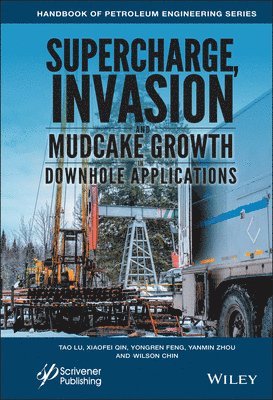
Mysterious "supercharge effects," encountered in formation testing pressure transient analysis, and reservoir invasion, mudcake growth, dynamic filtration, stuck-pipe remediation, and so on, are often discussed in contrasting petrophysical versus drilling contexts. However, these effects are physically coupled and intricately related. The authors focus on a comprehensive formulation, provide solutions for different specialized limits, and develop applications that illustrate how the central ideas can be used in seemingly unrelated disciplines. This approach contributes to a firm understanding of logging and drilling principles. Fortran source code, furnished where applicable, is listed together with recently developed software applications and conveniently summarized throughout the book. In addition, common (incorrect) methods used in the industry are re-analyzed and replaced with more accurate models, which are then used to address challenging field objectives.Sophisticated mathematics is explained in "down to earth" terms, but empirical validations, in this case through Catscan experiments, are used to "keep predictions honest." Similarly, early-time, low mobility, permeability prediction models used in formation testing, several invented by one of the authors, are extended to handle supercharge effects in overbalanced drilling and near-well pressure deficits encountered in underbalanced drilling. These methods are also motivated by reality. For instance, overpressures of 2,000 psi and underpressures near 500 psi are routinely reported in field work, thus imparting a special significance to the methods reported in the book.This new volume discusses old problems and modern challenges, formulates and develops advanced models applicable to both drilling and petrophysical objectives. The presentation focuses on central unifying physical models which are carefully formulated and mathematically solved. The wealth of applications examples and supporting software discussed provides readers with a unified focus behind daily work activities, emphasizing common features and themes rather than unrelated methods and work flows. This comprehensive book is "must" reading for every petroleum engineer.
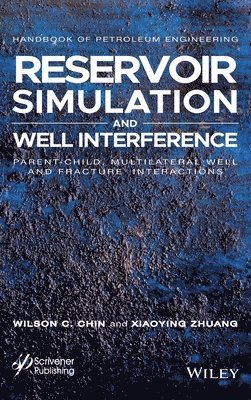
Reservoir Simulation and Well Interference
Parent-Child, Multilateral Well and Fracture Interactions
Inbunden, Engelska, 2020
2 852 kr
Skickas inom 3-6 vardagar
Co-written by a world-renowned petroleum engineer, this breakthrough new volume teaches engineers how to configure, place and produce horizontal and multilateral wells in geologically complicated reservoirs, select optimal well spacings and fracture separations, and how to manage factors influencing well productivity using proven cost-effective and user-friendly simulation methods.Charged in the 1990s with solving some of petroleum engineering's biggest problems that the industry deemed "unsolvable," the authors of this innovative new volume solved those problems, not just using a well-published math model, but one optimized to run rapidly, the first time, every time. This not only provides numerical output, but production curves and color pressure plots automatically. And each in a single hour of desk time.Using their Multisim software that is featured in this volume, secondary school students at the Aldine Independent School District delivered professional quality simulations in a training program funded by some of the largest energy companies in the world. Think what you, as a professional engineer, could do in your daily work. Valuable with or without the software, this volume is the cutting-edge of reservoir engineering today, prefacing each chapter with a "trade journal summary" followed by hands-on details, allowing readers to replicate and extend results for their own applications.This volume covers parent-child, multilateral well, and fracture flow interactions, reservoir flow analysis, many other issues involving fluid flow, fracturing, and many other common "unsolvable" problems that engineers encounter every day. It is a must-have for every engineer's bookshelf.
2 351 kr
Skickas inom 7-10 vardagar
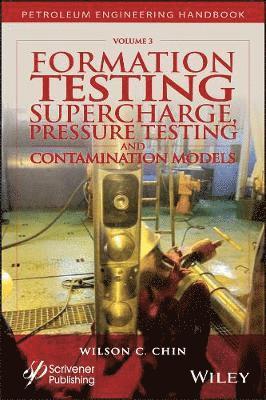
This new volume, the third in Wiley-Scrivener's series on formation testing, reviews pressure transient interpretation and contamination analysis methods, providing numerous practical discussions and examples with rigorous formulations solved through exact, closed form, analytical solutions.This new volume in the "Formation Testing" series further develops new methods and processes that are being developed in the oil and gas industry. In the 1990s through 2000s, the author co-developed Halliburton's commercially successful GeoTapTM real-time LWD/MWD method for formation testing, and also a parallel method used by China Oilfield Services, which enabled the use of data taken at early times, in low mobility and large flowline volume environments, to support the important estimation of mobility, compressibility and pore pressure, which are necessary for flow economics and fluid contact boundaries analyses (This work was later extended through two Department of Energy Small Business Innovation Research awards.).While extremely significant, the effect of high pressures in the borehole could not be fully accounted for. The formation tester measures a combination of reservoir and mud pressure and cannot ascertain how much is attributed to unimportant borehole effects. The usual approach is "simply wait" until the effects dissipate, which may require hours, which imply high drilling and logging costs, plus increased risks in safety and tool loss. The author has now modeled this "supercharge" effect and developed a powerful mathematical algorithm that fully accounts for mud interations. In short, accurate predictions for mobility, compressibility and pore pressure can now be undertaken immediately after an interval is drilled without waiting.This groundbreaking new work is a must-have for any petroleum, reservoir, or mud engineer working in the industry, solving day-to-day problems that he or she encounters in the field.
2 447 kr
Skickas inom 7-10 vardagar
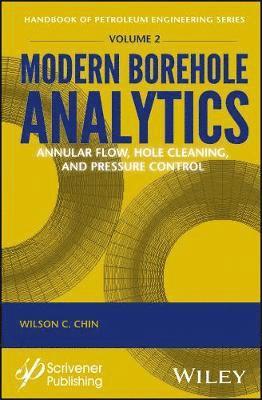
Written by a leading industry specialist, a must-have for drilling specialists, petroleum engineers, and field practitioners, this is the only book providing practical, rigorous and validated models for general annular flows, eccentric geometries, non-Newtonian fluids, yield stresses, multiphase effects, and transient motions and flow rates and includes new methods describing mudcake integrity and pore pressure for blowout assessment.Wilson C. Chin has written some of the most important and well-known books in the petroleum industry. These books, whose research was funded by the U.S. Department of Energy and several international petroleum corporations, have set very high standards. Many algorithms are used at leading oil service companies to support key drilling and well logging applications.For the first time, the physical models in these publications, founded on rigorous mathematics and numerical methods, are now available to the broader industry: students, petroleum engineers, drillers and faculty researchers. The presentations are written in easy-to-understand language, with few equations, offering simplified explanations of difficult problems and solutions which provide key insights into downhole physical phenomena through detailed tabulations and color graphics displays. Practical applications, such as cuttings transport, pressure control, mudcake integrity, formation effects in unconventional applications, and so on, are addressed in great detail, offering the most practical answers to everyday problems that the engineer encounters.The book does not stop at annular flow. In fact, the important role of mudcake growth and thickness in enabling steady flow in the annulus is considered, as is the role of (low) formation permeability in affecting mud filtration, cake growth, and fluid sealing at the sandface. This is the first publication addressing "the big picture," a "first" drawn from the author's related research in multiple disciplines such as drilling rheology, formation testing and reservoir simulation. A must-have for any petroleum engineer, petroleum professional, or student, this book is truly a groundbreaking volume that is sure to set new standards.
2 554 kr
Skickas inom 11-20 vardagar
A popular 1990s formation tester with a single "pumping" probe and one passive "observation port" displaced 180 deg away, designed to measure pressures at two locations for permeability prediction, encounters well known detection problems at low mobilities. This book, using aerodynamics methods, explains why and also reveals the existence of a wide stagnation zone that hides critical formation details. And it does much more. An exact analytical solution is used to validate a new transient, three-dimensional, finite difference model for more general testers, one that guides new hardware designs with independent azimuthally displaced probes having with different rates, flow schedules and nozzle geometries, supports interpretation and formation evaluation, and assists with job planning at the rigsite. The methods also apply to conventional tools, allowing comparisons between older and newer technologies. Importantly, the authors introduce a completely new three-probe design with independently operable active elements that eliminate all older tool deficiencies.Numerous subjects are discussed, such as pressure transient analyses with multiple operating probes, supercharge analysis with invasion and mudcake buildup, accurate and rapid calculations that allow more than 1,000 simulations per minute, extremely rapid batch mode calculations using convergence acceleration methods, rapid fluid withdrawal with minimal dissolved gas release, dip angle, heterogeneity and anisotropy evaluation, and many other topics. In addition, tool operation sequences, detailed engineering and design functions, field test procedures and laboratory facilities, are discussed and illustrated in photographs that go "behind the scenes" at one of the world’s largest international oil service companies. The book hopes to educate new engineers and veteran engineers alike in hardware and software design at a time when increasing efficiency is crucial and "doing more with less" represents the new norm.