Critical Specialties in Treating Autism and other Behavioral Challenges - Böcker
Quality Activities in Center-Based Programs for Adults with Autism
Moving from Nonmeaningful to Meaningful
363 kr
Skickas inom 7-10 vardagar
Quality Activities in Center-Based Programs for Adults with Autism: Moving from Nonmeaningful to Meaningful describes what constitutes meaningful versus nonpurposeful activities for adults with autism and other severe disabilities in a classroom or center-based program. Then this step-by-step guide presents an evidence-based process for changing nonpurposeful activities, using behavior analytic research and application. The goal is to help ensure adults with autism and other severe disabilities are engaged in week-day activities that truly enhance their income-earning capacity, independence with life skills, day-to-day enjoyment, and overall dignity.
Summarizes the existing state of activities for adults with autism and severe disabilities in center-based programs Covers how to empirically assess and monitor participation in meaningful activities Details evidence-based procedures for changing existing activities to become more meaningful Provides maintenance strategies for ensuring activities continue to be meaningful on a daily basis409 kr
Skickas inom 7-10 vardagar
A Practical Guide to Finding Treatments That Work for People with Autism provides a logical, culturally sensitive, and values-based resource to aid practitioners in making informed decisions on the most effective treatment for any given client at any given time.
By providing multiple illustrative examples, practitioners will learn to use their professional judgment to integrate the best available evidence with client values and context. This will increase the efficacy of autism treatments, with the goal of producing meaningful gains across a range of skills.
Presents a detailed description of the evidence-based practice of applied behavior analysis as it applies to ASD Offers a decision-making framework that helps clinicians integrate the best available evidence with client values and context Guides practitioners through the process of assessing treatment outcomes that fit with client values and contextual variables Provides concrete examples for various age groupsFlexible and Focused
Teaching Executive Function Skills to Individuals with Autism and Attention Disorders
409 kr
Skickas inom 7-10 vardagar
Flexible and Focused: Teaching Executive Function Skills to Individuals with Autism and Attention Disorders is a manual written for individuals who work with learners who struggle with executive function deficits. The manual takes the perspective that executive function skills can be improved through effective intervention, just like any other skills. This how-to manual provides practical strategies for teaching learners to be focused, organized, flexible, and able to effectively manage themselves. Ready-to-use lessons, data sheets, worksheets, and other tools for practitioners, educators, and parents are provided to help them tackle common problems associated with executive function deficits in learners of any diagnosis, ages 5 to adult. The principles of applied behavior analysis (ABA), which form the foundation of this manual, are translated into simple, easy-to-use procedures. Lessons for improving executive function skills in real-life everyday situations are provided in the following areas:
Self-awareness Inhibition and impulse control Self-management Attention Organization Problem solving Time management Planning Working memory Emotional self-regulation Flexibility Provides an overview of what constitutes executive function skills Outlines how techniques based on applied behavior analysis can be used to teach skills Presents step-by-step lessons for practitioners, educators, and parents to implement with individuals with executive function deficits Includes data sheets, task analyses, worksheets, and visual aids
433 kr
Skickas inom 7-10 vardagar
Treating Feeding Challenges in Autism: Turning the Tables on Mealtime distills existing research on feeding disorders treatment into the very best, most effective and most practical strategies for practitioners to implement with their clients who have autism and other developmental and behavioral disorders. The book focuses on the few but highly effective feeding treatment procedures that work in the large percentage of cases.
The book describes each procedure in practical, how-to language, with the goal of explaining how to implement them in the real-life settings in which practitioners actually work. The book includes a large variety of sample datasheets, intervention plans and graphs of sample data to serve as practical examples to guide clinicians through the process of selecting, implementing, analyzing and troubleshooting feeding interventions.
Summarizes the basic behavioral principles underlying feeding disorders Discusses the origin and function of feeding disorders Details the assessment of feeding disorders Covers practical issues related to feeding environment Lists materials needed for implementing feeding interventions Explains how to transfer strategies and procedures from the practitioner to parents and caregivers Includes sample datasheets, intervention plans and graphs of sample data564 kr
Skickas inom 7-10 vardagar
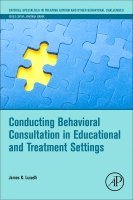
Conducting Behavioral Consultation in Educational and Treatment Settings is a practitioner's guide to implementing consultation with multidisciplinary care-providers for children and adults who have learning and behavioral challenges. The book focuses on the interactive, problem-solving, dispute resolution, time management and related skills necessary for conducting behavioral consultation successfully. Primary topics include (a) basic principles and practices of behavioral consultation, (b) roles, expectations and responsibilities of a behavioral consultant, (c) establishing a consultation relationship, (d) consultation in action (problem identification, problem analysis, intervention implementation and intervention evaluation), (e) supervision, (f) interpersonal skills, and (g) time management skills.
Features explicit, best practice recommendations Presents strategies for successful consulting Provides practice aides, such as tables, charts and checklists Includes case examples and vignettes in each chapter Highlights the experience of a world-renowned clinician754 kr
Skickas inom 7-10 vardagar
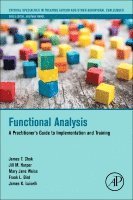
Functional Analysis: A Practitioner's Guide to Implementation and Training provides practitioners with the most updated information about�applying the�wide span of current functional analysis (FA) methodologies geared specifically to applied service settings. The book serves as a self-instructional implementation to a broad-base of trainees and care-providers within schools, clinics, centers and human services organizations.
Adopting a Behavioral Skills Training and competency-based training outcomes approach, the�learning materials and activities featured in the book include suggested slideshow presentations, role-play exercises, pre- and post-training quizzes, natural setting evaluation methods, data recording forms, instructional scripts and reproducible handouts.
Covers an historical overview and the ethical considerations of functional analysis Examines FA methodology, measurement methods and experimental designs Teaches how to independently design, conduct and interpret FAs Explains how to formulate FA-informed intervention plans Presents an agile curriculum that can be customized for different providers469 kr
Skickas inom 7-10 vardagar
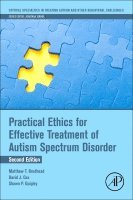
Practical Ethics for Effective Treatment of Autism Spectrum Disorder, Second Edition is for behavior analysts working directly with, or supervising those who work with, individuals with autism. The book addresses the principles and values that underlie the Behavior Analyst Certification Board's� Professional and Ethical Compliance Code for Behavior Analysts and factors that affect ethical decision-making. In addition, the book addresses critical and under-discussed topics, including scope of competence, evidence-based practice in behavior analysis, how to collaborate with professionals within and outside one's discipline, and how to design systems of ethical supervision and training customized to unique treatment settings.
Across many of the topics, the authors also discuss errors students and professionals may make during analyses of ethical dilemmas and misapplications of ethical codes within their practice. New to this revision are chapters on Quality Control in ABA Service Delivery, Ethical Issues in ABA Business Management and Standardizing Decision-making in ABA Service Delivery.
Reviews new BACB Ethics Code for Behavior AnalysisDiscusses factors that affect ethical decision-makingDescribes how to create systems for teaching and maintaining ethical behaviorDiscusses how to identify your own scope of competence in autism treatmentExamines the process of evidence-based practice and how it can be applied to behavior-analytic treatment for autismAddresses the importance of interdisciplinary collaboration and how to be a good collaboratorReviews common mistakes that students and supervisors make when analyzing ethical dilemmas, along with common misapplications of ethical codesIncludes new chapters on standardized decision-making and quality control in ABA service delivery763 kr
Skickas inom 7-10 vardagar
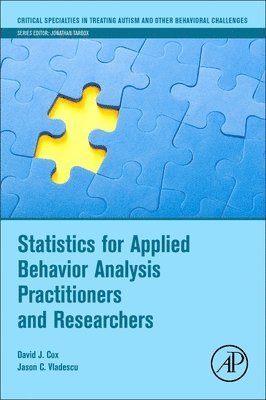
Professionals who provide services based on the principles of behavior are required to use evidence-based practices and to make data-based decisions regarding assessments and interventions. Doing so requires statistical literacy: competence in collecting, analyzing, interpreting and presenting aggregate quantitative data within or between subjects. Without statistical literacy, behavior analysts cannot take advantage of, or intelligently discuss, ongoing scientific developments around interventions for autism spectrum disorders (ASD). Statistics for Applied Behavior Analysis Practitioners and Researchers provides practical and useful content for individuals who work directly with, or supervise those who work directly with, individuals with ASD. This book introduces core concepts and principles of modern statistical analysis that behavior analysts will need to deliver and consume the larger scientific literature. The organization of the book follows the common sequence of decisions for collecting, describing and analyzing data associated with behavior analytic service delivery and research. By the end of the book, readers should be able to understand and accurately incorporate statistics in their assessment and intervention effects using statistics.
Describes the logic behind the many variations to statistically describe human behaviorExplains the conditions under which variations in statistical description are most appropriateHighlights common methods for quantitively determine the effectiveness of an interventionDiscusses the unique challenges of the time-series data and reviews current solutionsCovers current standards in writing and presenting statistical effects of interventionsReviews the application of statistical description for both single-case and between-group experimental designsA Practical Guide for Finding Interventions That Work for Autistic People
Diversity-Affirming Evidence-Based Practice
773 kr
Skickas inom 7-10 vardagar