Human Technology Interaction Series – serie
Visar alla böcker i serien Human Technology Interaction Series. Handla med fri frakt och snabb leverans.
14 produkter
14 produkter
Häftad, Engelska, 2015
470 kr
Skickas inom 5-8 vardagar
As the world grows increasingly complex--in issues of sustainability, culture, and technology--businesses and governments are searching for a form of problem solving that can effectively respond to unprecedented levels of ambiguity and disorder. Traditional "linear thinking" has been disparaged by the popular media as being inadequate for dealing with the global economic crisis. Traditional forms of marketing and product development have been rejected by businesses that need to find new ways of staying competitive in a global economy. Yet little has been offered as an alternative. It is not enough to demand that someone "be more innovative" without offering the tools to succeed.This book offers a way of thinking about complicated, multifaceted problems with a repeatable degree of success. Design synthesis methods can be applied in business to produce new and compelling products and services, or these methods can be applied in government with the goal of changing culture and bettering society. In both contexts, there is a need for timely and aggressive action. This text is intended to act as a practitioner's guide to using the magic of design to solve complex problems.
Inbunden, Engelska, 2020
882 kr
Skickas inom 5-8 vardagar
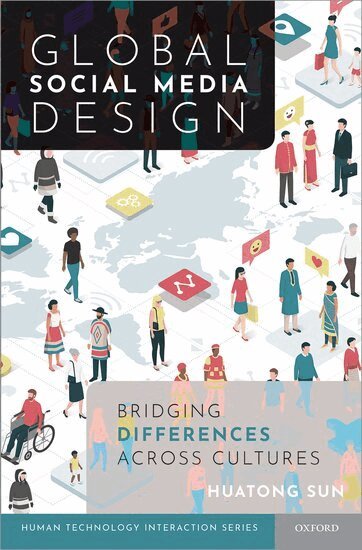
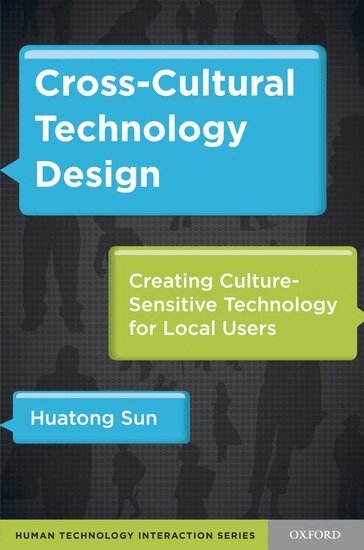
Social media users fracture into tribes, but social media ecosystems are globally interconnected technically, socially, culturally, and economically. At the crossroads, Huatong Sun, author of Cross-Cultural Technology Design, presents theory, method, and case studies to uncover the global interconnectedness of social media design and reorient universal design standards. Centering on the dynamics between structure and agency, Sun draws on practice theories and transnational fieldwork and articulates a critical design approach. The "CLUE2 (CLUE squared)" framework extends from situated activity to social practice, and connects macro institutions with micro interactions to redress asymmetrical relations in everyday life.Why were Japanese users not crazed about Facebook? Would Twitter have had been more successful than its copycat Weibo in China if not banned? How did mobilities and value propositions play out in the competition of WhatsApp, WeChat, LINE, and KakaoTalk for global growth? Illustrating the cultural entanglement with a relational view of design, Sun provides three provocative accounts of cross-cultural social media design and use. Concepts such as affordance, genre, and uptake are demonstrated as design tools to bind the material with the discursive and leap from the critical to the generative for culturally sustaining design.Sun calls to reshape the crossroads into a design square where differences are nourished as design resources, where diverse discourses interact for innovation, and where alternative design epistemes thrive from the local. This timely book will appeal to researchers, students, and practitioners who design across disciplines, paradigms, and boundaries to bridge differences in this increasingly globalized world.
Inbunden, Engelska, 2006
1 094 kr
Skickas inom 7-10 vardagar
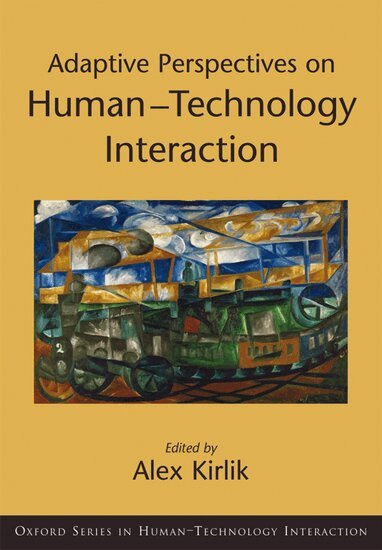
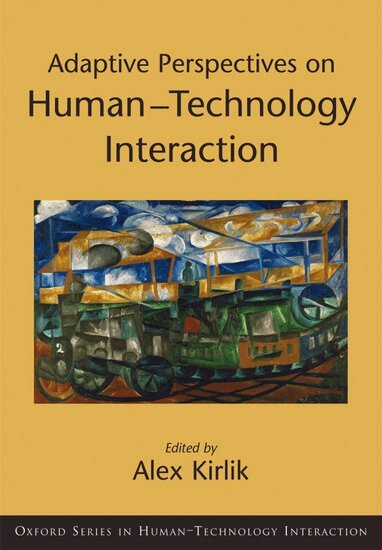
In everyday life, and particularly in the modern workplace, information technology and automation increasingly mediate, augment, and sometimes even interfere with how humans interact with their environment. How to understand and support cognition in human-technology interaction is both a practically and socially relevant problem. The chapters in this volume frame this problem in adaptive terms: how are behaviour and cognition adapted, or perhaps ill-adapted, to the demands and opportunities of an environment where interaction is mediated by tools and technology? The authors draw heavily on the work of Egon Brunswik, a pioneer in ecological and cognitive psychology, as well as on modern refinements and extensions of Brunswikian ideas, including Hammond's Social Judgment Theory, Gigerenzer's Ecological Rationality and Anderson's Rational Analysis. Inspired by Brunswik's view of cognition as "coming to terms" with the "causal texture" of the external world, the chapters in this volume provide quantitative and computational models and measures for studying how people come to terms with an increasingly technological ecology, and provide insights for supporting cognition and performance through design, training, and other interventions. The methods, models, and measures presented in this book provide timely and important resources for addressing problems in the rapidly growing field of human-technology interaction.
Inbunden, Engelska, 2006
1 045 kr
Skickas inom 7-10 vardagar
During the past decade, technology has become more pervasive, encroaching more and more on our lives. Computers, cell phones, and the internet have an enormous influence not only on how we function at work, but also on how we communicate and interact outside the office. Researchers have been documenting the effect that these types of technology have on individuals, families, and other social groups. Their work addresses questions that relate to how people use computers, cell phones, and the internet, how they integrate their use of new technology into daily routines, and how family function, social relationships, education, and socialization are changing as a result. This research is being conducted in a number of countries, by scientists from a variety of disciplines, who publish in very different places. The result is that it is difficult for researchers and students to get a current and coherent view of the research literature. This book brings together the leading researchers currently investigating the impact of information and communication technology outside of the workplace. Its goal is to develop a consolidated view of what we collectively know in this fast-changing area, to evaluate approaches to data collection and analysis, and to identify future directions for research. The book will appeal to professionals and students in social psychology, human-technology interaction, sociology, and communication.
Inbunden, Engelska, 2007
1 500 kr
Skickas inom 7-10 vardagar
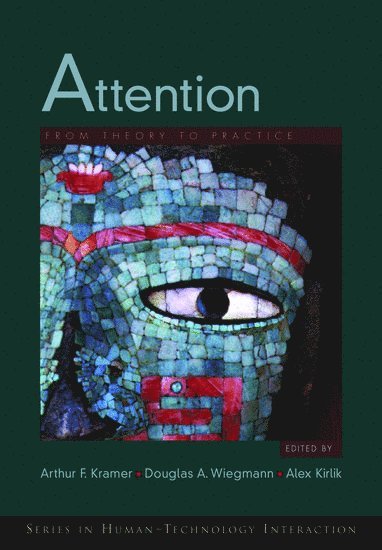
Attention has been one of the most popular subjects in basic cognitive-psychology research, and so its study has generated much empirical data and many theoretical explanations. It has also become a very important factor for those who study how we interact with technological systems and environments. How can these researchers in human-technology interaction take advantage of all the knowledge amassed on attention in basic-science research? This volume addresses this question by bringing together the leading researchers who have pursued both the development of models and theories of attention and their application to investigating and solving practically relevant problems in areas such as aircraft and automobile design, technology applications for health care settings and the home, and adapting technology for the aging population. The volume will include a comprehensive introduction on briding theory and practice in the psychology of attention and a conclusion outlining a future research agenda.
Häftad, Engelska, 2006
568 kr
Skickas inom 7-10 vardagar
During the past decade, technology has become more pervasive, encroaching more and more on our lives. Computers, cell phones, and the internet have an enormous influence not only on how we function at work, but also on how we communicate and interact outside the office. Researchers have been documenting the effect that these types of technology have on individuals, families, and other social groups. Their work addresses questions that relate to how people use computers, cell phones, and the internet, how they integrate their use of new technology into daily routines, and how family function, social relationships, education, and socialization are changing as a result. This research is being conducted in a number of countries, by scientists from a variety of disciplines, who publish in very different places. The result is that it is difficult for researchers and students to get a current and coherent view of the research literature. This book brings together the leading researchers currently investigating the impact of information and communication technology outside of the workplace. Its goal is to develop a consolidated view of what we collectively know in this fast-changing area, to evaluate approaches to data collection and analysis, and to identify future directions for research. The book will appeal to professionals and students in social psychology, human-technology interaction, sociology, and communication.
Häftad, Engelska, 2008
889 kr
Skickas inom 7-10 vardagar
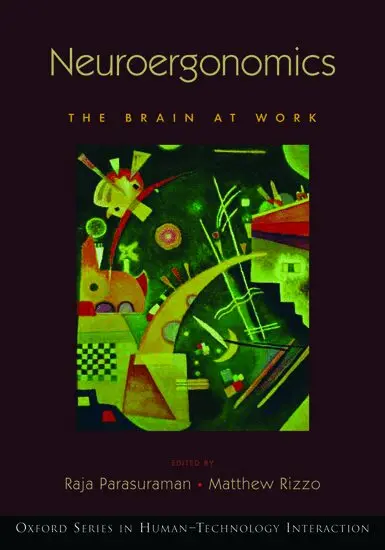
Neuroergonomics can be defined as the study of brain and behavior at work. It combines two disciplines - neuroscience, the study of brain function, and human factors, the study of how to match technology with the capabilities and limitations of people so they can work effectively and safely. The goal of merging these two fields is to use the startling discoveries of human brain and physiological functioning both to inform the design of technologies in the workplace and home, and to provide new training methods that enhance performance, expand capabilites, and optimize the fit between people and technology.Research in the area of neuroergonomics has blossomed in recent years with the emergence of noninvasive techniques for monitoring human brain function that can be used to study various aspects of human behavior in relation to technology and work, including mental workload, visual attention, working memory, motor control, human-automation interaction, and adaptive automation.This volume provides the first systematic overview of this emerging area, describing the theoretical background, basic research, major methods, as well as the new and future areas of application. This collection will benefit a number of readers: the experienced researcher investigating related questions in human facotrs and cognitive neuroscience, the student wishing to get a rapid but systematic overview of the field, and the designer interested in novel approaches and new ideas for application.
Häftad, Engelska, 2010
1 266 kr
Skickas inom 7-10 vardagar
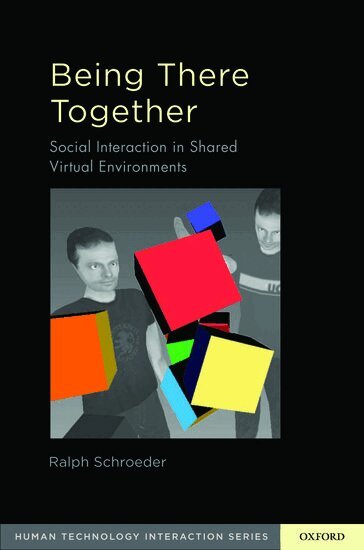
Virtual environments provide places for 'being there together ', for avatars to interact with each other in computer-generated spaces. They range from immersive systems in which people have life-size tracked avatar bodies to large-scale spaces such as Second Life where populations of users socialize in persistent virtual worlds. This book draws together research on how people interact in virtual environments: What difference does avatar appearance make? How do avatars collaborate and play together? How do the type of system and the space affect how people engage with each other? How does interaction between avatars differ from face-to-face interaction? What can social scientists learn from experiments and other studies of how people interact in virtual environments? What are the ethical and social issues in doing this research, and in the uses of this technology? And how do virtual environments differ from other communication technologies such as videoconferencing systems and other new media? This book is a state-of-the art survey of research on these topics, and offers a framework for understanding this technology and its future implications.
Häftad, Engelska, 2012
1 080 kr
Skickas inom 5-8 vardagar
Information technology is at the center of modern life. It supports most day-to-day activities: talking on the phone, getting money from an ATM, or working in the office. Whether for work, commerce, or fun, we interact with computers, networks, and databases -- all sorts of information technology. How does it work? Certainly, technological advances helped create this world. But what keeps it running? The answer is people. These people -- computer system administrators -- are the unsung heroes of the modern age. When we notice them, it is only because something went wrong. Small failures can become big problems, and big failures can make news headlines and cost lots of money. But most of the time, things go right, and system administrators are invisible. They work out of sight, down in the data-center, twenty-four hours a day, seven days a week. But how do they keep systems running? And more importantly, how can we help make them better at their jobs? To answer these questions, the authors of Taming Information Technology set out to study system administrators -- sysadmins, for short. They observed sysadmins in their natural environments, their offices, at the data center, or wherever they worked. The authors took notes, recorded video, interviewed, and, ultimately, put all these pieces together to try to understand what sysadmins do. This book, ten years in the making, is the result. It tells the story of system administration through the narratives of real system administrators. It documents dynamic systems of people and machines, of specialists working together to tame hugely complex information technology infrastructures, developing and adapting their own tools and practices over time to create productive work environments. The authors hope Taming Information Technology will lead the way to a future in which the important work of these IT workers is better appreciated, better understood, and better supported.
Häftad, Engelska, 2010
872 kr
Skickas inom 7-10 vardagar
In everyday life, and particularly in the modern workplace, information technology and automation increasingly mediate, augment, and sometimes even interfere with how humans interact with their environment. How to understand and support cognition in human-technology interaction is both a practically and socially relevant problem. The chapters in this volume frame this problem in adaptive terms: How are behavior and cognition adapted, or perhaps ill-adapted, to the demands and opportunities of an environment where interaction is mediated by tools and technology? The authors draw heavily on the work of Egon Brunswik, a pioneer in ecological and cognitive psychology, as well as on modern refinements and extensions of Brunswikian ideas, including Hammond's Social Judgment Theory, Gigerenzer's Ecological Rationality and Anderson's Rational Analysis. Inspired by Brunswik's view of cognition as "coming to terms" with the "casual texture" of the external world, the chapters in this volume provide quantitative and computational models and measures for studying how people come to terms with an increasingly technological ecology, and provide insights for supporting cognition and performance through design, training, and other interventions. The methods, models, and measures presented in this book provide timely and important resources for addressing problems in the rapidly growing field of human-technology interaction. The book will be of interest to researchers, students, and practitioners in human factors, cognitive engineering, human-computer interaction, judgment and decision making, and cognitive science.Please visit this website for additional materials:http://www.humanfactors.illinois.edu/resources/OtherResourses/LensModel.asp x
Häftad, Engelska, 2010
669 kr
Skickas inom 7-10 vardagar
Although much of the hubris and hyperbole surrounding the 1990's Internet has softened to a reasonable level, the inexorable momentum of information growth continues unabated. This wealth of information provides resources for adapting to the problems posed by our increasingly complex world, but the simple availability of more information does not guarantee its successful transformation into valuable knowledge that shapes, guides, and improves our activity. When faced with something like the analysis of sense-making behavior on the web, traditional research models tell us a lot about learning and performance with browser operations, but very little about how people will actively navigate and search through information structures, what information they will choose to consume, and what conceptual models they will induce about the landscape of cyberspace. Thus, it is fortunate that a new field of research, Adaptive Information Interaction (AII), is becoming possible. AII centers on the problems of understanding and improving human-information interaction. It is about how people will best shape themselves to their information environments, and how information environments can best be shaped to people. Its roots lie in human-computer interaction (HCI), information retrieval, and the behavioral and social sciences. This book is about Information Foraging Theory (IFT), a new theory in Adaptive Information Interaction that is one example of a recent flourish of theories in adaptationist psychology that draw upon evolutionary-ecological theory in biology. IFT assumes that people (indeed, all organisms) are ecologically rational, and that human information-seeking mechanisms and strategies adapt the structure of the information environments in which they operate. Its main aim is to create technology that is better shaped to users. Information Foraging Theory will be of interest to student and professional researchers in HCI and cognitive psychology.
Inbunden, Engelska, 2011
932 kr
Skickas inom 5-8 vardagar
As the world deals with increasing complexity -- in issues of sustainability, finance, culture and technology -- business and governments are searching for a form of problem solving that can deal with the unprecedented levels of ambiguity and chaos. Traditional "linear thinking" has been disparaged by the popular media as being inadequate for dealing with the global economic crisis. Standard forms of marketing and product development have been rejected by businesses who need to find a way to stay competitive in a global economy. Yet little has been offered as an alternative. It is not enough to demand that someone "be more innovative" without giving him the tools to succeed.Design synthesis is a way of thinking about complicated, multifaceted problems of this scale with a repeatable degree of success. Design synthesis methods can be applied in business, with the goal of producing new and compelling products and services, and they can be applied in government, with the goal of changing culture and bettering society. In both contexts, however, there is a need for speed and for aggressive action. This text is immediately relevant, and is more relevant than ever, as we acknowledge and continually reference a feeling of an impending and massive change. Simply, this text is intended to act as a practitioner's guide to exposing the magic of design.There are three simple goals for this text.The first goal is to present a theory of design synthesis in a simple and concise manner. This theory is based on academic research and discourse, but presented in a way that is clear and valuable to a practicing design manager, designer or design researcher. This theory of design synthesis can then be used to substantiate single methods of synthesis.The second goal is to offer a rationalization of why design synthesis is important, both in a general sense ("why should I care about this at all?") as well as in a more immediate sense ("why should I care about this right now?").The final goal is to present a set of actionable, learnable methods for design synthesis that can be applied to any design problem. Practicing industrial designers, interaction designers, interface designers, and designers of other disciplines can use these methods to make sense of complicated design problems and to move seamlessly from various forms of research to design. The methods can add a systematic sense of rigor to an otherwise subjective, often introspective process.
Inbunden, Engelska, 2012
753 kr
Skickas inom 5-8 vardagar
The demand and opportunity for cross-cultural technology design is rapidly rising due to globalization. However, all too often resulting technologies are technically usable, yet cannot be immediately put to meaningful use by users in their local, concrete contexts. Support for concrete user activities is frequently missing in design, as support for decontextualized actions is typically the focus of design. Sun examines this disconnect between action and meaning in cross-cultural technology design and presents an innovative framework, Culturally Localized User Experience (CLUE), to tackle this problem. Incorporating key concepts and methods from activity theory, British cultural studies, and rhetorical genre theory, the CLUE approach integrates action and meaning through a dialogical, cyclical design process to design technology that engages local users within culturally meaningful social practices. Illustrated with five in-depth case studies of mobile text messaging use by college students and young professionals in American and Chinese contexts spanning years, Sun demonstrates that a technology created for culturally localized user experience mediates both instrumental practices and social meanings. She calls for a change in cross-cultural design practices from simply applying cultural conventions in design to engaging with social affordances based on a rich understanding of meaningful contextualized activity. Meanwhile, the vivid user stories at sites of technology-in-use show the power of "user localization" in connecting design and use, which Sun believes is essential for the success of an emerging technology like mobile messaging in an era of participatory culture. This book will be of interest to researchers, students, practitioners, and anyone who wants to create culture-sensitive technology in this increasingly globalized world that requires advanced strategies and techniques for culturally localized, participatory design.
Inbunden, Engelska, 2010
1 233 kr
Skickas inom 5-8 vardagar
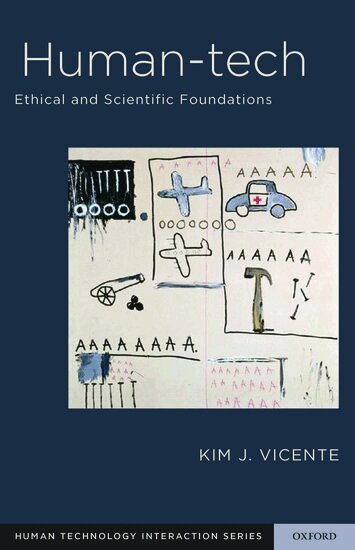
In The Human Factor, Kim Vicente coined the term 'Human-tech' to describe a more encompassing and ambitious approach to the study of Human-Technology Interaction (HTI) than is now evident in any of its participating disciplines, such as human factors, human-computer interaction, cognitive science and engineering, industrial design, informatics or applied psychology. Observing that the way forward is 'not by widgets alone,' Vicente's Human-tech approach addresses every level--physical, psychological, team, organizational, and political--at which technology impacts quality of life, identifies a human or societal need, and then tailors technology to what we know about human nature at that level. The Human Factor was written for a broad audience, in part to educate general readers beyond the HTI community about the need to think seriously about the tremendous impact that poorly designed technology can have, ranging from user frustration to the tragic loss of human life. The articles collected in this book provide much of the technical material behind the work that was presented in The Human Factor, and the commentaries by Alex Kirlik situate these articles in their broader historical, scientific and ethical context. This collection of articles and commentaries forms a set of recommendations for how HTI research ought to broaden both its perspective and its practical, even ethical, aspirations to meet the increasingly complicated challenges of designing technology to support human work, to improve quality of life, and to design the way will live with technology. As the first book both to integrate the theory and research underlying Human-tech, and to clearly delineate the scientific challenges and ethical responsibilities that await those who either design technology for human use, or design technology that influences or even structures the working or daily lives of others, Human-tech: Ethical and Scientific Foundations will appeal to the broad range of students and scholars in all of the HTI disciplines.