Mathematical World – serie
Visar alla böcker i serien Mathematical World. Handla med fri frakt och snabb leverans.
29 produkter
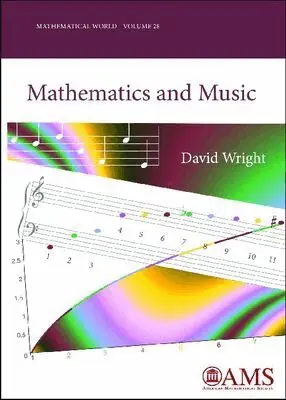
Mathematics and Music
Av David Wright
Häftad, 2009
819 kr
Lägg i varukorg
Many people intuitively sense that there is a connection between mathematics and music. If nothing else, both involve counting. There is, of course, much more to the association. David Wright's book is an investigation of the interrelationships between mathematics and music, reviewing the needed …
Stories About Maxima and Minima
Av American Mathematical Society
Häftad, 1991
556 kr
Lägg i varukorg
Throughout the history of mathematics, maximum and minimum problems have played an important role in the evolution of the field. Many beautiful and important problems have appeared in a variety of branches of mathematics and physics, as well as in other fields of sciences. The greatest scientists …
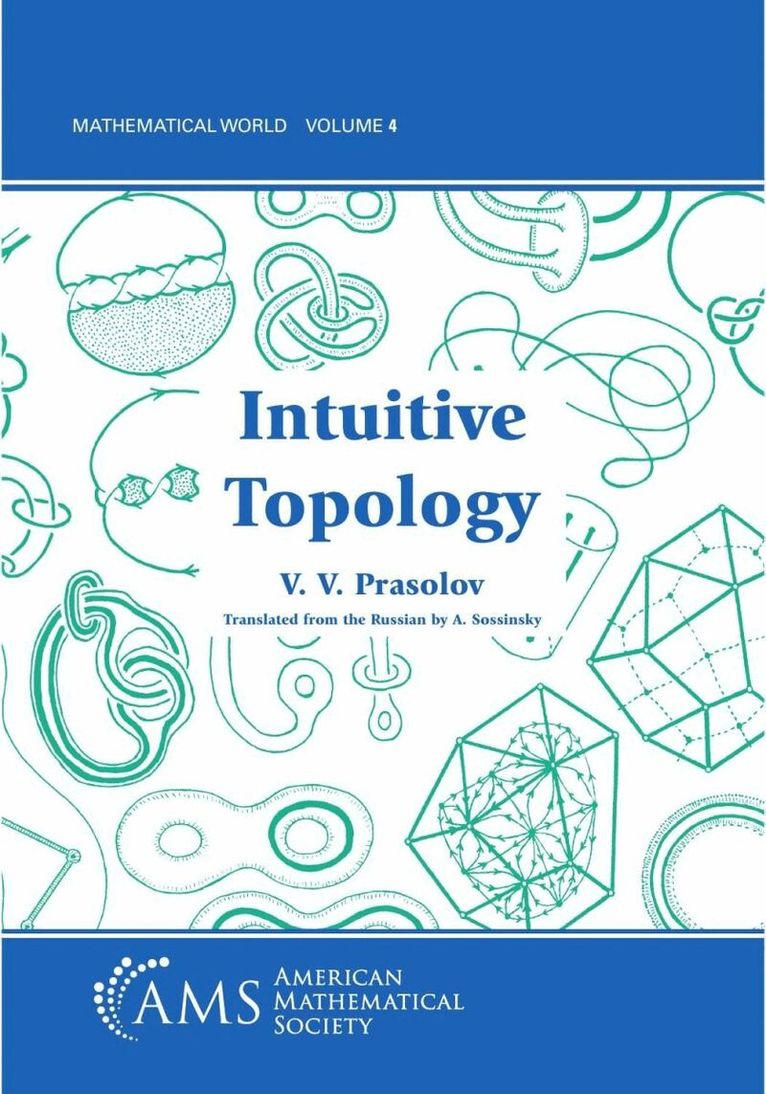
Intuitive Topology
Av American Mathematical Society
Häftad, 1994
556 kr
Lägg i varukorg
This book is an introduction to elementary topology presented in an intuitive way, emphasizing the visual aspect. Examples of nontrivial and often unexpected topological phenomena acquaint the reader with the picturesque world of knots, links, vector fields, and two-dimensional surfaces. The book …
Groups and Symmetry
A Guide to Discovering Mathematics
Av D.W. Farmer
Häftad, 1995
556 kr
Lägg i varukorg
In most mathematics textbooks, the most exciting part of mathematics - the process of invention and discovery - is completely hidden from the reader. The aim of ""Groups and Symmetry"" is to change all that. By means of a series of carefully selected tasks, this book leads readers to discover some …
Knots and Surfaces
A Guide to Discovering Mathematics
Av D.W. Farmer, Theodore B. Stanford
Häftad, 1995
556 kr
Lägg i varukorg
In most mathematics textbooks, the most exciting part of mathematics - the process of invention and discovery - is completely hidden from the reader. The aim of ""Knots and Surfaces"" is to change all that. By means of a series of carefully selected tasks, this book leads readers to discover some …
Basic Analysis
Japanese Grade 11
Häftad, 1996
598 kr
Lägg i varukorg
This is the translation of the Japanese textbook for the grade 11 course, 'Basic Analysis', which is one of three elective courses offered at this level in Japanese high schools. The book includes a thorough treatment of exponential, logarithmic, and trigonometric functions, progressions, and …
Mathematics 2
Japanese Grade 11
Häftad, 1996
795 kr
Lägg i varukorg
This is the translation from the Japanese textbook for the grade 11 course, 'General Mathematics'. It is part of the easier of the three elective courses in mathematics offered at this level and is taken by about 40 per cent of students. The book covers basic notions of probability and statistics, …
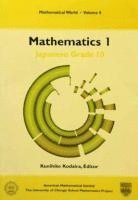
Mathematics 1
Japanese Grade 10
Av American Mathematical Society
Häftad, 1996
795 kr
Lägg i varukorg
The achievement of Japanese high school students gained world prominence largely as a result of their performance in the International Mathematics Studies conducted by the International Association for the Evaluation of Educational Achievement in the 1960s and 1980s. These textbooks (Mathematical …
Algebra in Ancient and Modern Times
Häftad, 1998
598 kr
Lägg i varukorg
This text offers a special account of Indian work in diophantine equations during the 6th through 12th centuries and Italian work on solutions of cubic and biquadratic equations from the 11th through 16th centuries. The volume traces the historical development of algebra and the theory of equations …
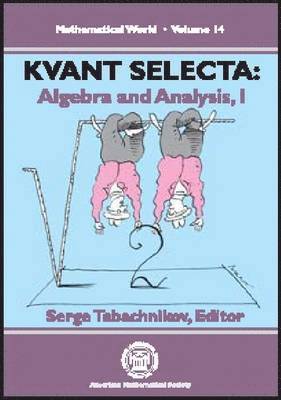
Kvant Selecta, Part 1
Algebra and Analysis
Av American Mathematical Society
Häftad, 1999
598 kr
Lägg i varukorg
This volume and ""Kvant Selecta: Algebra and Analysis, II"" (MAWRLD/15) are the first volumes of articles published from 1970 to 1990 in the Russian journal, ""Kvant"". The influence of this magazine on mathematics and physics education in Russia is unmatched. This collection represents the Russian …
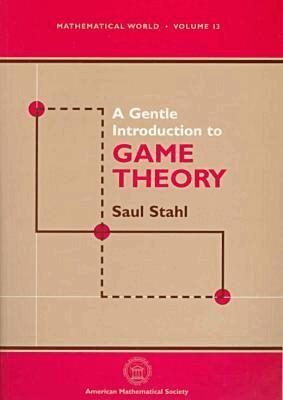
Gentle Introduction to Game Theory
Av American Mathematical Society
Häftad, 1998
598 kr
Lägg i varukorg
The mathematical theory of games was first developed as a model for situations of conflict, whether actual or recreational. It gained widespread recognition when it was applied to the theoretical study of economics by von Neumann and Morgenstern in Theory of Games and Economic Behavior in the …
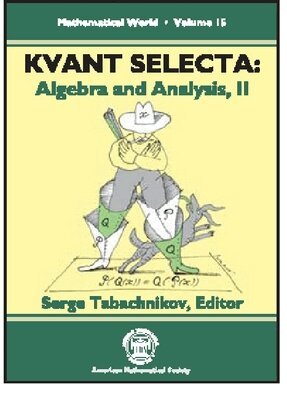
Kvant Selecta
Av American Mathematical Society
Häftad, 1999
598 kr
Lägg i varukorg
This volume and ""Kvant Selecta: Algebra and Analysis, I"" (""MAWRLD/14"") are the first volumes of articles published from 1970 to 1990 in the Russian journal, ""Kvant"". The influence of this magazine on mathematics and physics education in Russia is unmatched. This collection represents the …
Essays on Numbers and Figures
Av American Mathematical Society
Häftad, 2000
485 kr
Lägg i varukorg
This is the English translation of the book originally published in Russian. It contains 20 essays, each dealing with a separate mathematical topic. The topics range from brilliant mathematical statements with interesting proofs, to simple and effective methods of problem-solving, to interesting …
Kvant Selecta, Volume 1
Combinatorics
Av American Mathematical Society
Häftad, 2001
795 kr
Lägg i varukorg
There is a tradition in Russia that holds that mathematics can be both challenging and fun. One fine outgrowth of that tradition is the magazine, ""Kvant"", which has been enjoyed by many of the best students since its founding in 1970. The articles in ""Kvant"" assume only a minimal background, …
Portraits of the Earth
A Mathematician Looks at Maps
Häftad, 2002
598 kr
Lägg i varukorg
'Every map is a tool, a product of human effort and creativity, that represents some aspects of our world or universe...[This] course was powered by the belief that by exploring the mathematical ideas involved in creating and analyzing maps, students would see how mathematics could help them to …
Mathematical Gift, Volume 1
The Interplay Between Topology, Functions, Geometry, and Algebra
Av American Mathematical Society
Häftad, 2003
795 kr
Lägg i varukorg
This book will bring the beauty and fun of mathematics to the classroom. It offers serious mathematics in a lively, reader-friendly style. Included are exercises and many figures illustrating the main concepts. The first chapter presents the geometry and topology of surfaces. Among other topics, …
Mathematical Gift, Volume 2
The Interplay Between Topology, Functions, Geometry, and Algebra
Av American Mathematical Society
Häftad, 2004
795 kr
Lägg i varukorg
This book brings the beauty and fun of mathematics to the classroom. It offers serious mathematics in a lively, reader-friendly style. Included are exercises and many figures illustrating the main concepts. The first chapter talks about the theory of trigonometric and elliptic functions. It …
Mathematical Gift, Volume 3
The Interplay Between Topology, Functions, Geometry, and Algebra
Av American Mathematical Society
Häftad, 2005
795 kr
Lägg i varukorg
This book brings the beauty and fun of mathematics to the classroom. It offers serious mathematics in a lively, reader-friendly style. Included are exercises and many figures illustrating the main concepts. The first chapter talks about the theory of manifolds. It includes discussion of smoothness, …
Mathematical Ciphers
From Caesar to RSA
Av American Mathematical Society
Häftad, 2006
598 kr
Lägg i varukorg
A cipher is a scheme for creating coded messages for the secure exchange of information. Throughout history, many different coding schemes have been devised. One of the oldest and simplest mathematical systems was used by Julius Caesar. This is where ""Mathematical Ciphers"" begins. Building on …
Mathematical Gift, Volume 1-3
The Interplay Between Topology, Functions, Geometry, and Algebra
Av Morita Shigeyuki, Shiga Koji m. fl.
Häftad, 2005
1752 kr
Lägg i varukorg
This three-volume set addresses the interplay between topology, functions, geometry, and algebra. Bringing the beauty and fun of mathematics to the classroom, the authors offer serious mathematics in a lively, reader-friendly style. Included are exercises and many figures illustrating the main …
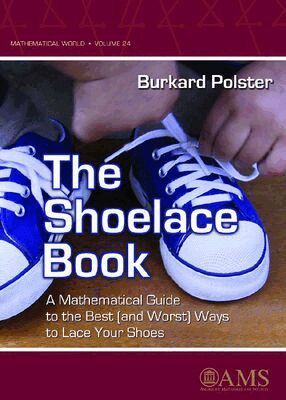
Shoelace Book
A Mathematical Guide to the Best (and Worst) Ways to Lace Your Shoes
Häftad, 2006
598 kr
Lägg i varukorg
Crisscross, zigzag, bowtie, devil, angel, or star: which are the longest, the shortest, the strongest, and the weakest lacings? Pondering the mathematics of shoelaces, the author paints a vivid picture of the simple, beautiful, and surprising characterizations of the most common shoelace patterns. …
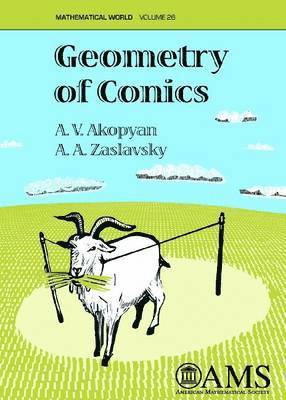
Geometry of Conics
Av American Mathematical Society
Häftad, 2007
598 kr
Lägg i varukorg
The book is devoted to the properties of conics (plane curves of second degree) that can be formulated and proved using only elementary geometry. Starting with the well-known optical properties of conics, the authors move to less trivial results, both classical and contemporary. In particular, the …
Introduction to the History of Algebra
Solving Equations from Mesopotamian Times to the Renaissance
Häftad, 2009
795 kr
Lägg i varukorg
'This text should not be viewed as a comprehensive history of algebra before 1600, but as a basic introduction to the types of problems that illustrate the earliest forms of algebra. It would be particularly useful for an instructor who is looking for examples to help enliven a course on elementary …
Mathematics of Encryption
An Elementary Introduction
Av Margaret Cozzens, Steven J. Miller
Häftad, 2013
795 kr
Lägg i varukorg
How quickly can you compute the remainder when dividing $109837^{97}$ by 120143? Why would you even want to compute this? And what does this have to do with cryptography? Modern cryptography lies at the intersection of mathematics and computer sciences, involving number theory, algebra, …
Fixed Points
Av American Mathematical Society
Häftad, 1991
556 kr
Lägg i varukorg
The theory of fixed points finds its roots in the work of Poincare, Brouwer, and Sperner and makes extensive use of such topological notions as continuity, compactness, homotopy, and the degree of a mapping. Fixed point theorems have numerous applications in mathematics; most of the theorems …
Mathematics and Sports
Av L. E. Sadovskiĭ, A. L. Sadovskiĭ
Häftad, 1993
556 kr
Lägg i varukorg
This unique book presents simple mathematical models of various aspects of sports with applications to sports training and competitions. Requiring only a background in precalculus, it would be suitable as a textbook for courses in mathematical modeling and operations research at the high school or …
Mathematics of Voting and Elections: a Hands-on Approach
Av Jonathan K. Hodge, Richard E. Klima
Häftad, 2018
795 kr
Lägg i varukorg
The Mathematics of Voting and Elections: A Hands-On Approach, Second Edition, is an inquiry-based approach to the mathematics of politics and social choice. The aim of the book is to give readers who might not normally choose to engage with mathematics recreationally the chance to discover some …
Integer and Polynomial Algebra
Av Kenneth R. Davidson, Matthew Satriano
Häftad, 2024
795 kr
Lägg i varukorg
This book is a concrete introduction to abstract algebra and number theory. Starting from the basics, it develops the rich parallels between the integers and polynomials, covering topics such as Unique Factorization, arithmetic over quadratic number fields, the RSA encryption scheme, and finite …
Mathematical Circles
(Russian Experience)
Av Dmitri Fomin, Sergey Genkin m. fl.
Häftad, 1996
795 kr
Tillfälligt slut
'This is a sample of rich Russian mathematical culture written by professional mathematicians with great experience in working with high school students...Problems are on very simple levels, but building to more complex and advanced work...contains solutions to almost all problems; methodological …