New Directions in Contemporary Art - Böcker
Visar alla böcker i serien New Directions in Contemporary Art. Handla med fri frakt och snabb leverans.
9 produkter
9 produkter
374 kr
Skickas inom 5-8 vardagar
Performance in the Museum charts the main stages of the inclusion of performance in the museum from the 1960s to the present day, offering a thought-provoking and highly readable assessment of some fundamental questions in contemporary curatorial practice. While performance emerged in the late 1960s as an anti-institutional form of art, it has recently gained an extraordinary visibility in contemporary art museums. This book focuses on four specific areas affecting museums: the staging of live performance within exhibitions; the conservation of performance; the acquisition of performance works; and research on performance. What emerges from this study is that the museum, although rarely anticipating the specific issues raised by performance, has assumed a unique position in devising curatorial strategies adapted to this medium.Through close analysis of a selection of exhibitions and curatorial practices from many different parts of the world, and from specific periods from the past sixty years, this book identifies key moments of the integration of performance into the museum. Despite the recent surge of exhibitions on performance and the part played by museums in this phenomenon, the history of the display, the conservation and the acquisition of live performance has remained largely uncharted. This book therefore makes an essential contribution to both the history of performance and curatorial studies.
254 kr
Skickas inom 5-8 vardagar
Biennials: The Exhibitions We Love to Hate examines one of the most significant recent transitions in the contemporary-art world: the proliferation of large-scale international recurrent survey shows of contemporary art, commonly referred to as contemporary biennials. Since the mid-1980s biennials have been instrumental in shaping curating as an autonomous practice. They have also been responsible for substantially reconfiguring the art world and disrupting the existing value chain of the art market, which now relies on biennials as much as it does on major museums’ acquisitions and exhibitions.At the same time, the arrival of new biennials in various parts of the world has also been associated with some of the most palpable side-effects of globalization. Branded by some critics as dollar-generating leisure events and showcases for highly consumable works of art, biennials have been repeatedly accused of homogenizing artistic and curatorial practices and leading to a certain fatigue. This publication makes an essential contribution to a fascinating cultural debate.
254 kr
Skickas inom 5-8 vardagar
The Culture Factory: Architecture and the Contemporary Art Museum explores the key battlegrounds in the design of the contemporary-art museum, describing the intersection of art, aesthetics and politics at the highest levels, and the commitment of states, cities and wealthy individuals to the display of art. Global in scope, the book examines key examples from Europe and the Americas to contemporary China. It describes museum building as the projection of political power, but also as a desire to acquire power. So it is a book about ambitious peripheries as much as the traditional centres: Dundee and Bilbao as well as New York and Paris.It is commonplace to assume that the contemporary-art museum has become ever more spectacular, and the place of art ever more subservient within it. This book argues that a tendency to spectacle coexists with another equally powerful tendency, to make art museums that celebrate the artistic process, typically attempting to recreate the feeling of the artist's studio. That tendency is strongly represented in the designs for the Centre Georges Pompidou, completed in 1977, and arguably in the many contemporary art museums which have adapted former industrial buildings.Richard J. Williams's stimulating text includes many historical examples to illustrate how we got to where we are now, from the Centre Pompidou in Paris, to the Guggenheim museums in New York and Bilbao, London’s Tate Modern, Oscar Niemeyer's work in Brazil and beyond, and the 798 Art District in Beijing.
Memory Art in the Contemporary World
Confronting Violence in the Global South
Inbunden, Engelska, 2022
374 kr
Skickas inom 5-8 vardagar
Memory Art in the Contemporary World deals with the ever-expanding field of transnational memory art, which has emerged from a political need to come to terms with traumatic historical pasts, from the Holocaust to apartheid, colonialism, state terror and civil war. The book focuses on the work of several contemporary artists from beyond the Northern Transatlantic, including William Kentridge, Vivan Sundaram, Doris Salcedo, Nalini Malani and Guillermo Kuitca, all of whom reflect on historical situations specific to their own countries but in work which has been shown to have a transnational reach. Andreas Huyssen considers their dual investment in memories of state violence and memories of modernism as central to the affective power of their work.This thought-provoking and highly relevant book reflects on the various forms and critical potential of memory art in a contemporary world which both obsesses about the past, in the building of monuments and museums and an emphasis on retro and nostalgia in popular culture, and simultaneously fosters historical amnesia in increasingly flattened notions of temporality encouraged by the internet and social media.
254 kr
Skickas inom 5-8 vardagar
At a time where there are repeated claims of the impending demise of art criticism, The Ends of Art Criticism seeks to dispel these myths by arguing that the lack of a single dominant voice in criticism is not, as some believe, a weakness, but a strength, allowing previously marginalised voices and new global and political perspectives to come to the fore. An essential book for anyone interested in contemporary art criticism, The Ends of Art Criticism benefits from an author whose 30 years of experience as editor of Art Monthly magazine allows her to offer opinionated and thought-provoking insight into the many questions and debates surrounding current critical writing on art, including the relationship between artists and critics, the academicisation of critical discourse, and the relationship between art history and criticism.
374 kr
Skickas inom 5-8 vardagar
Since the global financial crash of 2008, artists have become increasingly engaged in a wide range of cultural activism targeted against capitalism, political authoritarianism, colonial legacies, gentrification, but also in opposition to their own exploitation. They have also absorbed and reflected forms of protest within their art practice itself. The Art of Activism and the Activism of Art maps, critiques, celebrates and historicises activist art, exploring its current urgency alongside the processes which have given rise to activism by artists, and activist forms of art.Author Gregory Sholette approaches his subject from the unusual dual perspective of commentator (as scholar and writer) and insider (as activist artist). He describes a new wave of activist art taking place not only within community-based protest groups, as it has for decades, but also amongst professionally trained, MFA-bearing art practitioners, many of whom, by choice or by circumstance, refuse to respect the conventional borders separating painting from protest, or art from utility. The book explores the subtle distinction between activist forms of art and protest by artists, and proposes that contemporary activist art and art activism constitute a broader paradigm shift that reflects the crisis of contemporary capitalism.
475 kr
Skickas
How are contemporary artists responding to the climate crisis? Filipa Ramos takes an original approach to the subject by addressing two parallel strands. She looks firstly at pioneering approaches to ecology by key contemporary artists from different generations and cultural backgrounds working in different art media; and she considers the balance between ecology as theme and ecology as practice, underscoring the imperative for both artists and art institutions to adopt responsible environmental positions in their practice.This topical and important book discusses the work of artists who have returned to the land; reviews how questions of shared rights and environmental justice are represented in contemporary artistic practice; highlights the renewed importance of performance and time-based media in ecologically themed art; and looks at artists’ and art institutions’ complex relationship to environmental action.
396 kr
Kommande
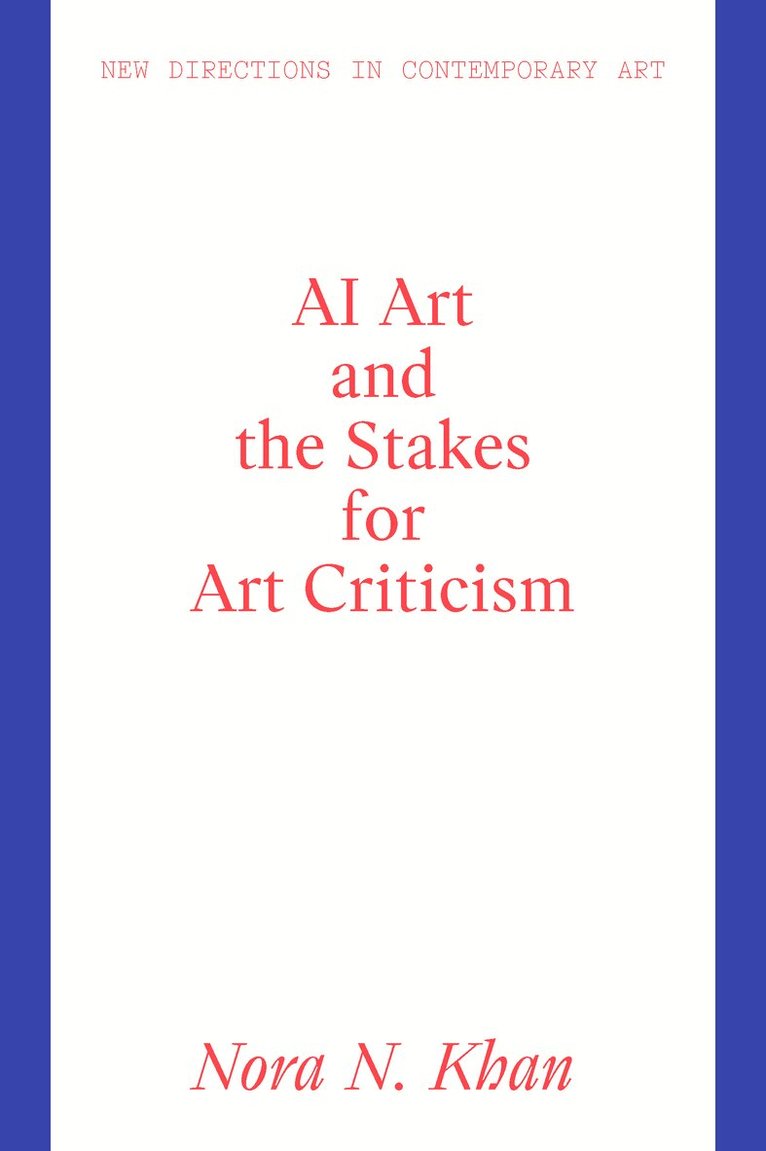
In an era when AI-generated images flood our screens and algorithms shape our visual culture, how do we critically evaluate art made by machines? Nora N. Khan's study cuts through the hype and mystification surrounding AI art to explore the field’s stakes for art criticism. The book attempts to move beyond describing machine-generated images as mere dreams or hallucinations to develop rigorous frameworks for their aesthetic evaluation. Khan traces both the complex entanglements of human creativity and machine intelligence, and the evolution of the critical framing of this specific relationship. Neither technophobic nor uncritically celebratory of art and images made with AI, she argues for the development of new critical competencies adequate to our algorithmic age, proposing that we read AI images not as autonomous machine visions but as mirrors reflecting our own visual culture back to us, distorted and recombined according to computational logic. Accessibly written, her book will be essential reading for critics, curators, artists, and anyone seeking to understand how artificial intelligence is reshaping the very terms of aesthetic experience and cultural production.
374 kr
Skickas inom 5-8 vardagar
Nina Möntmann's timely book extends the decolonisation debate to the institutions of contemporary art. In a thoughtfully articulated text, illustrated with pertinent examples of best practice, she argues that to play a crucial role within increasingly diverse societies museums and galleries of contemporary art have a responsibility to 'decentre' their institutions, removing from their collections, exhibition policies and infrastructures a deeply embedded Euro-centric cultural focus with roots in the history of colonialism. In this, she argues, they can learn from the example both of anthropological museums (such as the Rautenstrauch-Joest-Museum in Cologne), which are engaged in debates about the colonial histories of their collections, about trauma and repair, and of small-scale art spaces (such as La Colonie, Paris, ANO, Institute of Arts and Knowledge, Accra or Savvy Contemporary, Berlin), which have the flexibility, based on informal infrastructures, to initiate different kinds of conversation and collective knowledge production in collaboration with indigenous or local diasporic communities from the Global South.For the first time, this book identifies the influence that anthropological museums and small art spaces can exert on museums of contemporary art to initiate a process of decentring.