Oxford Mid-Century Studies Series – serie
Visar alla böcker i serien Oxford Mid-Century Studies Series. Handla med fri frakt och snabb leverans.
19 produkter
19 produkter
Inbunden, Engelska, 2022
1 498 kr
Skickas inom 5-8 vardagar
On the peripheries of UK poetry culture during his lifetime, W. S. Graham is now recognized one of the great poets of the twentieth century. In the first concerted study of Graham's poetics in a generation, David Nowell Smith argues that Graham is exemplary for the poetics of the mid-century: his extension of modernist explorations of rhythm and diction; his interweaving of linguistic and geographic places; his dialogue with the plastic arts; and the tensions that run through his work, between philosophical seriousness and play, solitude and sociality, regionalism and cosmopolitanism, the heft and evanescence of poetry's medium. Drawing on newly unearthed archival materials, Nowell Smith orients Graham's poetics around the question of the 'art object'. Graham sought to craft his poems into honed, finished 'objects'; yet he was also aware that the poem's 'finished object' is never wholly finished. Graham's work thus facilitates a broader reflection on language as a medium for art-making.
Inbunden, Engelska, 2023
1 299 kr
Skickas inom 5-8 vardagar
Literature and Justice in Mid Twentieth Century Britain: Crime and War Crimes examines how ideas about crime, criminality, and judicial procedure that had developed in a domestic context influenced the representation and understanding of war crimes trials, victims of war crimes, and war criminals in post-Second World War Britain. The representation of Belsen concentration camp and the subsequent British-run trial of its personnel are a particular focal point. Drawing on a range of source material including life-writing, journalism, and detective fiction, as well as criminological and sociological works from this period, this book explains why the fate of the Jews and other victims of the Nazis was sometimes brought starkly into focus and sometimes marginalised in public discourse at this period. What remain are glimpses of the events now called the Holocaust, but glimpses that can be as powerful and as meaningful as more direct or explicit representations.
Inbunden, Engelska, 2024
1 145 kr
Skickas inom 5-8 vardagar
Mid-Century Romance chronicles a revival of the historical novel in the middle decades of the twentieth century in the cultures of British modernism and international communism. Born of a national turn in world politics, these novels met the turbulence of mid-century history with narratives of national becoming, roadmaps to situate their readers in the pattern of social change. Their writers were often mindful of the genre's romantic-era heritage: they saw themselves as following in the footsteps of Sir Walter Scott and they drew on the same rescued remains of primitive poetry and popular antiquities that romanticism first used to construct its versions of national identity, culture, and tradition. This book shows how the impulse to salvage traces of ancestral culture and press them to new purpose links the mid-century national-historical novel to the rise of radical social history and magical realism.Post-war anticommunism shaped a tradition of the novel as a preserve of art and the individual. Mid-Century Romance counters with a different genealogy of the British and world novel, whose object is society and the future of community, the nation and its people. It situates its cast of British writers--including the modernists Hope Mirrlees and Virginia Woolf, the communists Jack Lindsay and Sylvia Townsend Warner, the eccentric modernist and sometime fellow traveller John Cowper Powys, and the New Left luminary Raymond Williams--in a transnational perspective that reaches from Bihar, India to Bahia, Brazil.
Inbunden, Engelska, 2024
1 375 kr
Skickas inom 5-8 vardagar
Frank O'Hara's New York School and Mid-Century Mannerism offers a ground-breaking account of the poet Frank O'Hara and the extraordinary cultural blossoming O'Hara catalysed, namely the mid-century experimental and multi-disciplinary arts scene, the New York School. Fresh accounts of canonical figures (Jackson Pollock, Willem de Kooning, George Balanchine, Fred Astaire) and original work on those too little discussed (Edwin Denby, Elaine de Kooning) resound with analysis of queer iconology from Michelangelo's David to James Dean. Sam Ladkin argues that O'Hara and the New York School revive Mannerism. Turning away from interpretations of O'Hara's Transcendentalism, Romanticism, or pastoralism, 'mid-century Mannerism' helps explain O'Hara's self-conscious style, its play with sweet and grand grace, contortion of conventional measure, risks with affectation, conceits, nonchalance, and scrambling of high/low culture. Mannerism clarifies the sociability implicit in the formal innovations of the New York School. The work also studies the kinship between art mediums by retooling rhetoric and recovering a perennial manneristic tendency beyond period style. Genealogies of grace, the figura serpentinata, sprezzatura, ornatus, and the marvellous exemplify qualities exhibited by O'Hara's New York School. Ladkin relates the essential role of dance in the New York School. O'Hara's reception has been tied to painting, predominantly Abstract Expressionism. He was also, however, a balletomane, a fan, for whom ballet was 'made up exclusively of qualities which other arts only aspire to in order to be truly modern.' Relaying ballet's Mannerist origins and aesthetics, and demonstrating its influence alongside Broadway and Hollywood musical-dance on art and poetry, completes the portrait of mid-century modernity.
Inbunden, Engelska, 2023
1 345 kr
Skickas inom 7-10 vardagar
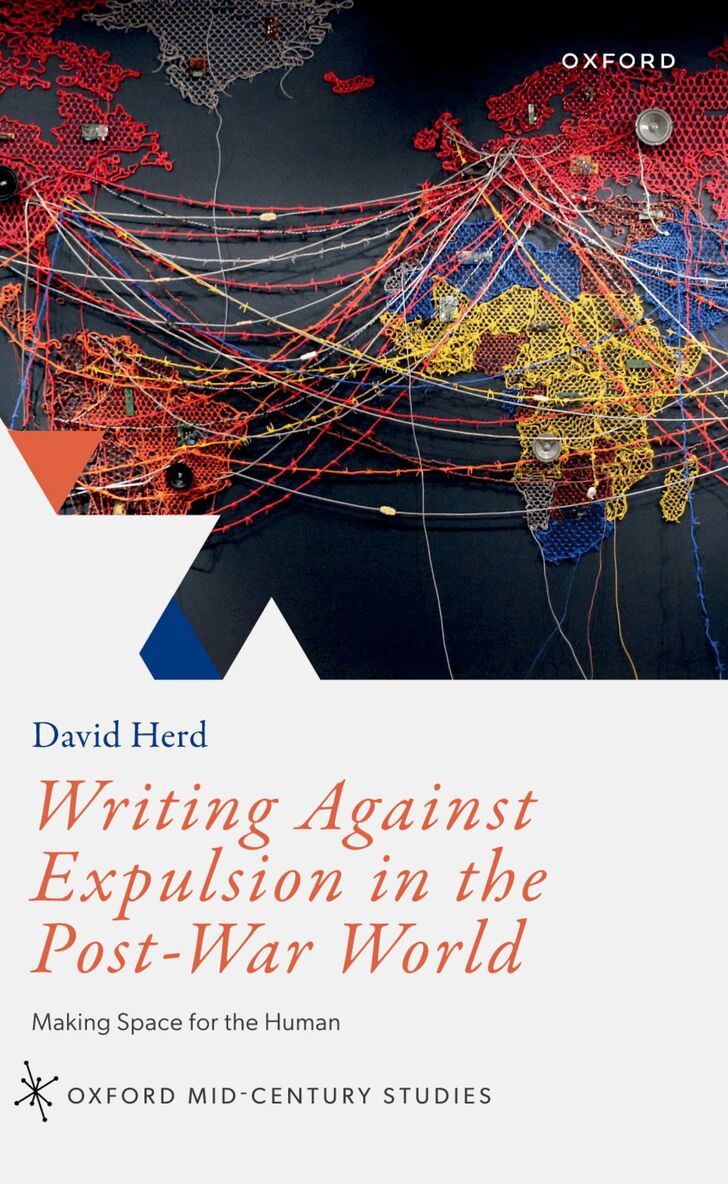
Writing Against Expulsion in the Post-War World: Making Space for the Human tells a pre-history of the Hostile Environment. The book's starting point is the rapidly escalating use of detention as a response to human movement and the global production of geopolitical non-personhood in which detention results. As a matter of urgency, the book argues, we need to understand what is at stake in such policies and to resist the world we are making when we detain and expel. Writing Against Expulsion returns to a post-war period when the brutal consequences of the politics of expulsion were visible and when it was clear to writers of all kinds that space for the human had to be made.Drawing on contemporary histories of forced displacement, eye witness accounts, international legal documents, and on a range of emblematic cross-disciplinary texts and authors — the Universal Declaration of Human Rights, the political philosophy of Hannah Arendt, the poetry of Charles Olson, the revolutionary theory of Frantz Fanon — the book shows how mid-century writers both documented the lived experience of expulsion and asserted ways of thinking and acting by which expulsion could be prevented. What emerged were new languages of rights and recognition — new accounts of Moving, Making and Speaking — through which the exclusions of nation and border could be countered.
Inbunden, Engelska, 2023
1 558 kr
Skickas inom 5-8 vardagar
The Promise of Welfare in the Postwar British Novel offers a new literary history of the Second World War and its aftermath by focusing on wartime visions of rebuilding Britain. Shifting attention from the "People's War" to the "People's Peace," this book shows that literature returns to the historic transition from warfare to welfare to narrate its transformative social potential and darker failures. The welfare state envisioned that managing individuals' private lives would result in a more coherent and equitable community, a promise encapsulated in the 1942 Beveridge Report's promise of care from the "cradle to the grave." The postwar novel reveals the intimate effects that follow when infrastructures of collective living seek to organize social interaction, tracing these effects through quasi-administrated home spaces such as girls' hostels, makeshift sanatoria, and experimental schools. Mid-century writers including Elizabeth Bowen, Muriel Spark, and Samuel Selvon used the militarized Home Front to present postwar Britain as a zone of lost privacy and new collective logics. As the century progressed, and as the unrealized dreams of welfare came to be dismantled, authors including Alan Hollinghurst, Michael Ondaatje, and Kazuo Ishiguro registered an unfulfilled nostalgia for a Britain that never was, situating British domestic policies within trajectories of historic and social violence. Contemporary fiction continues to reanimate the transition from a warfare state to a welfare state, preserving its transformative potential while redefining its possible futures. With this long view of postwar fiction, this volume demonstrates the holding power of welfare's promises of repair and Britain's mid-century on the British cultural imagination.
Inbunden, Engelska, 2021
1 421 kr
Skickas inom 5-8 vardagar
Whereas modernist writers lauded the consecrated realm of subjective interiority, mid-century writers were engrossed by the materialization of the collective mind. An obsession with group thinking was fuelled by the establishment of academic sociology and the ubiquitous infiltration of public opinion research into a bevy of cultural and governmental institutions. As authors witnessed the materialization of the once-opaque realm of public consciousness for the first time, their writings imagined the potentialities of such technologies for the body politic. Polling opened new horizons for mass politics. Public Opinion Polling in Mid-Century British Literature traces this most crucial period of group psychology's evolution--the mid-century--when "psychography," a term originating in Victorian spiritualism, transformed into a scientific praxis. The imbrication of British writers within a growing institutionalized public opinion infrastructure bolstered an aesthetic turn towards collectivity and an interest in the political ramifications of meta-psychological discourse. Examining works by H.G. Wells, Evelyn Waugh, Val Gielgud, Olaf Stapledon, Virginia Woolf, Naomi Mitchison, Celia Fremlin, Cecil Day-Lewis, and Elizabeth Bowen, this book utilizes extensive archival research to trace the embeddedness of writers within public opinion institutions, providing a fresh explanation for the new "material" turn so often associated with interwar writing.
Inbunden, Engelska, 2020
1 498 kr
Skickas inom 7-10 vardagar
Reconstructing Modernism establishes for the first time the centrality of modernist buildings and architectural periodicals to British mid-century literature. Drawing upon a wealth of previously unexplored architectural criticism by British authors, this book reveals how arguments about architecture led to innovations in literature, as well as to redesigns in the concept of modernism itself. While the city has long been a focus of literary modernist studies, architectural modernism has never had its due. Scholars usually characterize architectural modernism as a parallel modernism or even an incompatible modernism to literature. Giving special attention to dystopian classics Brave New World and Nineteen Eighty-Four, this study argues that sustained attention to modern architecture shaped mid-century authors' political and aesthetic commitments. After many writers deemed modernist architects to be agents for communism and other collectivist movements, they squared themselves--and literary modernist detachment and aesthetic autonomy--against the seemingly tyrannical utopianism of modern architecture; literary aesthetic qualities were reclaimed as political qualities. In this way, Reconstructing Modernism redraws the boundaries of literary modernist studies: rather than simply adding to its canon, it argues that the responsibility for defining literary modernism for the mid-century public was shared by an incredible variety of authors--Edwardians, modernists, satirists, and even anti-modernists.
Inbunden, Engelska, 2019
1 577 kr
Skickas inom 5-8 vardagar
Red Britain sets out a provocative rethinking of the cultural politics of mid-century Britain by drawing attention to the extent, diversity, and longevity of the cultural effects of the Russian Revolution. Drawing on new archival research and historical scholarship, this book explores the conceptual, discursive, and formal reverberations of the Bolshevik Revolution in British literature and culture. It provides new insight into canonical writers including Doris Lessing, George Orwell, Dorothy Richardson, H.G Wells, and Raymond Williams, as well bringing to attention a cast of less-studied writers, intellectuals, journalists, and visitors to the Soviet Union. Red Britain shows that the cultural resonances of the Russian Revolution are more far-reaching and various than has previously been acknowledged. Each of the five chapters takes as its subject one particular problem or debate, and investigates the ways in which it was politicised as a result of the Russian Revolution and the subsequent development of the Soviet state. The chapters focus on the idea of the future; numbers and arithmetic; law and justice; debates around agriculture and landowning; and finally orality, literacy, and religion. In all of these spheres, Red Britain shows how the medievalist, romantic, oral, pastoral, anarchic, and ethical emphases of English socialism clashed with, and were sometimes overwritten by, futurist, utilitarian, literate, urban, statist, and economistic ideas associated with the Bolshevik Revolution.
Inbunden, Engelska, 2018
482 kr
Skickas inom 5-8 vardagar
Before his masterpiece The Rise of the Novel made him one of the most influential post-war British literary critics, Ian Watt was a soldier, a prisoner of war of the Japanese, and a forced labourer on the notorious Burma-Thailand Railway. Both an intellectual biography and an intellectual history of the mid-century, this book reconstructs Watt's wartime world: these were harrowing years of mass death, deprivation, and terror, but also ones in which communities and institutions were improvised under the starkest of emergency conditions. Ian Watt: The Novel and the Wartime Critic argues that many of our foundational stories about the novel—about the novel's origins and development, and about the social, moral, and psychological work that the novel accomplishes—can be traced to the crises of the Second World War and its aftermath.
Inbunden, Engelska, 2018
1 163 kr
Skickas inom 5-8 vardagar
During and after the Second World War, there was a concerted thinking about religion in Britain. Not only were leading international thinkers of the day theologians--Ronald Niebuhr, Paul Tillich, Jacques Maritain--but leading writers contributed to discussions about religion. Graham Greene, Muriel Spark, and Barbara Pym incorporated miracles, evil, and church-going into their novels, while Louis MacNeice, T. S. Eliot, and C. S. Lewis gave radio broadcasts about the role of Christianity in contemporary society. Certainly the war revived interest in aspects of Christian life. Salvation and redemption were on many people's minds. The Ministry of Information used images of bombed churches to stoke patriotic fervour, and King George VI led a series of Days of National Prayer that coincided with crucial events in the Allied campaign. After the war and throughout the 1950s, approximately 1.4 million Britons converted to Roman Catholicism as a way of expressing their spiritual ambitions and solidarity with humanity on a world-wide scale. Religion provided one way for writers to answer the question, 'what is man?' It also afforded ways to think about social obligation and ethical engagement. Moreover, the mid-century turn to religion offered ways to articulate statehood, not from the perspective of nationhood and politics, but from the perspective of moral action and social improvement. Instead of being a retreat into seclusion and solitude, the mid-century turn to religion is a call to responsibility.
Inbunden, Engelska, 2020
1 498 kr
Skickas inom 7-10 vardagar
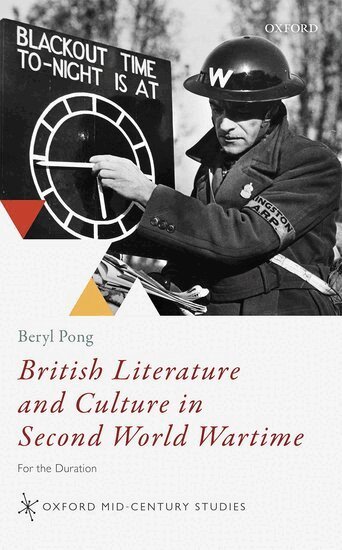
British Literature and Culture in Second World Wartime excavates British late modernism's relationship to war in terms of chronophobia: a joint fear of the past and future. As a wartime between, but distinct from, those of the First World War and the Cold War, Second World wartime involves an anxiety that is both repetition and imaginary: both a dread of past violence unleashed anew, and that of a future violence still ungraspable. Identifying a constellation of temporalities and affects under three tropes--time capsules, time zones, and ruins--this volume contends that Second World wartime is a pivotal moment when wartime surpassed the boundaries of a specific state of emergency, becoming first routine and then open-ended. It offers a synoptic, wide-ranging look at writers on the home front, including Henry Green, Elizabeth Bowen, Virginia Woolf, and Rose Macaulay, through a variety of genres, such as life-writing, the novel, and the short story. It also considers an array of cultural and archival material from photographers such as Cecil Beaton, filmmakers such as Charles Crichton, and artists such as John Minton. It shows how figures harnessed or exploited their media's temporal properties to formally register the distinctiveness of this wartime through a complex feedback between anticipation and retrospection, oftentimes fashioning the war as a memory, even while it was taking place. While offering a strong foundation for new readers of the mid-century, the book's overall theoretical focus on chronophobia will be an important intervention for those already working in the field.
Inbunden, Engelska, 2021
1 202 kr
Skickas inom 5-8 vardagar
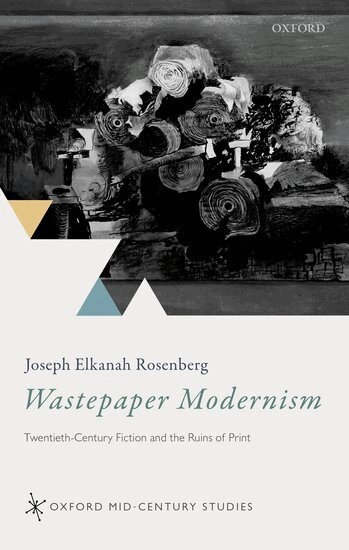
From Henry James' fascination with burnt manuscripts to destroyed books in the fiction of the Blitz; from junk mail in the work of Elizabeth Bowen to bureaucratic paperwork in Vladimir Nabokov; modern fiction is littered with images of tattered and useless paper that reveal an increasingly uneasy relationship between literature and its own materials over the course of the twentieth-century. Wastepaper Modernism argues that these images are vital to our understanding of modernism, disclosing an anxiety about textual matter that lurks behind the desire for radically different modes of communication. At the same time that writers were becoming infatuated with new technologies like the cinema and the radio, they were also being haunted by their own pages. Having its roots in the late-nineteenth century, but finding its fullest constellation in the wake of the high modernist experimentation with novelistic form, "wastepaper modernism" arises when fiction imagines its own processes of transmission and representation breaking down. When the descriptive capabilities of the novel exhaust themselves, the wastepaper modernists picture instead the physical decay of the book's own primary matter. Bringing together book history and media theory with detailed close reading, Wastepaper Modernism reveals modernist literature's dark sense of itself as a ruin in the making.
Inbunden, Engelska, 2024
1 206 kr
Skickas inom 5-8 vardagar
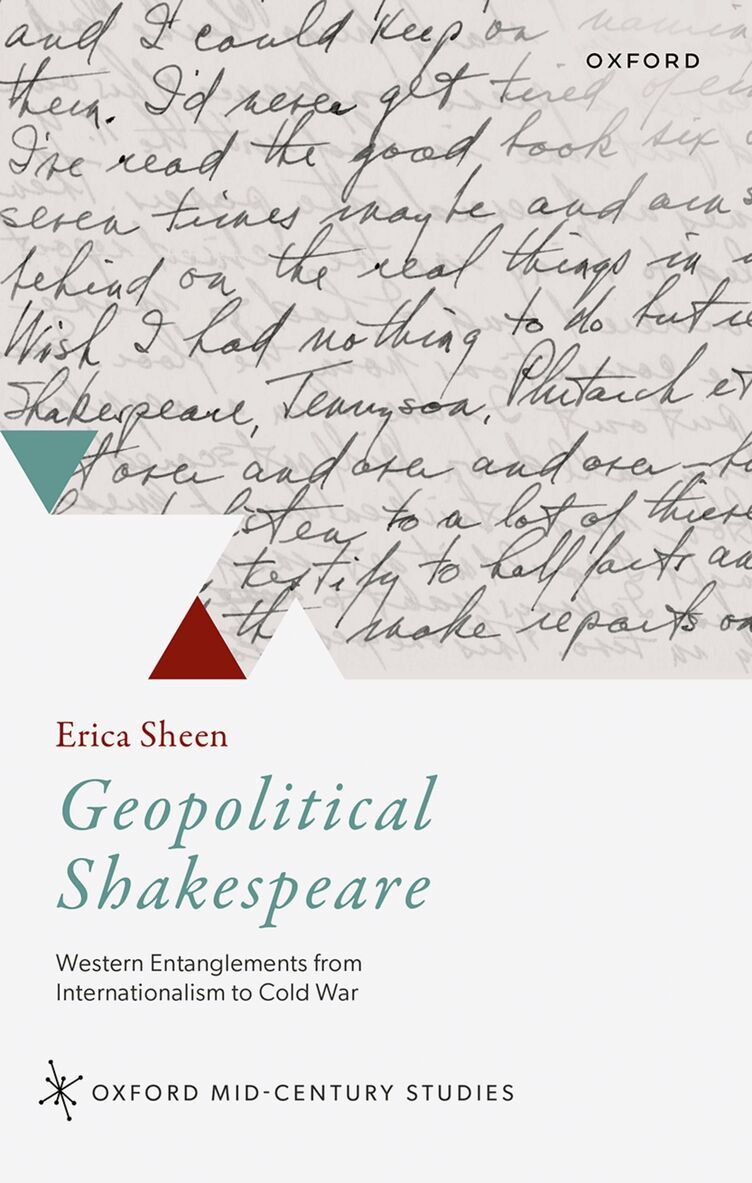
Geopolitical Shakespeare: Western Entanglements from Internationalism to Cold War examines the entanglement of Shakespearean culture in the geopolitical dynamics of the post-war West. Taking its cue from a speech given by Albert Einstein in London in 1933, in which Shakespeare is cited as an example of the Western value of personal and intellectual freedom, this book explores a series of events between 1945 and 1955 featuring key historical figures--scientists, international lawyers, diplomats and politicians, writers, actors, and filmmakers--who experienced the tensions of the early Cold War through Shakespeare, or called on him to articulate this new post-war world. Erica Sheen examines political, diplomatic, cultural, and economic interactions within 'core' Western power relations--the USA, UK, and Europe, with particular reference to Germany--in which Shakespeare, or the idea of Shakespeare, was entangled in the struggle for new ideas and social structures.The subjects of this book include John Humphrey and the drafting of the Universal Declaration of Human Rights; the Nuremberg Trials and the foundation of West Germany; Noel Annan and the Berlin Elizabethan Festival; an American production of Hamlet in Elsinore; Laurence Olivier, David Selznick, and the Shakespeare film in post-war Hollywood; Graham Greene and The Third Man; and Carl Schmitt and Salvador de Madariaga on Hamlet in post-war Europe. In each of these case studies, Sheen discovers a Shakespeare for our time: engaged in contestations of territoriality in cultures of international law and human rights, theatre, film, and literature.
Inbunden, Engelska, 2024
1 631 kr
Skickas
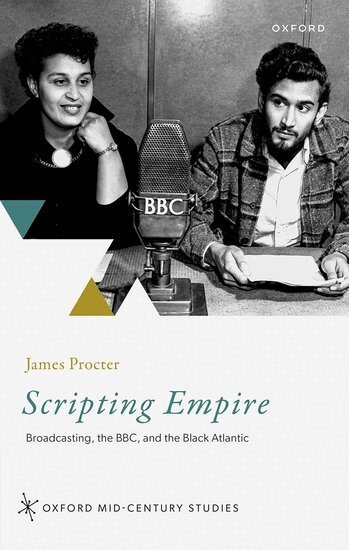
Scripting Empire recovers the literary and cultural history of West Indian and West African writing at the BBC in order to rethink the critical mid-century decades of shrinking British sovereignty, late modernism, and mass migration to the metropole. Between the 1930s and the 1960s, a remarkable group of black Atlantic artists and intellectuals became producers, editors, and freelancers at the corporation, including Una Marson, Langston Hughes, Louise Bennett, Wole Soyinka, Derek Walcott, Amos Tutuola, V.S. Naipaul, Sam Selvon, Cyprian Ekwensi, Stuart Hall, and C.L.R. James. Operating at the interface of a range of literary and broadcast genres, this loose network of African Caribbean writers and thinkers prompt a reassessment of the aesthetic, formal, and political fallout of decolonization between the outbreak of World War II and the first airings of post-colonial independence. Scripting Empire works comparatively across dozens of different programmes spanning the General Overseas Service, Home Service, Light Programme, and Third Programme. Drawing upon a transnational archive of materials including scripts, correspondence, periodicals, visual records, and sound recordings, it seeks to re-position the cultural contribution of West Indians and West Africans within a more pervasive and porous account of radio transmission, the legacy of which extends well beyond broadcasting.
Inbunden, Engelska, 2025
1 202 kr
Skickas inom 5-8 vardagar
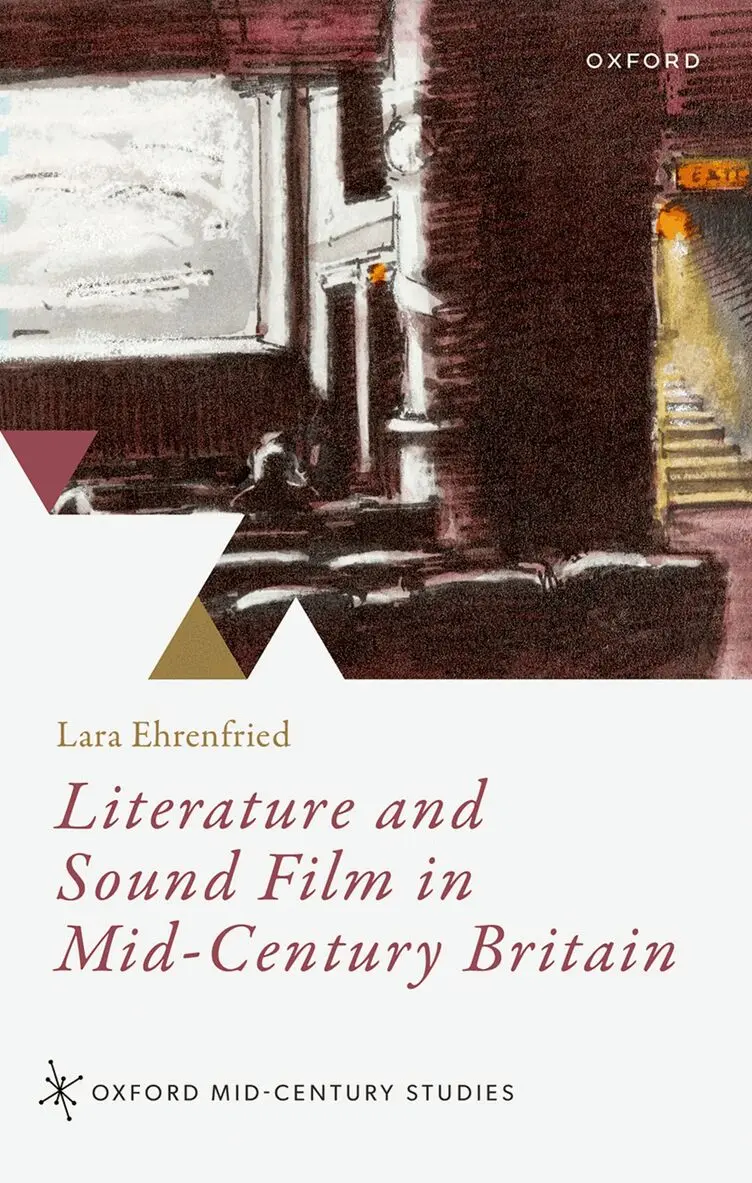
What happened to cinema and literature when synchronized sound was introduced to the film industry in the late 1920s? Literature and Sound Film in Mid-Century Britain studies the paths of film and text following this event. It asks how British cinema responded to the introduction of sound and how mid-century literature took up the challenge of the synchronized, audio-visual entertainment experience offered by this media change. By examining the technological and industrial histories of film and its narrative strategies and by drawing links to twentieth-century literary culture, this study offers a new way of approaching mid-century writing and its media ecology. Developing innovative, audio-visual close readings, this book offers a multi-sensory, multi-media approach that reframes the relationships between cinema and literature in the twentieth century. The study addresses a wide range of film genres, such as musical film, screwball comedy, the thriller, documentary, and melodrama alongside the writings of a large group of authors including Elizabeth Bowen, Patrick Hamilton, Evelyn Waugh, Lewis Grassic Gibbon, Henry Green, Jean Rhys, Ivy Compton-Burnett, and Eric Ambler. It covers an expansive range of films and texts of the 1930s and 1940s and invites readers to comprehensively rethink mid-century media culture by arguing for a growing synergy of film and text.
Inbunden, Engelska, 2026
1 421 kr
Skickas inom 5-8 vardagar
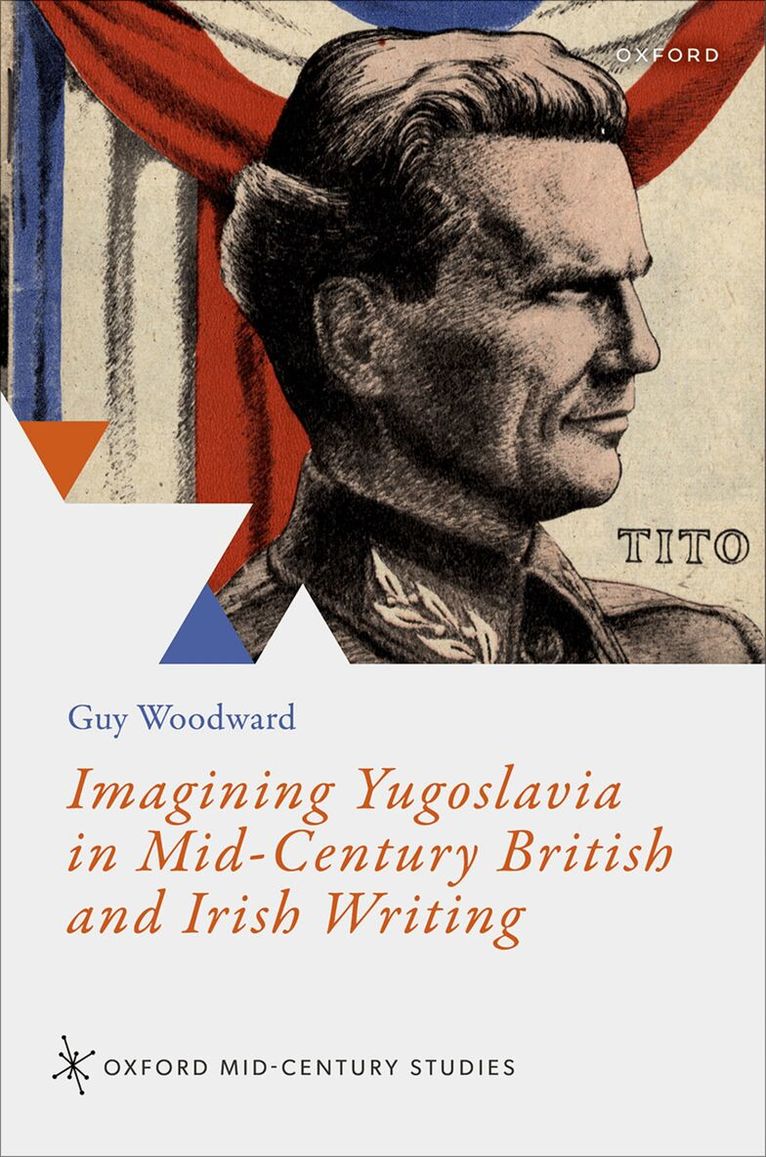
During the Second World War, Britain was both strategically and imaginatively invested in Yugoslavia. The Balkan state was celebrated and idealized in home front propaganda as a site of resistance, a locus of spirituality, and then as a brave communist experiment containing the promise of utopia. After the war, many hailed Tito's Yugoslavia as an exceptional socialist society steering a course between the extremes of western free-market capitalism and Soviet repression, while others cursed the regime as totalitarian, or mourned the loss of a picturesque Ruritanian kingdom to a communist regime. From the BBC to Ealing Studios, from special operations memoirs to Cold War travelogues, this book explores and interrogates a peculiar fascination with Yugoslavia in mid-twentieth-century British and Irish literature and culture. Exploring representations of Yugoslavia in print, over the airwaves and on screen, it examines how and why many of the key British and Irish writers of the era became drawn into military and political debates around the fate of the country. The cast of characters is extensive and colourful, and includes Rebecca West, author of the colossal modernist travelogue Black Lamb and Grey Falcon (1941), the broadcaster and dramatist Denis Johnston, the poet and radio dramatist Louis MacNeice, novelists Lawrence Durrell and Anthony Powell, the historian E. P. Thompson, essayist Hubert Butler, special operations agent turned Conservative MP Fitzroy Maclean, and the Labour politicians Nye Bevan and Barbara Castle. Projections of other countries reveal much about culture and politics closer to home: by tracing the various roles played by this now-extinct Balkan state in the cultural imaginations of the declining imperial metropole and its former colony, this new cultural history illuminates forgotten lines of transmission between north-west and south-east Europe. Drawing on extensive archival research, Imagining Yugoslavia in Mid-Century British and Irish Writing is the first dedicated study of British and Irish cultural engagement with Yugoslavia in this period and makes a serious contribution to the cultural and intellectual history of the Second World War and Cold War.
Häftad, Engelska, 2025
315 kr
Skickas inom 5-8 vardagar
Writing Against Expulsion in the Post-War World: Making Space for the Human tells a pre-history of the Hostile Environment. The book's starting point is the rapidly escalating use of detention as a response to human movement and the global production of geopolitical non-personhood in which detention results. As a matter of urgency, the book argues, we need to understand what is at stake in such policies and to resist the world we are making when we detain and expel. Writing Against Expulsion returns to a post-war period when the brutal consequences of the politics of expulsion were visible and when it was clear to writers of all kinds that space for the human had to be made.Drawing on contemporary histories of forced displacement, eye witness accounts, international legal documents, and on a range of emblematic cross-disciplinary texts and authors — the Universal Declaration of Human Rights, the political philosophy of Hannah Arendt, the poetry of Charles Olson, the revolutionary theory of Frantz Fanon — the book shows how mid-century writers both documented the lived experience of expulsion and asserted ways of thinking and acting by which expulsion could be prevented. What emerged were new languages of rights and recognition — new accounts of Moving, Making and Speaking — through which the exclusions of nation and border could be countered.
Inbunden, Engelska, 2026
1 421 kr
Kommande
British Writers in Occupied Germany offers an original account of the contribution of British mid-century writers and their works to the moral, political, and intellectual re-orientation of Germany after World War II (1945^–^55), as well as an examination of the literature that emerged from the encounters these writers had with the defeated country. At a moment when interest in the socio-political agency of the writer and the function of literature is intensifying, this book revaluates mid-century writers such as Stephen Spender, T. S. Eliot, and Elizabeth Bowen and their commitment to democratizing postwar Germany. Drawing on a wide range of previously overlooked archival material, it explores what motivated these writers, which forms their engagement took, which institutions propagated their activities, and to what extent the 'projection of Britain' in occupied Germany was influenced by British experiences in the colonies, where literature had been viewed as a valuable means of guidance and the shaping of character. Through its analysis of some of the earliest accounts of British-German encounters against the backdrop of the devastation of the war, the book furthermore changes what we think we know about the British postwar understanding of the Germans and of the British self-image. When reconsidered in the light of this history, the ruins of Germany (particularly those of Nuremberg) emerge not only as tropes of decay and death, but also as prompts used by mid-century British writers to remember Germany's multi-layered past and to contemplate the future that must inevitably be shaped by that past and its ruins.