Perspectives in Cognitive Neuroscience - Böcker
Visar alla böcker i serien Perspectives in Cognitive Neuroscience. Handla med fri frakt och snabb leverans.
6 produkter
6 produkter
Del 6 - Perspectives in Cognitive Neuroscience
Hemispheric Asymmetry
What's Right and What's Left
Häftad, Engelska, 2001
494 kr
Skickas inom 10-15 vardagar
Is "right-brain" thought essentially creative, and "left-brain" strictly logical? Joseph B. Hellige argues that this view is far too simplistic. Surveying extensive data in the field of cognitive science, he disentangles scientific facts from popular assumptions about the brain's two hemispheres.In Hemispheric Asymmetry, Hellige explains that the "right brain" and "left brain" are actually components of a much larger cognitive system encompassing cortical and subcortical structures, all of which interact to produce unity of thought and action. He further explores questions of whether hemispheric asymmetry is unique to humans, and how it might have evolved. This book is a valuable overview of hemispheric asymmetry and its evolutionary precedents.
Del 7 - Perspectives in Cognitive Neuroscience
Psychophysiology
The Mind-Body Perspective
Häftad, Engelska, 2001
428 kr
Skickas inom 7-10 vardagar
In our high-speed culture, terms like "stressed-out," "Type-A personality," "biofeedback," and "relaxation response" have become commonplaces. More than ever before, we are aware of the relationship between our mental and emotional states and our physical well-being. Findings from the field of psychophysiology, which investigates the reflexive interaction between psychology and physiology, have revised our approach to illness and its prevention and treatment. We know, for example, that stress, combined with other factors, increases vulnerability to heart attack and stroke. Successful treatment must include lifestyle changes to reduce the effects of stress on the body.In this important text, Kenneth Hugdahl presents a comprehensive introduction to the history, methods, and applications of psychophysiology and explores other areas concerned with the "mind-body interface," such as psychosomatic medicine, behavioral medicine, clinical psychology, psychiatry, neuropsychology, and cognitive neuroscience. By showing how social, behavioral, cognitive, and emotional events are mirrored in physiological processes, he gives us a clearer understanding of complex cognitive processes.This book illustrates psychophysiology's importance as a research and clinical tool and highlights its many contributions to the assessment and diagnosis of physical disorders. It also provides a framework for extending psychophysiological insights to other areas of psychology and neuroscience.
Del 8 - Perspectives in Cognitive Neuroscience
Neural Plasticity
The Effects of Environment on the Development of the Cerebral Cortex
Inbunden, Engelska, 2002
959 kr
Skickas inom 10-15 vardagar
Neural plasticity--the brain's ability to change in response to normal developmental processes, experience, and injury--is a critically important phenomenon for both neuroscience and psychology. Increasing evidence about the extent of plasticity--long past the supposedly critical first three years--has recently emerged. Neural Plasticity offers the first succinct and lucid integration of this research and its implications. Pointing out the negative and the positive consequences of plasticity, Peter Huttenlocher describes plasticity in children and adults (in normal aging and in response to trauma), in sensory systems, the motor cortex, higher cortical functions, and language development, proceeding system by system, and paying particular attention to the cerebral cortex. One of the book's strengths is its range of references, not only to studies on human subjects but to the experimental study of animal models as well. This book will be a unique contribution to research and to the literature on clinical neuroscience.
Del 9 - Perspectives in Cognitive Neuroscience
Human Language and Our Reptilian Brain
The Subcortical Bases of Speech, Syntax, and Thought
Häftad, Engelska, 2002
438 kr
Skickas inom 10-15 vardagar
This book is an entry into the fierce current debate among psycholinguists, neuroscientists, and evolutionary theorists about the nature and origins of human language. A prominent neuroscientist here takes up the Darwinian case, using data seldom considered by psycholinguists and neurolinguists to argue that human language--though more sophisticated than all other forms of animal communication--is not a qualitatively different ability from all forms of animal communication, does not require a quantum evolutionary leap to explain it, and is not unified in a single "language instinct." Using clinical evidence from speech-impaired patients, functional neuroimaging, and evolutionary biology to make his case, Philip Lieberman contends that human language is not a single separate module but a functional neurological system made up of many separate abilities. Language remains as it began, Lieberman argues: a device for coping with the world. But in a blow to human narcissism, he makes the case that this most remarkable human ability is a by-product of our remote reptilian ancestors' abilities to dodge hazards, seize opportunities, and live to see another day.
185 kr
Skickas inom 7-10 vardagar
The neuroscientist Alain Berthoz experimented on Russian astronauts in space to answer these questions: How does weightlessness affect motion? How are motion and three-dimensional space perceived? In this erudite and witty book, Berthoz describes how human beings on earth perceive and control bodily movement. Reviewing a wealth of research in neurophysiology and experimental psychology, he argues for a rethinking of the traditional separation between action and perception, and for the division of perception into five senses.In Berthoz’s view, perception and cognition are inherently predictive, functioning to allow us to anticipate the consequences of current or potential actions. The brain acts like a simulator that is constantly inventing models to project onto the changing world, models that are corrected by steady, minute feedback from the world. We move in the direction we are looking, anticipate the trajectory of a falling ball, recover when we stumble, and continually update our own physical position, all thanks to this sense of movement.This interpretation of perception and action allows Berthoz, in The Brain’s Sense of Movement, to focus on psychological phenomena largely ignored in standard texts: proprioception and kinaesthesis, the mechanisms that maintain balance and coordinate actions, and basic perceptual and memory processes involved in navigation.
Del 11 - Perspectives in Cognitive Neuroscience
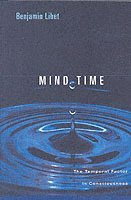
Mind Time
The Temporal Factor in Consciousness
Häftad, Engelska, 2005
267 kr
Skickas inom 7-10 vardagar
Our subjective inner life is what really matters to us as human beings--and yet we know relatively little about how it arises. Over a long and distinguished career Benjamin Libet has conducted experiments that have helped us see, in clear and concrete ways, how the brain produces conscious awareness. For the first time, Libet gives his own account of these experiments and their importance for our understanding of consciousness.Most notably, Libet's experiments reveal a substantial delay--the "mind time" of the title--before any awareness affects how we view our mental activities. If all conscious awarenesses are preceded by unconscious processes, as Libet observes, we are forced to conclude that unconscious processes initiate our conscious experiences. Freely voluntary acts are found to be initiated unconsciously before an awareness of wanting to act--a discovery with profound ramifications for our understanding of free will.How do the physical activities of billions of cerebral nerve cells give rise to an integrated conscious subjective awareness? How can the subjective mind affect or control voluntary actions? Libet considers these questions, as well as the implications of his discoveries for the nature of the soul, the identity of the person, and the relation of the non-physical subjective mind to the physical brain that produces it. Rendered in clear, accessible language, Libet's experiments and theories will allow interested amateurs and experts alike to share the experience of the extraordinary discoveries made in the practical study of consciousness.