• Fri frakt över 249 kr
  • •
  • Snabba leveranser
  • •
  • Billiga böcker
Kundservice

Du är på sajten för privatpersoner.

Företag, bibliotek eller offentlig verksamhet?

Du handlar på classic.bokus.com, där alla dina funktioner finns intakta.
Till classic.bokus.com
Bokus logotyp. Gå till startsidan.
  • Erbjudanden
  • Nyheter
  • Student
  • Topplistor
  • Barn & ungdom
  • Bokus Play
  • E-böcker
  • Pocketböcker
  • Spel & pussel

10% rabatt på allt med kod: NYSTART10 →

Sidfot

Mina sidor

    Hjälp

    • Kundservice
    • Vanliga frågor och svar
    • Frakt och leverans
    • Retur vid ångerrätt
    • Reklamera vara
    • Betalning
    • Köpvillkor
    • Allmänna villkor
    • Information om webbplatsens tillgänglighet

    Om Bokus

    • Om oss
    • Pressrum
    • För studenter
    • För företag
    • För bibliotek och offentlig verksamhet
    • För leverantörer
    • Hållbarhet

    Populärt

    • Aktuella erbjudanden
    • Presentkort
    • Studentlitteratur
    • Nya böcker
    • Topplistor
    • Signerade böcker
    • Engelska böcker

    Inspiration

    • Boktips
    • BookTok
    • Populära bokserier
    • Barnbokskaraktärer
    • Populära författare
    Logotyp för Bokus
    Följ oss på Facebook (extern länk)Följ oss på Instagram (extern länk)Följ oss på YouTube (extern länk)Följ oss på TikTok (extern länk)
    bokus @ CookiesAnpassa cookiesIntegritetspolicyKöpvillkor
    Till Citymail hemsida (extern länk)Till Budbee hemsida (extern länk)Till Postnord hemsida (extern länk)Till Schenker hemsida (extern länk)Till Early Bird hemsida (extern länk)Till Walleys hemsida (extern länk)
    1. Naturvetenskap och teknik
    2. Matematik och naturvetenskap
    3. Biologi
    4. Biovetenskap

    Brain’s Sense of Movement

    AvAlain Berthoz

    Häftad, Engelska, 2002

    Del 10 i serien Perspectives in Cognitive Neuroscience

    192 kr

    Beställningsvara. Skickas inom 5-8 vardagar. Fri frakt över 249 kr.

    Beskrivning

    The neuroscientist Alain Berthoz experimented on Russian astronauts in space to answer these questions: How does weightlessness affect motion? How are motion and three-dimensional space perceived? In this erudite and witty book, Berthoz describes how human beings on earth perceive and control bodily movement. Reviewing a wealth of research in neurophysiology and experimental psychology, he argues for a rethinking of the traditional separation between action and perception, and for the division of perception into five senses.In Berthoz’s view, perception and cognition are inherently predictive, functioning to allow us to anticipate the consequences of current or potential actions. The brain acts like a simulator that is constantly inventing models to project onto the changing world, models that are corrected by steady, minute feedback from the world. We move in the direction we are looking, anticipate the trajectory of a falling ball, recover when we stumble, and continually update our own physical position, all thanks to this sense of movement.This interpretation of perception and action allows Berthoz, in The Brain’s Sense of Movement, to focus on psychological phenomena largely ignored in standard texts: proprioception and kinaesthesis, the mechanisms that maintain balance and coordinate actions, and basic perceptual and memory processes involved in navigation.

    Produktinformation

    • Utgivningsdatum:2002-09-30
    • Mått:160 x 235 x 22 mm
    • Vikt:500 g
    • Format:Häftad
    • Språk:Engelska
    • Serie:Perspectives in Cognitive Neuroscience
    • Antal sidor:352
    • Förlag:Harvard University Press
    • ISBN:9780674009806
    • Översättare:Giselle Weiss

    Utforska kategorier

    • Biovetenskap inom Naturvetenskap och teknik
    • Kognitiv psykologi inom Psykologi och pedagogik
    • Neurologi och klinisk neurofysiologi inom Medicin

    Mer om författaren

    Alain Berthoz is Emeritus Professor at the Collège de France and Director of the Laboratory of Physiology of Perception and Action at the CNRS.

    Recensioner i media

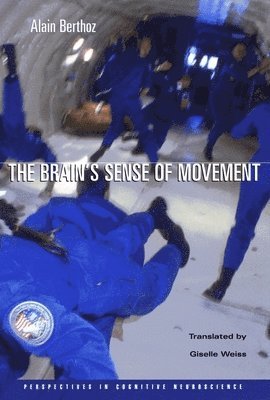
    This book is fascinating if one reads no more than the table of contents! With a jacket photo of semiweightless astronauts and chapter sections titled ‘Am I in My Bed Hanging from the Ceiling?,’ ‘The Art of Breaking,’ ‘What If Newton Had Wanted to Catch the Apple?,’ and ‘“Go Where I’m Looking,” Not “Look Where I’m Going,”’ among others, how could one not investigate further? …Anyone who has ever wondered, ‘How did I catch that?,’ ‘How did I hit that?,’ or ‘How in the world did I get out of the way of that?!’ will find this a good read.