Princeton Foundations of Contemporary Philosophy - Böcker
Visar alla böcker i serien Princeton Foundations of Contemporary Philosophy. Handla med fri frakt och snabb leverans.
13 produkter
13 produkter
414 kr
Skickas inom 7-10 vardagar
In this book, one of the world's foremost philosophers of language presents his unifying vision of the field - its principal achievements, its most pressing current questions, and its most promising future directions. In addition to explaining the progress philosophers have made toward creating a theoretical framework for the study of language, Scott Soames investigates foundational concepts - such as truth, reference, and meaning - that are central to the philosophy of language and important to philosophy as a whole. The first part of the book describes how philosophers from Frege, Russell, Tarski, and Carnap to Kripke, Kaplan, and Montague developed precise techniques for understanding the languages of logic and mathematics, and how these techniques have been refined and extended to the study of natural human languages. The book then builds on this account, exploring new thinking about propositions, possibility, and the relationship between meaning, assertion, and other aspects of language use. An invaluable overview of the philosophy of language by one of its most important practitioners, this book will be essential reading for all serious students of philosophy.
300 kr
Skickas inom 7-10 vardagar
This is a concise, comprehensive, and accessible introduction to the philosophy of biology written by a leading authority on the subject. Geared to philosophers, biologists, and students of both, the book provides sophisticated and innovative coverage of the central topics and many of the latest developments in the field. Emphasizing connections between biological theories and other areas of philosophy, and carefully explaining both philosophical and biological terms, Peter Godfrey-Smith discusses the relation between philosophy and science; examines the role of laws, mechanistic explanation, and idealized models in biological theories; describes evolution by natural selection; and assesses attempts to extend Darwin's mechanism to explain changes in ideas, culture, and other phenomena. Further topics include functions and teleology, individuality and organisms, species, the tree of life, and human nature. The book closes with detailed, cutting-edge treatments of the evolution of cooperation, of information in biology, and of the role of communication in living systems at all scales.Authoritative and up-to-date, this is an essential guide for anyone interested in the important philosophical issues raised by the biological sciences.
235 kr
Skickas inom 7-10 vardagar
A masterful overview of the philosophy of language from one of its most important thinkersIn this book one of the world's foremost philosophers of language presents his unifying vision of the field—its principal achievements, its most pressing current questions, and its most promising future directions. In addition to explaining the progress philosophers have made toward creating a theoretical framework for the study of language, Scott Soames investigates foundational concepts—such as truth, reference, and meaning—that are central to the philosophy of language and important to philosophy as a whole. The first part of the book describes how philosophers from Frege, Russell, Tarski, and Carnap to Kripke, Kaplan, and Montague developed precise techniques for understanding the languages of logic and mathematics, and how these techniques have been refined and extended to the study of natural human languages. The book then builds on this account, exploring new thinking about propositions, possibility, and the relationship between meaning, assertion, and other aspects of language use.An invaluable overview of the philosophy of language by one of its most important practitioners, this book will be essential reading for all serious students of philosophy.
228 kr
Skickas inom 7-10 vardagar
Philosophical Logic is a clear and concise critical survey of nonclassical logics of philosophical interest written by one of the world's leading authorities on the subject. After giving an overview of classical logic, John Burgess introduces five central branches of nonclassical logic (temporal, modal, conditional, relevantistic, and intuitionistic), focusing on the sometimes problematic relationship between formal apparatus and intuitive motivation. Requiring minimal background and arranged to make the more technical material optional, the book offers a choice between an overview and in-depth study, and it balances the philosophical and technical aspects of the subject. The book emphasizes the relationship between models and the traditional goal of logic, the evaluation of arguments, and critically examines apparatus and assumptions that often are taken for granted. Philosophical Logic provides an unusually thorough treatment of conditional logic, unifying probabilistic and model-theoretic approaches.It underscores the variety of approaches that have been taken to relevantistic and related logics, and it stresses the problem of connecting formal systems to the motivating ideas behind intuitionistic mathematics. Each chapter ends with a brief guide to further reading. Philosophical Logic addresses students new to logic, philosophers working in other areas, and specialists in logic, providing both a sophisticated introduction and a new synthesis.
300 kr
Skickas inom 7-10 vardagar
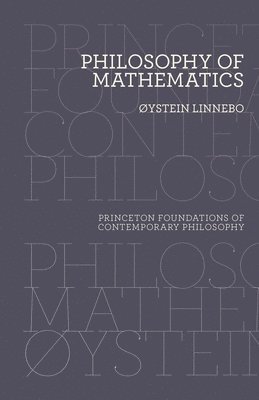
A sophisticated, original introduction to the philosophy of mathematics from one of its leading contemporary scholars Mathematics is one of humanity's most successful yet puzzling endeavors. It is a model of precision and objectivity, but appears distinct from the empirical sciences because it seems to deliver nonexperiential knowledge of a nonphysical reality of numbers, sets, and functions. How can these two aspects of mathematics be reconciled? This concise book provides a systematic yet accessible introduction to the field that is trying to answer that question: the philosophy of mathematics. Written by Oystein Linnebo, one of the world's leading scholars on the subject, the book introduces all of the classical approaches to the field, including logicism, formalism, intuitionism, empiricism, and structuralism. It also contains accessible introductions to some more specialized issues, such as mathematical intuition, potential infinity, the iterative conception of sets, and the search for new mathematical axioms. The groundbreaking work of German mathematician and philosopher Gottlob Frege, one of the founders of analytic philosophy, figures prominently throughout the book.Other important thinkers whose work is introduced and discussed include Immanuel Kant, John Stuart Mill, David Hilbert, Kurt Godel, W. V. Quine, Paul Benacerraf, and Hartry H. Field. Sophisticated but clear and approachable, this is an essential introduction for all students and teachers of philosophy, as well as mathematicians and others who want to understand the foundations of mathematics.
228 kr
Skickas inom 7-10 vardagar
This is a concise introduction to current philosophical debates about truth. Combining philosophical and technical material, the book is organized around, but not limited to, the view known as deflationism. In clear language, Burgess and Burgess cover a wide range of issues, including the nature of truth, the status of truth-value gaps, the relationship between truth and meaning, relativism and pluralism about truth, and semantic paradoxes from Alfred Tarski to Saul Kripke and beyond. The book provides a rich picture of contemporary philosophical theorizing about truth, one that will be essential reading for philosophy students as well as philosophers specializing in other areas.
210 kr
Skickas inom 7-10 vardagar
In Philosophy of Law, Andrei Marmor provides a comprehensive analysis of contemporary debates about the fundamental nature of law--an issue that has been at the heart of legal philosophy for centuries. What the law is seems to be a matter of fact, but this fact has normative significance: it tells people what they ought to do. Marmor argues that the myriad questions raised by the factual and normative features of law actually depend on the possibility of reduction--whether the legal domain can be explained in terms of something else, more foundational in nature. In addition to exploring the major issues in contemporary legal thought, Philosophy of Law provides a critical analysis of the people and ideas that have dominated the field in past centuries. It will be essential reading for anyone curious about the nature of law.
228 kr
Skickas inom 7-10 vardagar
This concise book introduces nonphysicists to the core philosophical issues surrounding the nature and structure of space and time, and is also an ideal resource for physicists interested in the conceptual foundations of space-time theory. Tim Maudlin's broad historical overview examines Aristotelian and Newtonian accounts of space and time, and traces how Galileo's conceptions of relativity and space-time led to Einstein's special and general theories of relativity. Maudlin explains special relativity with enough detail to solve concrete physical problems while presenting general relativity in more qualitative terms. Additional topics include the Twins Paradox, the physical aspects of the Lorentz-FitzGerald contraction, the constancy of the speed of light, time travel, the direction of time, and more. * Introduces nonphysicists to the philosophical foundations of space-time theory * Provides a broad historical overview, from Aristotle to Einstein * Explains special relativity geometrically, emphasizing the intrinsic structure of space-time * Covers the Twins Paradox, Galilean relativity, time travel, and more * Requires only basic algebra and no formal knowledge of physics
228 kr
Skickas inom 7-10 vardagar
This is a concise, comprehensive, and accessible introduction to the philosophy of biology written by a leading authority on the subject. Geared to philosophers, biologists, and students of both, the book provides sophisticated and innovative coverage of the central topics and many of the latest developments in the field. Emphasizing connections between biological theories and other areas of philosophy, and carefully explaining both philosophical and biological terms, Peter Godfrey-Smith discusses the relation between philosophy and science; examines the role of laws, mechanistic explanation, and idealized models in biological theories; describes evolution by natural selection; and assesses attempts to extend Darwin's mechanism to explain changes in ideas, culture, and other phenomena. Further topics include functions and teleology, individuality and organisms, species, the tree of life, and human nature. The book closes with detailed, cutting-edge treatments of the evolution of cooperation, of information in biology, and of the role of communication in living systems at all scales.Authoritative and up-to-date, this is an essential guide for anyone interested in the important philosophical issues raised by the biological sciences.
260 kr
Skickas inom 7-10 vardagar
One of the world's leading epistemologists provides a sophisticated, revisionist introduction to the subjectIn this concise book, one of the world’s leading epistemologists provides a sophisticated, revisionist introduction to the problem of knowledge in Western philosophy. Modern and contemporary accounts of epistemology tend to focus on limited questions of knowledge and skepticism, such as how we can know the external world, other minds, the past through memory, the future through induction, or the world’s depth and structure through inference. This book steps back for a better view of the more general issues posed by the ancient Greek Pyrrhonists. Returning to and illuminating this older, broader epistemological tradition, Ernest Sosa develops an original account of the subject, giving it substance not with Cartesian theology but with science and common sense. Descartes is a part of this ancient tradition, but he goes beyond it by considering not just whether knowledge is possible in the first place, but also how we can properly attain it. In Cartesian epistemology, Sosa finds a virtue-theoretic account, one that he extends beyond the Cartesian context. Once epistemology is viewed in this light, many of its problems can be solved or fall away. The result is an important reevaluation of epistemology that will be essential reading for students and teachers.
244 kr
Skickas inom 7-10 vardagar
A sophisticated and original introduction to the philosophy of quantum mechanics from one of the world’s leading philosophers of physicsIn this book, Tim Maudlin, one of the world’s leading philosophers of physics, offers a sophisticated, original introduction to the philosophy of quantum mechanics. The briefest, clearest, and most refined account of his influential approach to the subject, the book will be invaluable to all students of philosophy and physics.Quantum mechanics holds a unique place in the history of physics. It has produced the most accurate predictions of any scientific theory, but, more astonishing, there has never been any agreement about what the theory implies about physical reality. Maudlin argues that the very term “quantum theory” is a misnomer. A proper physical theory should clearly describe what is there and what it does—yet standard textbooks present quantum mechanics as a predictive recipe in search of a physical theory.In contrast, Maudlin explores three proper theories that recover the quantum predictions: the indeterministic wavefunction collapse theory of Ghirardi, Rimini, and Weber; the deterministic particle theory of deBroglie and Bohm; and the conceptually challenging Many Worlds theory of Everett. Each offers a radically different proposal for the nature of physical reality, but Maudlin shows that none of them are what they are generally taken to be.
312 kr
Skickas inom 7-10 vardagar
A sophisticated, original introduction to the philosophy of mathematics from one of its leading thinkersMathematics is a model of precision and objectivity, but it appears distinct from the empirical sciences because it seems to deliver nonexperiential knowledge of a nonphysical reality of numbers, sets, and functions. How can these two aspects of mathematics be reconciled? This concise book provides a systematic, accessible introduction to the field that is trying to answer that question: the philosophy of mathematics. Øystein Linnebo, one of the world's leading scholars on the subject, introduces all of the classical approaches to the field as well as more specialized issues, including mathematical intuition, potential infinity, and the search for new mathematical axioms. Sophisticated but clear and approachable, this is an essential book for all students and teachers of philosophy and of mathematics.
312 kr
Skickas
How to understand a long-standing puzzle in political philosophy: the relationship between justice and legitimacyCan laws be unjust and yet remain, in some sense, morally legitimate? In this book, Jonathan Quong considers central issues in political philosophy through the lens of this single question. He explores and evaluates recent influential work on this topic and then proposes a novel approach of his own. The puzzle at the heart of his account is the phenomenon of legitimate injustice—laws and policies that are substantively unjust yet may be legitimately imposed by government officials. How can such laws be legitimate if, as some have argued, justice is the first virtue of social institutions?Quong analyzes the work of those who deny that injustice committed by states can be legitimate simply by virtue of its democratic or procedural pedigree; the Kantian account of legitimate institutions and justice; instrumental approaches to political legitimacy; and the recent wave of work in democratic theory focused on its egalitarian character. Arguing that these analyses do not offer an adequate solution to the puzzle and that there are compelling reasons to revise or reject them, Quong lays out his view and explains the implications for more general theories of political morality. He argues that we can explain legitimate injustice by appeal to distributive justice. If political disagreement is inevitable, then unjust legislation is largely unavoidable; it constitutes a burden that must be distributed according to just principles. Quong’s novel and illuminating framework offers a unique introduction to crucial questions in political philosophy.