• Fri frakt över 249 kr
  • •
  • Snabba leveranser
  • •
  • Billiga böcker
Kundservice

Du är på sajten för privatpersoner.

Företag, bibliotek eller offentlig verksamhet?

Du handlar på classic.bokus.com, där alla dina funktioner finns intakta.
Till classic.bokus.com
Bokus logotyp. Gå till startsidan.
  • Erbjudanden
  • Nyheter
  • Student
  • Topplistor
  • Barn & ungdom
  • Bokus Play
  • E-böcker
  • Pocketböcker
  • Spel & pussel

10% rabatt på allt med kod NYSTART10 →

Sidfot

Mina sidor

    Hjälp

    • Kundservice
    • Vanliga frågor och svar
    • Frakt och leverans
    • Retur vid ångerrätt
    • Reklamera vara
    • Betalning
    • Köpvillkor
    • Allmänna villkor
    • Information om webbplatsens tillgänglighet

    Om Bokus

    • Om oss
    • Pressrum
    • För studenter
    • För företag
    • För bibliotek och offentlig verksamhet
    • För leverantörer
    • Hållbarhet

    Populärt

    • Aktuella erbjudanden
    • Presentkort
    • Studentlitteratur
    • Nya böcker
    • Topplistor
    • Signerade böcker
    • Engelska böcker

    Inspiration

    • Boktips
    • BookTok
    • Populära bokserier
    • Barnbokskaraktärer
    • Populära författare
    Logotyp för Bokus
    Följ oss på Facebook (extern länk)Följ oss på Instagram (extern länk)Följ oss på YouTube (extern länk)Följ oss på TikTok (extern länk)
    bokus @ CookiesAnpassa cookiesIntegritetspolicyKöpvillkor
    Till Citymail hemsida (extern länk)Till Budbee hemsida (extern länk)Till Postnord hemsida (extern länk)Till Schenker hemsida (extern länk)Till Early Bird hemsida (extern länk)Till Walleys hemsida (extern länk)
    1. Psykologi och pedagogik
    2. Pedagogik
    3. Pedagogisk metodik

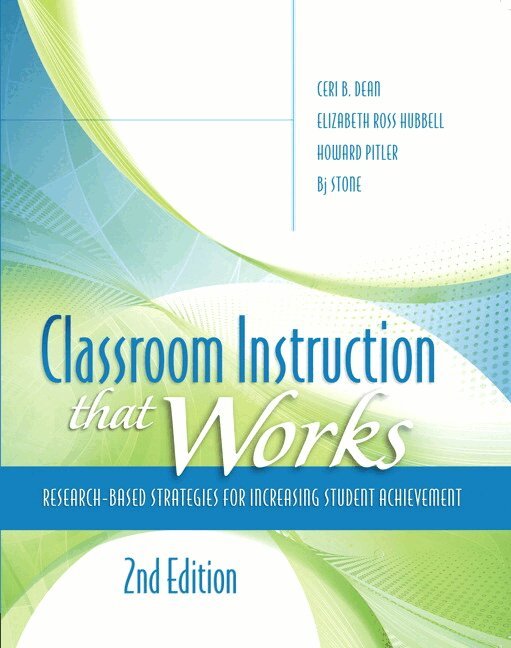
    Classroom Instruction that Works

    Research-Based Strategies for Increasing Student Achievement

    AvCeri Dean,Elizabeth Hubbell

    Häftad, Engelska, 2013

    479 kr

    Beställningsvara. Skickas inom 7-10 vardagar. Fri frakt över 249 kr.

    Beskrivning

    In 2001, Classroom Instruction That Works asked a few simple questions and inspired more than a million teachers to refine their approach to teaching. What works in education? How do we know? How can educational research find its way into the classroom? How can we apply it to help individual students?


    This all-new, completely revised second edition of that classic text draws on the research and developments of the following decade to reanalyze and reevaluate the teaching strategies that have the most positive effect on student learning:


    • Setting objectives and providing feedback

    • Reinforcing effort and providing recognition

    • Cooperative learning

    • Cues, questions, and advance organizers

    • Nonlinguistic representations

    • Summarizing and note taking

    • Assigning homework and providing practice

    • Identifying similarities and differences

    • Generating and testing hypotheses


    These strategies are organized and presented within a framework that is geared toward instructional planning, which highlights the point that all of the strategies are effective and should be used to complement one another. Each strategy is supported with recommended classroom practices, examples of the strategy in use, tips for teaching, and information about using the strategy with today’s learners.


    Whether you are coming to this book for the first time or are a veritable expert in the nine strategies, this second edition will help you develop your instructional approach, broaden your influence as a teacher, and enhance the learning potential of all your students. We haven’t reinvented the wheel. We’ve taken classroom instruction that works and made it thrive.

    Produktinformation

    • Utgivningsdatum:2013-02-12
    • Mått:100 x 100 x 100 mm
    • Vikt:100 g
    • Format:Häftad
    • Språk:Engelska
    • Antal sidor:224
    • Upplaga:2
    • Förlag:Pearson Education
    • ISBN:9780133366723

    Utforska kategorier

    • Pedagogisk metodik inom Psykologi och pedagogik
    • Lärarutbildning inom Psykologi och pedagogik

    Mer om författaren

    Ceri B. Dean is vice president for field services at Midcontinent Research for Education and Learning (McREL). She is responsible for the development and successful implementation of McREL's professional development, technical assistance, and consultation services. She has served as the director of large-scale projects, including the North Central Comprehensive Center at McREL, a U.S. Department of Education—funded technical assistance center. She is codeveloper of materials to facilitate delivery of McREL's comprehensive approach to school improvement, Success in Sight, and she has coauthored a number of McREL publications. She is a former high school mathematics teacher and holds a Ph.D. in Curriculum and Instruction from the University of Connecticut at Storrs and an M.S. in Atmospheric Science from Colorado State University. Elizabeth Ross Hubbell is a principal consultant at McREL. She conducts workshops and training for K–12 teachers on research-based instructional strategies and technology integration, writes curriculum models for online classes, conducts technology audits for districts, and trains school and district leaders in using Power Walkthrough software. She holds an M.A. in Information and Learning Technologies from the University of Colorado—Denver and a B.S. in Early Childhood/Elementary Education from the University of Georgia. Elizabeth was one of four national finalists in Technology & Learning's Ed Tech Leader of the Year 2003. She is coauthor of Using Technology with Classroom Instruction that Works and The Future of Schooling: Educating America in 2020.Howard Pitler is a senior director at McREL. He conducts workshops and training for K–12 teachers on research-based instructional strategies and technology integration, conducts technology audits for districts, and works with school and district leaders in using Power Walkthrough classroom observation software. He holds an Ed.D. in Educational Administration from Wichita State University, an M.A. in Music Performance from Wichita State, and a B.A. in Music Education from Indiana State University. Howard is an Apple Distinguished Educator and a Smithsonian Laureate, and he was a 1997 National Distinguished Principal. He has been published in several journals, and he is coauthor of Using Technology with Classroom Instruction that Works.Bj Stone is a principal consultant at McREL. She facilitates learning sessions with teachers and administratorsin the areas of research-based instructional strategies, vocabulary instruction, curriculum development, andassessment design. Bj was designated as a Teaching Fellow in a large National Science Foundation—funded grant for preservice teachers and has been published in the Journal of Teacher Education. Bj is a former middle and high school science teacher, university instructor, and assistant superintendent. She has a B.S in Biology, a M.S. in Science Education, and an Ed.D. in Educational Leadership and Policy Study from the University of Northern Colorado.About McRELMid-continent Research for Education and Learning (McREL) is a nationally recognized, nonprofit education research and development organization, headquartered in Denver, Colorado with offices in Honolulu, Hawai‘i and Omaha, Nebraska. Since 1966, McREL has helped translate research and professional wisdom about what works in education into practical guidance for educators. Our 120-plus staff members and affiliates include respected researchers, experienced consultants, and published writers who provide educators with research-based guidance, consultation, and professional development for improving student outcomes.

    Innehållsförteckning

    • Part I    Creating the Environment for Learning1 Setting Objectives and Providing Feedback2 Reinforcing Effort and Providing Recognition3 Cooperative Learning  Part II    Helping Students Develop Understanding4 Cues, Questions, and Advance Organizers5 Nonlinguistic Representations6 Summarizing and Note Taking7 Assigning Homework and Providing Practice  Part III    Helping Students Extend and Apply Knowledge8 Identifying Similarities and Differences9 Generating and Testing Hypotheses  Part IV    Putting the Instructional Strategies to Use10 Instructional Planning Using the Nine Categories of Strategies