• Fri frakt över 249 kr
  • •
  • Snabba leveranser
  • •
  • Billiga böcker
Kundservice

Du är på sajten för privatpersoner.

Företag, bibliotek eller offentlig verksamhet?

Du handlar på classic.bokus.com, där alla dina funktioner finns intakta.
Till classic.bokus.com
Bokus logotyp. Gå till startsidan.
  • Erbjudanden
  • Nyheter
  • Student
  • Topplistor
  • Barn & ungdom
  • Bokus Play
  • E-böcker
  • Pocketböcker
  • Spel & pussel

10% rabatt på allt med kod: NYSTART10 →

Sidfot

Mina sidor

    Hjälp

    • Kundservice
    • Vanliga frågor och svar
    • Frakt och leverans
    • Retur vid ångerrätt
    • Reklamera vara
    • Betalning
    • Köpvillkor
    • Allmänna villkor
    • Information om webbplatsens tillgänglighet

    Om Bokus

    • Om oss
    • Pressrum
    • För studenter
    • För företag
    • För bibliotek och offentlig verksamhet
    • För leverantörer
    • Hållbarhet

    Populärt

    • Aktuella erbjudanden
    • Presentkort
    • Studentlitteratur
    • Nya böcker
    • Topplistor
    • Signerade böcker
    • Engelska böcker

    Inspiration

    • Boktips
    • BookTok
    • Populära bokserier
    • Barnbokskaraktärer
    • Populära författare
    Logotyp för Bokus
    Följ oss på Facebook (extern länk)Följ oss på Instagram (extern länk)Följ oss på YouTube (extern länk)Följ oss på TikTok (extern länk)
    bokus @ CookiesAnpassa cookiesIntegritetspolicyKöpvillkor
    Till Citymail hemsida (extern länk)Till Budbee hemsida (extern länk)Till Postnord hemsida (extern länk)Till Schenker hemsida (extern länk)Till Early Bird hemsida (extern länk)Till Walleys hemsida (extern länk)
    1. Naturvetenskap och teknik
    2. Teknik och industri
    3. Tillverkningsteknik

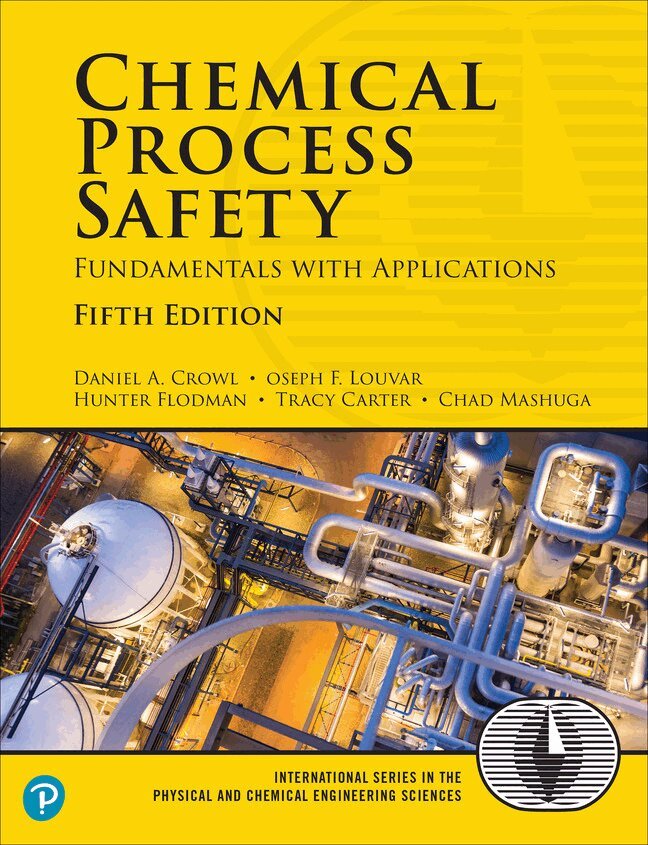
    Chemical Process Safety

    Fundamentals with Applications

    AvDaniel Crowl,Joseph Louvar

    Häftad, Engelska, 2027

    Del i serien International Series in the Physical and Chemical Engineering Sciences

    1 143 kr

    Kommande

    Fler format och utgåvor

    Häftad

    1 823 kr

    Beskrivning

    The #1 Process Safety Textbook Worldwide for Teaching and Industrial Reference

    Process safety continues to evolve to prevent industrial accidents. Chemical Process Safety, Fifth Edition, builds on its legacy as the definitive guide both for university instruction and an industrial/professional reference for all engineers.

    This edition improves the organization, updates the content to current industrial practices and uses a 100 gal (378 L) multi-purpose pilot plant vessel throughout to bring the reader closer to industrial practices and applications.

    Maintaining its hallmark balance of theory and application, this book integrates theory, calculations, case histories, examples, and homework problems closely coupled with supporting figures and tables to help readers understand concepts and apply them in practice.

    • Introductory chapter provides an overview of process safety
    • The history of process safety from medieval times to the present
    • Comprehensive chapter on the AIChE Center for Chemical Process Safety (CCPS) 20 Elements of Risk-Based Process Safety (RBPS), with detailed accident case histories for each element
    • Close coupling of the content to CCPS references.
    • Detailed specifications for the 100 gal pilot plant vessel (PPV), including piping and instrument diagrams and specifications for the surrounding pilot plant development area (PPDA), as well as PPV example applications and homework problems
    • Updated 2-phase flow relief sizing method using the Omega Method

    Produktinformation

    • Utgivningsdatum:2027-02-11
    • Format:Häftad
    • Språk:Engelska
    • Serie:International Series in the Physical and Chemical Engineering Sciences
    • Upplaga:5
    • Förlag:Pearson Education
    • ISBN:9780135319086

    Utforska kategorier

    • Tillverkningsteknik inom Naturvetenskap och teknik

    Mer om författaren

    Daniel A. Crowl is an Emeritus Professor at Michigan Technological University, where his research on flammable gases and liquids helped improve worldwide flammability standards. Crowl began teaching at Wayne State University in 1977, worked at BASF in 1984, and moved to Michigan Technological University in 1990 as the first Herbert H. Dow Professor for Chemical Process Safety. After retiring from Michigan Tech in 2015, he taught the required process safety course in chemical engineering as an adjunct professor at the University of Utah until 2019. He is a Fellow of AIChE, the ACS Safety and Health Division, and CCPS, and he is CCPS Certified in process safety. He has held numerous AIChE leadership roles, authored or edited many technical papers and process safety books, and edited the safety section in the seventh and eighth editions of Perry's Chemical Engineer's Handbook. His awards include the Merit Award from the Mary K. O'Connor Process Safety Center, the ACS Chemical Health and Safety Award, the AIChE Safety and Health Division's Bill Doyle and Walton/Miller awards, the American Chemistry Council's Catalyst Award, the AIChE Board's Gary Leach Award, and the University of Illinois Department of Chemical and Biomolecular Engineering Distinguished Alumni Achievement Award.Joseph F. Louvar was a professor at Wayne State University, where he taught chemical process safety, risk assessment, and process design for 10 years after retiring from BASF Corporation. He was the author of many safety-related publications and, along with coauthoring this book, coauthored Health and Environmental Risk Analysis: Fundamentals with Applications. He chaired the Loss Prevention Committee of the AIChE Safety and Health Division, served as the CCPS staff consultant for the Undergraduate Education Committee (now known as SACHE), and co-edited AIChE's process safety journal, Process Safety Progress.Tracy L. Carter is a faculty member in the Department of Chemical Engineering at Northeastern University. She teaches process safety and unit operations, leads the Process Safety Certificate program, serves on the Chemical Engineering Safety Committee, and leads the College of Engineering Communication Lab supporting graduate students with technical communication. Before joining Northeastern, Carter worked in R&D on medical device design, which inspired her to develop courses that apply process safety concepts to industry sectors beyond petrochemicals. She mentors other faculty teaching process safety through the Center for Chemical Process Safety Industry/Faculty Workshops and the AIChE Virtual Community of Practice for Process Safety. She also remains active in the field by chairing the Plant Process Safety Symposium at the annual Global Congress for Process Safety, serving on the Process Safety Division Career and Education Committee, and reviewing articles for Process Safety Progress and Chemical Engineering Education.Chad V. Mashuga is a registered Professional Engineer and serves as Associate Professor of Practice in the Department of Chemical Engineering at Texas A&M University, where he is also affiliated with the Turbo Machinery Laboratory and the Gas Fuels Research Center. Before joining Texas A&M, he spent 15 years in the chemical process industry with BASF and The Dow Chemical Company, specializing in process and experimental safety and the flammability and explosion behavior of dusts, gases, liquids, and aerosols. He has led numerous industry and academic projects involving the development of specialized safety instrumentation, which has resulted in practical industrial safety solutions and multiple patents. His research focuses on flammability, explosion behavior, and hazard mitigation, while his teaching emphasizes process safety engineering and the integration of safety principles into professional practice.Hunter R. Flodman is an associate professor of practice in the Department of Chemical and Biomolecular Engineering at the University of Nebraska–Lincoln. He has a BS and PhD in chemical engineering and an MS in environmental engineering, and has taught junior- and senior-level unit operations lab and process control lab courses for 13 years. He also teaches a variety of lecture courses for the department and has professional expertise in chemical process safety and process control. He facilitates workshops and teaches professional training courses in process safety and process control for the Manufacturing Extension Partnership, with offerings designed specifically for biofuel producers. He also facilitates Center for Chemical Process Safety faculty workshops in the United States and Europe hosted by industry sponsors. His teaching focuses on narrowing the gap between the chemical engineering curriculum and industry needs by using problems, projects, and hands-on experiences that apply engineering and science principles to real-world challenges and help prepare students for successful engineering careers.

    Innehållsförteckning

    • PrefaceAbout the AuthorsNomenclatureChapter 1: IntroductionChapter 2: Process Safety OverviewChapter 3: The 20 Elements of Risk Based Safety Process (RBPS)Chapter 4: The Multi-Purpose Pilot Plant Vessel (PPV)Chapter 5: ToxicologyChapter 6: Industrial HygieneChapter 7: Source ModelsChapter 8: Hazardous Material DispersionChapter 9: Fires and ExplosionsChapter 10: Concepts to Prevent Fires and ExplosionsChapter 11: Chemical ReactivityChapter 12: Introduction to ReliefsChapter 13: Relief SizingChapter 14: Hazards Identification and EvaluationChapter 15: Risk Analysis and AssessmentAppendix A: Unit Conversion ConstantsAppendix B: Flammability Data for Selected HydrocarbonsAppendix C: Saturation Vapor Pressure DataAppendix D: Special Types of Reactive ChemicalsAppendix E: Hazardous Chemicals Data for a Variety of Chemical SubstancesAppendix F: Process DiagramsAppendix G: Process Development (PD) Area General SpecificationsAppendix H: Specifications for the 100 Gallon (378.5 L) Multipurpose VesselAppendix I: Personal Protective Equipment (PPE) Usage Guidelines for the Process Development Area (PD)Index