• Fri frakt över 249 kr
  • •
  • Snabba leveranser
  • •
  • Billiga böcker
Kundservice

Du är på sajten för privatpersoner.

Företag, bibliotek eller offentlig verksamhet?

Du handlar på classic.bokus.com, där alla dina funktioner finns intakta.
Till classic.bokus.com
Bokus logotyp. Gå till startsidan.
  • Erbjudanden
  • Nyheter
  • Student
  • Topplistor
  • Barn & ungdom
  • Bokus Play
  • E-böcker
  • Pocketböcker
  • Spel & pussel

10% rabatt på allt med kod: NYSTART10 →

Sidfot

Mina sidor

    Hjälp

    • Kundservice
    • Vanliga frågor och svar
    • Frakt och leverans
    • Retur vid ångerrätt
    • Reklamera vara
    • Betalning
    • Köpvillkor
    • Allmänna villkor
    • Information om webbplatsens tillgänglighet

    Om Bokus

    • Om oss
    • Pressrum
    • För studenter
    • För företag
    • För bibliotek och offentlig verksamhet
    • För leverantörer
    • Hållbarhet

    Populärt

    • Aktuella erbjudanden
    • Presentkort
    • Studentlitteratur
    • Nya böcker
    • Topplistor
    • Signerade böcker
    • Engelska böcker

    Inspiration

    • Boktips
    • BookTok
    • Populära bokserier
    • Barnbokskaraktärer
    • Populära författare
    Logotyp för Bokus
    Följ oss på Facebook (extern länk)Följ oss på Instagram (extern länk)Följ oss på YouTube (extern länk)Följ oss på TikTok (extern länk)
    bokus @ CookiesAnpassa cookiesIntegritetspolicyKöpvillkor
    Till Citymail hemsida (extern länk)Till Budbee hemsida (extern länk)Till Postnord hemsida (extern länk)Till Schenker hemsida (extern länk)Till Early Bird hemsida (extern länk)Till Walleys hemsida (extern länk)
    1. Naturvetenskap och teknik
    2. Teknik och industri
    3. Tillverkningsteknik

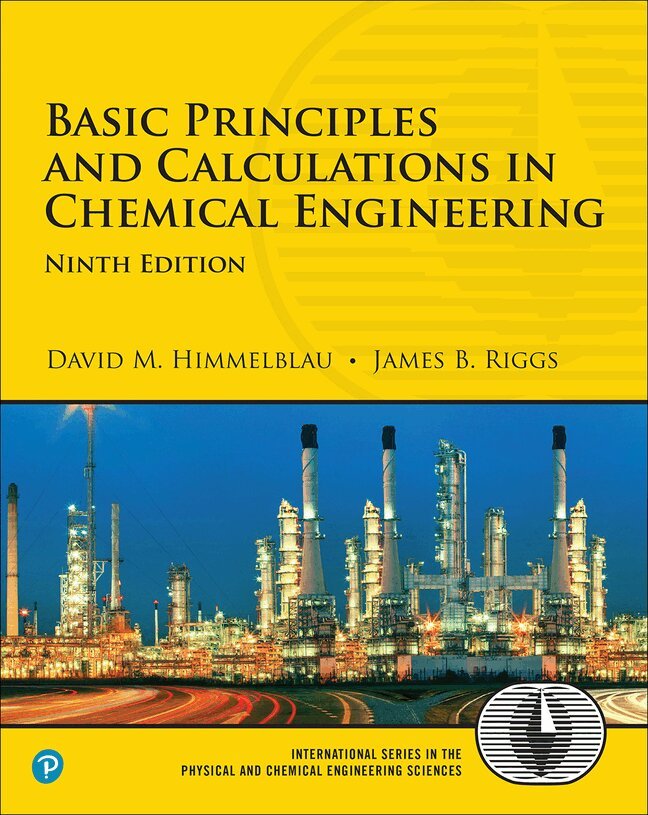
    Basic Principles and Calculations in Chemical Engineering

    AvDavid Himmelblau,James Riggs

    Häftad, Engelska, 2022

    Del i serien International Series in the Physical and Chemical Engineering Sciences

    1 134 kr

    Beställningsvara. Skickas inom 7-10 vardagar. Fri frakt över 249 kr.

    Fler format och utgåvor

    Övrigt

    2 149 kr

    Häftad

    965 kr

    Beskrivning

    The #1 Guide to Chemical Engineering Principles, Techniques, Calculations, and Applications--Revised, Streamlined, and Modernized with New Examples

    Basic Principles and Calculations in Chemical Engineering, Ninth Edition, has been thoroughly revised, streamlined, and updated to reflect sweeping changes in the chemical engineering field. This introductory guide addresses the full scope of contemporary chemical, petroleum, and environmental engineering applications and contains extensive new coverage and examples related to biotech, nanotech, green/environmental engineering, and process safety, with many new MATLAB and Python problems throughout.

    Authors David M. Himmelblau and James B. Riggs offer a strong foundation of skills and knowledge for successful study and practice, guiding students through formulating and solving material and energy balance problems, as well as describing gases, liquids, and vapors. Throughout, they introduce efficient, consistent, learner-friendly ways to solve problems, analyze data, and gain a conceptual, application-based understanding of modern processes.

    This edition condenses coverage from previous editions to serve today's students and faculty more efficiently. In two entirely new chapters, the authors provide a comprehensive introduction to dynamic material and energy balances, as well as psychrometric charts.
    • Modular chapters designed to support introductory courses of any length
    • Introductions to unit conversions, basis selection, and process measurements
    • Strategies for solving diverse material and energy balance problems, including material balances with chemical reaction and for multi-unit processes, and energy balances with reaction
    • Clear introductions to key concepts ranging from stoichiometry to enthalpy
    • Coverage of ideal/real gases, multi-phase equilibria, unsteady-state material, humidity (psychrometric) charts, and more
    • Self-assessment questions to help readers identify areas they don't fully understand
    • Thought, discussion, and homework problems in every chapter
    • New biotech, bioengineering, nanotechnology, green/environmental engineering, and process safety coverage
    • Relevant new MATLAB and Python homework problems and projects
    • Extensive tables, charts, and glossaries in each chapter
    • Reference appendices presenting atomic weights and numbers, Pitzer Z^0/Z^1 factors, heats of formation and combustion, and more
    Easier than ever to use, this book is the definitive practical introduction for students, license candidates, practicing engineers, and scientists.

    Supplemental Online Content (available with book registration):
    • Three additional chapters on Heats of Solution and Mixing, Liquids and Gases in Equilibrium with Solids, and Solving Material and Energy Balances with Process Simulators (Flowsheeting Codes)
    • Nine additional appendices: Physical Properties of Various Organic and Inorganic Substances, Heat Capacity Equations, Vapor Pressures, Heats of Solution and Dilution, Enthalpy-Concentration Data, Thermodynamic Charts, Physical Properties of Petroleum Fractions, Solution of Sets of Equations, Fitting Functions to Data
    Register your book for convenient access to downloads, updates, and/or corrections as they become available. See inside book for details.

    Produktinformation

    • Utgivningsdatum:2022-09-09
    • Mått:202 x 254 x 34 mm
    • Vikt:1 660 g
    • Format:Häftad
    • Språk:Engelska
    • Serie:International Series in the Physical and Chemical Engineering Sciences
    • Antal sidor:896
    • Upplaga:9
    • Förlag:Pearson Education
    • ISBN:9780137327171

    Utforska kategorier

    • Tillverkningsteknik inom Naturvetenskap och teknik

    Mer om författaren

    David M. Himmelblau was Paul D. and Betty Robertson Meek and American Petrofina Foundation Centennial Professor Emeritus in Chemical Engineering at the University of Texas, where he taught for forty-two years. He authored eleven books and more than two hundred articles on process analysis, fault detection, and optimization. He was president of the CACHE Corporation, and director of AIChE. James B. Riggs was a university professor for thirty years. Twenty-five of those years were spent at Texas Tech University, where he founded and directed the Texas Tech Process Control and Optimization Consortium. He authored several popular textbooks, including Computational Methods for Engineers with MATLAB Applications, Thirteenth Edition; Programming with MATLAB for Engineers, Fourteenth Edition; and Chemical and Bio-Process Control, Fifth Edition.

    Innehållsförteckning

    • Preface xv How to Use This Book xvii Acknowledgments xxi About the Authors xxiii Part I: Introduction 1 Chapter 1: Introduction to Chemical Engineering 3 1.1 A Brief History of Chemical Engineering 3 1.2 Types of Jobs Chemical Engineers Perform 6 1.3 Industries in Which Chemical Engineers Work 8 1.4 Sustainability 10 1.5 Ethics 24 Chapter 2: Introductory Concepts 29 2.1 Units of Measure 29 2.2 Unit Conversions 35 2.3 Equations and Units 41 2.4 Measurement Errors and Significant Figures 47 2.5 Validation of Results 53 2.6 Mass, Moles, and Density 55 2.7 Process Variables 75 Part II: Material Balances 125 Chapter 3: Material Balances 127 3.1 The Connection between a Process and Its Schematic 129 3.2 Introduction to Material Balances 134 3.3 A General Strategy for Solving Material Balance Problems 145 3.4 Material Balances for Single Unit Systems 164 3.5 Vectors and Matrices 188 3.6 Solving Systems of Linear Equations with MATLAB 190 3.7 Solving Systems of Linear Equations with Python 196 Chapter 4: Material Balances with Chemical Reaction 225 4.1 Stoichiometry 226 4.2 Terminology for Reaction Systems 235 4.3 Species Mole Balances 248 4.4 Element Material Balances 268 4.5 Material Balances for Combustion Systems 276 Chapter 5: Material Balances for Multiunit Processes 313 5.1 Preliminary Concepts 314 5.2 Sequential Multiunit Systems 317 5.3 Recycle Systems 340 5.4 Bypass and Purge 357 5.5 The Industrial Application of Material Balances 367 Part III: Gases, Vapors, and Liquids 401 Chapter 6: Ideal and Real Gases 403 6.1 Ideal Gases 405 6.2 Real Gases: Equations of State 422 6.3 Real Gases: Compressibility Charts 436 6.4 Real Gas Mixtures 444 Chapter 7: Multiphase Equilibrium 473 7.1 Introduction 473 7.2 Phase Diagrams and the Phase Rule 475 7.3 Single-Component Two-Phase Systems (Vapor Pressure) 487 7.4 Two-Component Gas/Single-Component Liquid Systems 504 7.5 Two-Component Gas/Two-Component Liquid Systems 523 7.6 Multicomponent Vapor-Liquid Equilibrium 536 Part IV: Energy Balances 559 Chapter 8: Energy Balances without Reaction 561 8.1 Terminology Associated with Energy Balances 564 8.2 Overview of Types of Energy and Energy Balances 569 8.3 Energy Balances for Closed, Unsteady-State Systems 574 8.4 Energy Balances for Open, Steady-State Systems 597 8.5 Mechanical Energy Balances 627 8.6 Energy Balances for Special Cases 640 Chapter 9: Energy Balances with Reaction 681 9.1 The Standard Heat (Enthalpy) of Formation 682 9.2 The Heat (Enthalpy) of Reaction 688 9.3 Integration of Heat of Formation and Sensible Heat 700 9.4 The Heat (Enthalpy) of Combustion 726 Part V: Combined Material and Energy Balances 747 Chapter 10: Humidity (Psychrometric) Charts 749 10.1 Terminology 751 10.2 The Humidity (Psychrometric) Chart 755 10.3 Applications of the Humidity Chart 765 Chapter 11: Unsteady-State Material and Energy Balances 781 11.1 Unsteady-State Balances 783 11.2 Numerical Integration of ODEs 790 11.3 Examples 799 Supplemental online materials: Chapter 12: Heats of Solution and Mixing 825 Chapter 13: Liquids and Gases in Equilibrium with Solids 845 Chapter 14: Solving Material and Energy Balances Using Process Simulators (Flowsheeting Codes) 857 Part VI: Supplementary Material--Appendixes 889 Appendix A: Atomic Weights and Numbers 893 Appendix B: Tables of the Pitzer Z^0 and Z^1 Factors 894 Appendix C: Heats of Formation and Combustion 899 Appendix D: Answers to Selected Problems 903 Supplemental online materials: Appendix E: Physical Properties of Various Organic and Inorganic Substances 908 Appendix F: Heat Capacity Equations 920 Appendix G: Vapor Pressures 924 Appendix H: Heats of Solution and Dilution 925 Appendix I: Enthalpy-Concentration Data 926 Appendix J: Thermodynamic Charts 933 Appendix K: Physical Properties of Petroleum Fractions 940 Appendix L: Solution of Sets of Equations 949 Appendix M: Fitting Functions to Data 971 Index 975