• Fri frakt över 249 kr
  • •
  • Snabba leveranser
  • •
  • Billiga böcker
Kundservice

Du är på sajten för privatpersoner.

Företag, bibliotek eller offentlig verksamhet?

Du handlar på classic.bokus.com, där alla dina funktioner finns intakta.
Till classic.bokus.com
Bokus logotyp. Gå till startsidan.
  • Erbjudanden
  • Student
  • Topplistor
  • Barn & ungdom
  • Bokus Play
  • E-böcker
  • Ljudböcker
  • Pocketböcker
  • Spel och pussel

5% studentrabatt – använd koden KURSBOK27 →

Sidfot

Mina sidor

    Hjälp

    • Kundservice
    • Vanliga frågor och svar
    • Frakt och leverans
    • Retur vid ångerrätt
    • Reklamera vara
    • Betalning
    • Köpvillkor
    • Allmänna villkor
    • Information om webbplatsens tillgänglighet

    Om Bokus

    • Om oss
    • Pressrum
    • För studenter
    • För företag
    • För bibliotek och offentlig verksamhet
    • För leverantörer
    • Hållbarhet

    Populärt

    • Aktuella erbjudanden
    • Presentkort
    • Studentlitteratur
    • Nya böcker
    • Topplistor
    • Signerade böcker
    • Engelska böcker

    Inspiration

    • Boktips
    • BookTok
    • Barnbokskaraktärer
    • Populära författare
    Logotyp för Bokus
    Följ oss på Facebook (extern länk)Följ oss på Instagram (extern länk)Följ oss på YouTube (extern länk)Följ oss på TikTok (extern länk)
    bokus @ CookiesAnpassa cookiesIntegritetspolicyKöpvillkor
    Till Citymail hemsida (extern länk)Till Budbee hemsida (extern länk)Till Postnord hemsida (extern länk)Till Schenker hemsida (extern länk)Till Early Bird hemsida (extern länk)Till Walleys hemsida (extern länk)
    1. Samhälle och politik
    2. Samhälle och kultur
    3. Sociala och etiska frågor
    4. Diskriminering och rättvisa

    Discourse on Inequality

    AvJean-Jacques Rousseau

    E-bok
    Engelska, 2003

    93 kr

    Läs direkt i Bokus Reader – eller ladda ned till din enhet

    Fler format och utgåvor

    Häftad

    137 kr

    Inbunden

    290 kr

    Häftad

    123 kr

    Häftad

    116 kr

    Beskrivning

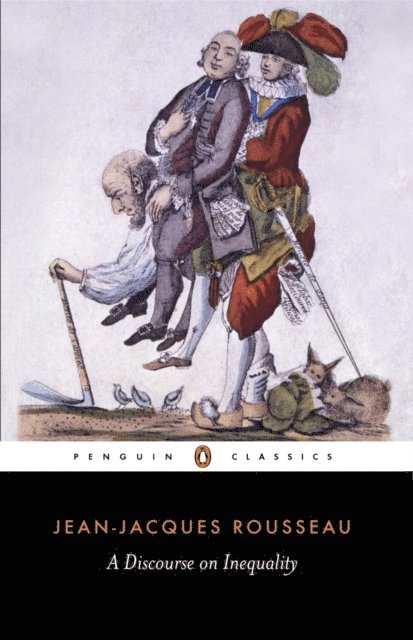
    In A Discourse on Inequality Rousseau sets out to demonstrate how the growth of civilization corrupts man’s natural happiness and freedom by creating artificial inequalities of wealth, power and social privilege. Contending that primitive man was equal to his fellows, Rousseau believed that as societies become more sophisticated, the strongest and most intelligent members of the community gain an unnatural advantage over their weaker brethren, and that constitutions set up to rectify these imbalances through peace and justice in fact do nothing but perpetuate them. Rousseau’s political and social arguments in the Discourse were a hugely influential denunciation of the social conditions of his time and one of the most revolutionary documents of the eighteenth-century.

    Produktinformation

    • Utgivningsdatum:2003-09-25
    • Språk:Engelska
    • Filformat:EPUB
    • Kopieringsskydd:LCP
    • ISBN:9780141920009
    • Förlag:Penguin Books Ltd
    • Översättare:Maurice Cranston

    Utforska kategorier

    • Diskriminering och rättvisa inom Samhälle och politik
    • Statsvetenskap och politisk teori inom Samhälle och politik
    • Filosofiska discipliner inom Filosofi och religion

    Mer om författaren

    JEAN-JACQUES ROUSSEAU was born in Geneva in 1712. Abandoned by his father at the age of ten he tried his hand as an engraver's apprentice before he left the city in 1728. From then on he was to wander Europe seeking an elusive happiness. At Turin he became a Catholic convert; and as a footman, seminarist, music teacher or tutor visited many parts of Switzerland and France. In 1732 he settled for eight years at Chambéry or Les Charmettes, the country house of Madame de Warens, remembered by Rousseau as an idyllic place in the Confessions. In 1741 he set out for Paris where he met Diderot who commissioned him to write the musical articles for the Encyclopédie. In the meantime he fathered five children by Thérèse Levasseur, a servant girl, and abandoned them to a foundling home. The 1750s witnessed a breach with Voltaire and Diderot and his writing struck a new note of defiant independence. In his Discours sur les sciences et les arts and the Discours sur l'origine de l'inégalité he showed how the growth of civilization corrupted natural goodness and increased inequality between men. In 1758 he attacked his former friends, the Encyclopaedists, in the Lettre à d'Alembert sur les spectacles which pilloried cultured society. In 1757 he moved to Montmorency and these five years were the most fruitful of his life. His remarkable novel La nouvelle Héloise (1761), met with immediate and enormous success. In this and in Émile, which followed a year later, Rousseau invoked the inviolability of personal ideals against the power of the state and the pressures of society. The crowning achievement of his political philosophy was The Social Contract, published in 1762. That same year he wrote an attack on revealed religion, the Profession de foi du vicaire savoyard. He was driven from Switzerland and fled to England where he only succeeded in making an enemy of Hume and returned to his continental peregrinations. In 1770 Rousseau completed his Confessions. His last years were spent largely in France where he died in 1778.