• Fri frakt över 249 kr
  • •
  • Snabba leveranser
  • •
  • Billiga böcker
Kundservice

Du är på sajten för privatpersoner.

Företag, bibliotek eller offentlig verksamhet?

Du handlar på classic.bokus.com, där alla dina funktioner finns intakta.
Till classic.bokus.com
Bokus logotyp. Gå till startsidan.
  • Erbjudanden
  • Nyheter
  • Student
  • Topplistor
  • Barn & ungdom
  • Bokus Play
  • E-böcker
  • Pocketböcker
  • Spel & pussel

10% rabatt på allt med kod: NYSTART10 →

Sidfot

Mina sidor

    Hjälp

    • Kundservice
    • Vanliga frågor och svar
    • Frakt och leverans
    • Retur vid ångerrätt
    • Reklamera vara
    • Betalning
    • Köpvillkor
    • Allmänna villkor
    • Information om webbplatsens tillgänglighet

    Om Bokus

    • Om oss
    • Pressrum
    • För studenter
    • För företag
    • För bibliotek och offentlig verksamhet
    • För leverantörer
    • Hållbarhet

    Populärt

    • Aktuella erbjudanden
    • Presentkort
    • Studentlitteratur
    • Nya böcker
    • Topplistor
    • Signerade böcker
    • Engelska böcker

    Inspiration

    • Boktips
    • BookTok
    • Populära bokserier
    • Barnbokskaraktärer
    • Populära författare
    Logotyp för Bokus
    Följ oss på Facebook (extern länk)Följ oss på Instagram (extern länk)Följ oss på YouTube (extern länk)Följ oss på TikTok (extern länk)
    bokus @ CookiesAnpassa cookiesIntegritetspolicyKöpvillkor
    Till Citymail hemsida (extern länk)Till Budbee hemsida (extern länk)Till Postnord hemsida (extern länk)Till Schenker hemsida (extern länk)Till Early Bird hemsida (extern länk)Till Walleys hemsida (extern länk)
    1. Juridik
    2. Rättsvetenskap
    3. Lag och samhälle

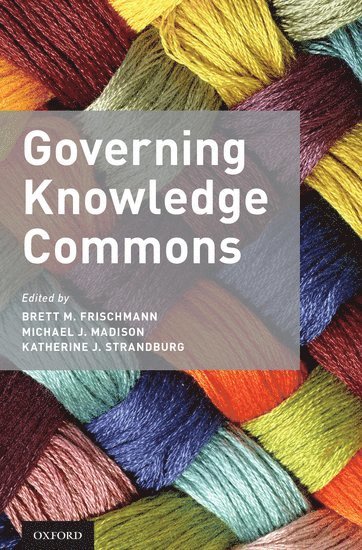
    Governing Knowledge Commons

    AvBrett M. Frischmann,Michael J. Madison

    Häftad, Engelska, 2014

    807 kr

    Beställningsvara. Skickas inom 7-10 vardagar. Fri frakt över 249 kr.

    Beskrivning

    "Knowledge commons" describes the institutionalized community governance of the sharing and, in some cases, creation, of information, science, knowledge, data, and other types of intellectual and cultural resources. It is the subject of enormous recent interest and enthusiasm with respect to policymaking about innovation, creative production, and intellectual property. Taking that enthusiasm as its starting point, Governing Knowledge Commons argues that policymaking should be based on evidence and a deeper understanding of what makes commons institutions work. It offers a systematic way to study knowledge commons, borrowing and building on Elinor Ostrom's Nobel Prize-winning research on natural resource commons. It proposes a framework for studying knowledge commons that is adapted to the unique attributes of knowledge and information, describing the framework in detail and explaining how to put it into context both with respect to commons research and with respect to innovation and information policy. Eleven detailed case studies apply and discuss the framework exploring knowledge commons across a wide variety of scientific and cultural domains.

    Produktinformation

    • Utgivningsdatum:2014-09-25
    • Mått:231 x 155 x 35 mm
    • Vikt:678 g
    • Format:Häftad
    • Språk:Engelska
    • Antal sidor:520
    • Förlag:OUP USA
    • ISBN:9780190225827

    Utforska kategorier

    • Lag och samhälle inom Juridik
    • Miljörätt inom Juridik
    • Immaterialrätt inom Juridik

    Mer om författaren

    Brett M. Frischmann is Professor of Law and Director of the Intellectual Property and Information Law Program at the Benjamin N. Cardozo School of Law, Yeshiva University. He is the author of Infrastructure: The Social Value of Shared Resources (Oxford, 2012) which won the 2013 PROSE Book Award for the best book in law and legal studies. He is also co-author of Cyberlaw: Problems of Policy and Jurisprudence in the Information Age (4th edition, 2011).Michael J. Madison is Professor of Law and Faculty Director of the Innovation Practice Institute at the University of Pittsburgh School of Law, where he writes and teaches about information law and theory, along with various disciplines of intellectual property law, contracts and commercial law, and property law. He is the co-author of The Law of Intellectual Property (4th edition).Katherine J. Strandburg is the Alfred B. Engelberg Professor of Law at the New York University School of Law and Faculty Director of the Engelberg Center on Innovation Law and Policy, where she teaches and writes about intellectual property law, especially as it intersects with user and commons-based innovation, and information privacy law. She is a co-editor of several books on intellectual property and information privacy law and policy, and she regularly authors amicus briefs on these subjects.

    Recensioner i media

    Governing Knowledge Commons comes at the right time with the right mix of case studies for inferences on when, how, and for how long, commons institutions can provide production incentives while mitigating those for free riding. Increasingly, advances in knowledge, research, and solutions to economic and social problems occur where individual property rights are absent. Common property institutions can make productive cooperation possible, and this volume helps in understanding the linkages between the commons and creativity."

    Innehållsförteckning

    • Acknowledgments ; Introduction ; Chapter 1: Governing the Knowledge Commons ; Chapter 2: Learning from Lin: Lessons and Cautions from the Natural Commons for the Knowledge Commons / by Daniel H. Cole ; Chapter 3: Between Spanish Huertas and the Open Road: A Tale of Two Commons? / by Yochai Benkler ; Chapter 4: Constructing the Genome Commons / Jorge L. Contreras ; Chapter 4B: Governing Genomic Data: Plea for an 'Open Commons' / by Geertrui Van Overwalle ; Chapter 5: The Rare Diseases Clinical Research Network and the Urea Cycle Disorders Consortium as Nested Knowledge Commons / by Katherine J. Strandburg, Brett Frischmann, and Can Cui ; Chapter 6: Commons at the Intersection of Peer Production, Citizen Science, and Big Data: Galaxy Zoo / by Michael J. Madison ; Chapter 7: Toward the Comparison of Open Source Commons Institutions / by Charlie Schweik ; Chapter 8: Governance of Online Creation Communities for the Building of Digital Commons: Viewed Through the Framework of the Institutional Analysis and Development / Mayo Fuster Morell ; Chapter 9: Creating a Context for Entrepreneurship: Examining How Users' Technological & Organizational Innovations Set the Stage for Entrepreneurial Activity / Sonali K. Shah and Cyrus C.M. Mody ; Chapter 10: An Inventive Commons: Shared Sources of the Airplane and its Industry / by Peter B. Meyer ; Chapter 11: Exchange Practices Among Nineteenth-century US Newspaper Editors: ; Cooperation in Competition / by Laura J. Murray ; Chapter 12: How War Creates Commons: General McNaughton and the National Research Council, 1914-1939 / by S. Tina Piper ; Chapter 13: Labor and/as Love: Roller Derby's Knowledge Commons / by David Fagundes ; Chapter 14: Legispedia / by Brigham Daniels ; Chapter 15: Conclusion ; Index