• Fri frakt över 249 kr
  • •
  • Snabba leveranser
  • •
  • Billiga böcker
Kundservice

Du är på sajten för privatpersoner.

Företag, bibliotek eller offentlig verksamhet?

Du handlar på classic.bokus.com, där alla dina funktioner finns intakta.
Till classic.bokus.com
Bokus logotyp. Gå till startsidan.
  • Erbjudanden
  • Nyheter
  • Student
  • Topplistor
  • Barn & ungdom
  • Bokus Play
  • E-böcker
  • Pocketböcker
  • Spel & pussel

10% rabatt på allt med kod: NYSTART10 →

Sidfot

Mina sidor

    Hjälp

    • Kundservice
    • Vanliga frågor och svar
    • Frakt och leverans
    • Retur vid ångerrätt
    • Reklamera vara
    • Betalning
    • Köpvillkor
    • Allmänna villkor
    • Information om webbplatsens tillgänglighet

    Om Bokus

    • Om oss
    • Pressrum
    • För studenter
    • För företag
    • För bibliotek och offentlig verksamhet
    • För leverantörer
    • Hållbarhet

    Populärt

    • Aktuella erbjudanden
    • Presentkort
    • Studentlitteratur
    • Nya böcker
    • Topplistor
    • Signerade böcker
    • Engelska böcker

    Inspiration

    • Boktips
    • BookTok
    • Populära bokserier
    • Barnbokskaraktärer
    • Populära författare
    Logotyp för Bokus
    Följ oss på Facebook (extern länk)Följ oss på Instagram (extern länk)Följ oss på YouTube (extern länk)Följ oss på TikTok (extern länk)
    bokus @ CookiesAnpassa cookiesIntegritetspolicyKöpvillkor
    Till Citymail hemsida (extern länk)Till Budbee hemsida (extern länk)Till Postnord hemsida (extern länk)Till Schenker hemsida (extern länk)Till Early Bird hemsida (extern länk)Till Walleys hemsida (extern länk)
    1. Ekonomi och Ledarskap
    2. Nationalekonomi
    3. Ekonomisk politik

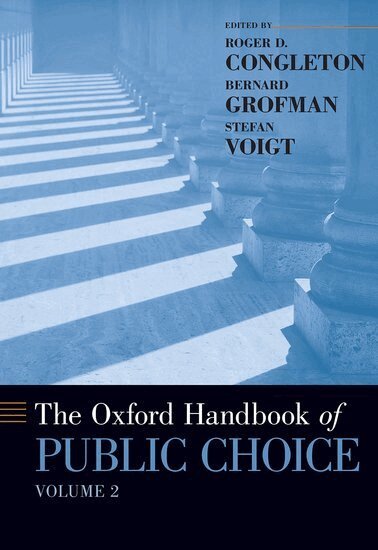
    The Oxford Handbook of Public Choice, Volume 2

    AvRoger D. Congleton,Bernard N. Grofman

    Inbunden, Engelska, 2019

    Del i serien Oxford Handbooks

    3 077 kr

    Beställningsvara. Skickas inom 5-8 vardagar. Fri frakt över 249 kr.

    Beskrivning

    The Oxford Handbook of Public Choice provides a comprehensive overview of the research in economics, political science, law, and sociology that has generated considerable insight into the politics of democratic and authoritarian systems as well as the influence of different institutional frameworks on incentives and outcomes. The result is an improved understanding of public policy, public finance, industrial organization, and macroeconomics as the combination of political and economic analysis shed light on how various interests compete both within a given rules of the games and, at times, to change the rules. These volumes include analytical surveys, syntheses, and general overviews of the many subfields of public choice focusing on interesting, important, and at times contentious issues. Throughout the focus is on enhancing understanding how political and economic systems act and interact, and how they might be improved.Both volumes combine methodological analysis with substantive overviews of key topics. This second volume examines constitutional political economy and also various applications, including public policy, international relations, and the study of history, as well as methodological and measurement issues. Throughout both volumes important analytical concepts and tools are discussed, including their application to substantive topics. Readers will gain increased understanding of rational choice and its implications for collective action; various explanations of voting, including economic and expressive; the role of taxation and finance in government dynamics; how trust and persuasion influence political outcomes; and how revolution, coups, and authoritarianism can be explained by the same set of analytical tools as enhance understanding of the various forms of democracy.

    Produktinformation

    • Utgivningsdatum:2019-02-07
    • Mått:249 x 183 x 61 mm
    • Vikt:1 769 g
    • Format:Inbunden
    • Språk:Engelska
    • Serie:Oxford Handbooks
    • Antal sidor:1 016
    • Förlag:OUP USA
    • ISBN:9780190469771

    Utforska kategorier

    • Ekonomisk politik inom Ekonomi och Ledarskap
    • Nationalekonomi inom Ekonomi och Ledarskap

    Mer om författaren

    Roger D. Congleton is the BB&T Professor of Economics at West Virginia University. He is coeditor of the journal, Constitutional Political Economy , and has publishing well over a hundred fifty articles on public choice related topics in journals and academic books.Professor Congleton also served as president of the Public Choice Society from March 2018 through March 2020.Bernard Grofman is the Jack W. Peltason Chair of Democracy Studies and Professor of Political Science, University of California, Irvine.Stefan Voigt is professor of Law & Economics at the University of Hamburg in Germany. He is best known for his research in constitutional political economy. Together with Roger Congleton, he is editor of the journal, Constitutional Political Economy.

    Innehållsförteckning

    • PART V: Constitutional Political Economy A. On the Architecture of Governance 1. How Should Votes be Cast and Counted?Nicolaus Tideman 2. Voters and representatives: How should representatives be selected?Thomas Braendle and Alois Stutzer 3. Divided Government: the king and the councilGeorge Tridimas 4. BicameralismCecilia Testa 5. Federalism Jaroslaw Kantorowicz 6. Executive Veto Power and Constitutional Design Nicholas R. Miller 7. Politics and the Legal SystemLee Epstein, Andrew D. Martin, Kevin Quinn & Jeffrey A. Segal 8. Constitutional ReviewNuno Garoupa 9. Institutions for Amending ConstitutionsCristina Bucur and Bjørn Erik Rasch 10. Constitutional TransitionZachary Elkins 11. Electoral systems in the makingDaniel Bochsler 12. Choosing Voting Rules in the European UnionB?la Plechanovová, Madeleine O. Hosli and Anatolij Plechanov B. The Theory of Dictatorship 13. Leviathan, Taxation, and Public GoodsMartin C. McGuire 14. Fiscal Powers Revisited: The Leviathan Model after 40 YearsGeoffrey Brennan and Hartmut Kliemt 15. Are There Types of Dictatorship?Ronald Wintrobe 16. Are there really dictatorships? The Selectorate and authoritarian governanceAlejandro Quiroz Flores 17. The coup: competition for office in authoritarian regimesToke Aidt and Gabriel Leon 18. The Logic of Revolutions: Rational Choice PerspectivesTimur Kuran and Diego Romero C. On the Effects of the Institutions of Governance 19. Direct Democracy and Public PolicyJohn G. Matsusaka 20. Policy differences among parliamentary and presidential systemsSebastian M. Saiegh 21. The Significance of Political PartiesMichael Munger 22. The least dangerous branch? Public choice, constitutional courts, and democratic governanceGeorg Vanberg 23. Challenges in Estimating the Effects of Constitutional Design on Public PolicyStefan Voigt and Jerg Gutmann PART VI: APPLICATIONS, EXTENSIONS, AND METHODOLOGICAL ISSUES A. The Politics of Public Policy 24. The Political Economy of Taxation: Power, Structure, RedistributionStanley L. Winer 25. The politics of central bank independenceJakob de Haan and Sylvester C.W. Eijffinger 26. The Political Economy of Redistribution PolicyLuna Bellani and Heinrich Ursprung 27. Political Participation and the welfare Rainald Borck 28. Institutions for Solving Commons Problems: Lessons and Implications for Institutional DesignPaul Dragos Aligica and Michael E. Cox 29. Rational Ignorance and Public ChoiceIlya Somin 30. Is Government Growth Inevitable?Randall G. Holcombe B. International Public Choice 31. The Political Economy of International OrganizationsAxel Dreher and Valentin F. Lang 32. The Politics of International TradeWilfred J. Ethier and Arye L. Hillman 33. Politics, Direct Investment, Public Debt Markets and the Shadow Economy: What do we (not) know?Friedrich Schneider 34. The Politics of International AidHristos Doucouliagos 35. Is democracy exportable?Pierre Salmon C. Public Choice and History 36. Ancient Greece: Democracy and AutocracyRobert K. Fleck and F. Andrew Hanssen 37. Christian History and Public ChoiceMario Ferrero 38. Voting at the U.S. Constitutional ConventionKeith L. Dougherty 39. Precursors to public choiceIain McLean D. Measurement and other Methodological Issues 40. Estimates of the Spatial Voting ModelChristopher Hare and Keith T. Poole 41. The Dimensionality of Parliamentary VotingKeith T. Poole 42. Voting and PopularityGebhard Kirchgässner 43. Detection of election fraudSusumu Shikano and Verena Mack 44. Experimental Public Choice: ElectionsAaron Kamm and Arthur Schram 45. Experimental Evidence on Expressive Voting Jean-Robert Tyran and Alexander K. Wagner