• Fri frakt över 249 kr
  • •
  • Snabba leveranser
  • •
  • Billiga böcker
Kundservice

Du är på sajten för privatpersoner.

Företag, bibliotek eller offentlig verksamhet?

Du handlar på classic.bokus.com, där alla dina funktioner finns intakta.
Till classic.bokus.com
Bokus logotyp. Gå till startsidan.
  • Erbjudanden
  • Nyheter
  • Student
  • Topplistor
  • Barn & ungdom
  • Bokus Play
  • E-böcker
  • Pocketböcker
  • Spel & pussel

10% rabatt på allt med kod: NYSTART10 →

Sidfot

Mina sidor

    Hjälp

    • Kundservice
    • Vanliga frågor och svar
    • Frakt och leverans
    • Retur vid ångerrätt
    • Reklamera vara
    • Betalning
    • Köpvillkor
    • Allmänna villkor
    • Information om webbplatsens tillgänglighet

    Om Bokus

    • Om oss
    • Pressrum
    • För studenter
    • För företag
    • För bibliotek och offentlig verksamhet
    • För leverantörer
    • Hållbarhet

    Populärt

    • Aktuella erbjudanden
    • Presentkort
    • Studentlitteratur
    • Nya böcker
    • Topplistor
    • Signerade böcker
    • Engelska böcker

    Inspiration

    • Boktips
    • BookTok
    • Populära bokserier
    • Barnbokskaraktärer
    • Populära författare
    Logotyp för Bokus
    Följ oss på Facebook (extern länk)Följ oss på Instagram (extern länk)Följ oss på YouTube (extern länk)Följ oss på TikTok (extern länk)
    bokus @ CookiesAnpassa cookiesIntegritetspolicyKöpvillkor
    Till Citymail hemsida (extern länk)Till Budbee hemsida (extern länk)Till Postnord hemsida (extern länk)Till Schenker hemsida (extern länk)Till Early Bird hemsida (extern länk)Till Walleys hemsida (extern länk)
    1. Språk och ordböcker
    2. Språkvetenskap och lingvistik

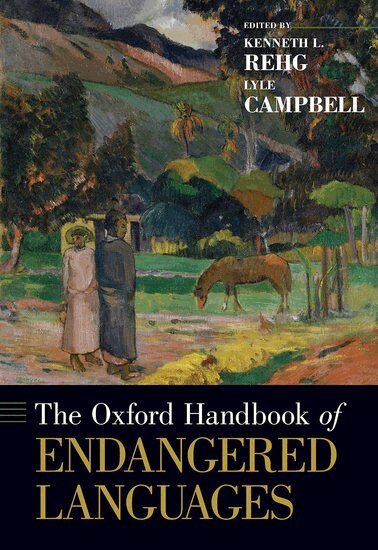
    The Oxford Handbook of Endangered Languages

    AvKenneth L. Rehg,Lyle Campbell

    Inbunden, Engelska, 2018

    Del i serien Oxford Handbooks

    3 032 kr

    Beställningsvara. Skickas inom 5-8 vardagar. Fri frakt över 249 kr.

    Beskrivning

    The endangered languages crisis is widely acknowledged among scholars who deal with languages and indigenous peoples as one of the most pressing problems facing humanity, posing moral, practical, and scientific issues of enormous proportions. Simply put, no area of the world is immune from language endangerment.The Oxford Handbook of Endangered Languages, in 39 chapters, provides a comprehensive overview of the efforts that are being undertaken to deal with this crisis. A comprehensive reference reflecting the breadth of the field, the Handbook presents in detail both the range of thinking about language endangerment and the variety of responses to it, and broadens understanding of language endangerment, language documentation, and language revitalization, encouraging further research. The Handbook is organized into five parts. Part 1, Endangered Languages, addresses the fundamental issues that are essential to understanding the nature of the endangered languages crisis. Part 2, Language Documentation, provides an overview of the issues and activities of concern to linguists and others in their efforts to record and document endangered languages. Part 3, Language Revitalization, includes approaches, practices, and strategies for revitalizing endangered and sleeping ("dormant") languages. Part 4, Endangered Languages and Biocultural Diversity, extends the discussion of language endangerment beyond its conventional boundaries to consider the interrelationship of language, culture, and environment, and the common forces that now threaten the sustainability of their diversity. Part 5, Looking to the Future, addresses a variety of topics that are certain to be of consequence in future efforts to document and revitalize endangered languages.

    Produktinformation

    • Utgivningsdatum:2018-09-06
    • Mått:178 x 254 x 61 mm
    • Vikt:1 760 g
    • Format:Inbunden
    • Språk:Engelska
    • Serie:Oxford Handbooks
    • Antal sidor:976
    • Förlag:OUP USA
    • ISBN:9780190610029

    Utforska kategorier

    • Språkvetenskap och lingvistik inom Språk och ordböcker
    • Antropologi inom Samhälle och politik

    Mer om författaren

    Kenneth L. Rehg is an Associate Professor of Linguistics at the University of Hawai'i at Mânoa (retired) and an authority on the languages of Micronesia. He is the (co)author of three books and numerous papers on these languages and the founding editor of Language Documentation & Conservation. His interests include language documentation, lexicography, phonology, historical linguistics, and the application of linguistics to the formation of educational policies and practices in the developing nations of the Pacific.Lyle Campbell is Emeritus Professor of Linguistics at the University of Hawai'i at Mânoa. He has held joint appointments in Linguistics, Anthropology, Behavioral Research, Latin American Studies, and Spanish, and has been a Visiting Professor in Australia, Brazil, Canada, Finland, Germany, Mexico, New Zealand, and Spain. His interests include language documentation, historical linguistics, indigenous languages of the Americas, and typology.

    Recensioner i media

    The book will be of interest and a valuable guide to students and young researchers interested in pursuing research and implementing language documentation and revitalisation programmes. It is also a good source of reference for those who seek information about language endangerment and revitalisation worldwide.

    Innehållsförteckning

    • ForewordMichael Krauss IntroductionLyle Campbell and Kenneth L. Rehg Part I: Endangered Languages(1) The status of the world's endangered languagesAnna Belew and Sean Simpson(2) Assessing degrees of language endangermentNala H. Lee and John R. Van Way(3) Language contact and language endangermentSarah G. Thomason(4) Indigenous language rights-miner's canary or mariner's tern?Teresa L. McCarty Part II: Language Documentation(5) The goals of language documentationRichard Rhodes and Lyle Campbell(6) Documentation, linguistic typology, and formal grammarKeren Rice(7) The design and implementation of documentation projects for spoken languagesShobhana Chelliah(8) Endangered sign languages: An introductionJames Woodward(9) Design and implementation of collaborative language documentation projectsRacquel-María Sapién(10) Tools and technology for language documentation and revitalizationKeren Rice and Nick Thieberger(11) Corpus compilation and exploitation in language documentation projectsUlrike Mosel(12) Writing grammars of endangered languagesAmber Camp, Lyle Campbell, Victoria Chen, Nala H. Lee, Matthew Lou-Magnuson, and Samantha Rarrick(13) Compiling dictionaries of endangered languagesKenneth L. Rehg(14) Orthography design and implementation for endangered languagesMichael Cahill(15) Language archivingAndrea L. Berez-Kroeker and Ryan E. Henke(16) Tools from the ethnography of communication for language documentationSimeon Floyd(17) Language documentation in diaspora communitiesDaniel Kaufman & Ross Perlin(18) Ethics in language documentation and revitalizationJeff Good Part III: Language Revitalization(19) Approaches to and strategies for language revitalizationLeanne Hinton(20) Comparative analysis in language revitalization practices: addressing the challengeGabriela Pérez Báez, Rachel Vogel, and Eve Okura Koller(21) The linguistics of language revitalization: Problems of acquisition and attritionWilliam O'Grady(22) New media for endangered languagesLaura Buszard-Welcher(23) Language recovery paradigmsAlan R. King(24) Myaamiaataweenki: Revitalization of a sleeping languageDaryl Baldwin and David J. Costa(25) Language revitalization in kindergarten: A case study of Truku Seediq language immersionApay Tang(26) Mâori: Revitalisation of an endangered languageJeanette King(27) Language revitalization in AfricaBonny Sands(28) Planning minority language maintenance: challenges and limitationsSue Wright Part IV: Endangered Languages and Biocultural Diversity(29) Congruence between species and language diversityDavid Harmon and Jonathan Loh(30) Sustaining biocultural diversityLuisa Maffi(31) Traditional and local knowledge systems as language legacies critical for conservationWill C. McClatchey(32) Climate change and its consequences for cultural and language endangermentChristopher P. Dunn(33) Interdisciplinary language documentationGary Holton(34) Why lexical loss and culture death endanger scienceIan Mackenzie and Wade DavisPart V: Looking to the Future(35) Funding the documentation and revitalization of endangered languagesSusan Penfield(36) Teaching linguists to document endangered languagesCarol Genetti(37) Training language activists to support endangered languagesNora C. England(38) Designing mobile applications for endangered languagesSteven Bird(39) Indigenous language use impacts wellnessAlice Taff, Melvatha Chee, Jaeci Hall, Millie Yéi Dulitseen Hall, Kawenniyóhstha Nicole Martin, Annie Johnston AfterwordDavid Crystal