• Fri frakt över 249 kr
  • •
  • Snabba leveranser
  • •
  • Billiga böcker
Kundservice

Du är på sajten för privatpersoner.

Företag, bibliotek eller offentlig verksamhet?

Du handlar på classic.bokus.com, där alla dina funktioner finns intakta.
Till classic.bokus.com
Bokus logotyp. Gå till startsidan.
  • Erbjudanden
  • Nyheter
  • Student
  • Topplistor
  • Barn & ungdom
  • Bokus Play
  • E-böcker
  • Pocketböcker
  • Spel & pussel

10% studentrabatt med kod TERM26

Sidfot

Mina sidor

    Hjälp

    • Kundservice
    • Vanliga frågor och svar
    • Frakt och leverans
    • Retur vid ångerrätt
    • Reklamera vara
    • Betalning
    • Köpvillkor
    • Allmänna villkor
    • Information om webbplatsens tillgänglighet

    Om Bokus

    • Om oss
    • Pressrum
    • För studenter
    • För företag
    • För bibliotek och offentlig verksamhet
    • För leverantörer
    • Hållbarhet

    Populärt

    • Aktuella erbjudanden
    • Presentkort
    • Studentlitteratur
    • Nya böcker
    • Topplistor
    • Signerade böcker
    • Engelska böcker

    Inspiration

    • Boktips
    • BookTok
    • Populära bokserier
    • Barnbokskaraktärer
    • Populära författare
    Logotyp för Bokus
    Följ oss på Facebook (extern länk)Följ oss på Instagram (extern länk)Följ oss på YouTube (extern länk)Följ oss på TikTok (extern länk)
    bokus @ CookiesAnpassa cookiesIntegritetspolicyKöpvillkor
    Till Citymail hemsida (extern länk)Till Budbee hemsida (extern länk)Till Postnord hemsida (extern länk)Till Schenker hemsida (extern länk)Till Early Bird hemsida (extern länk)Till Walleys hemsida (extern länk)
    1. Naturvetenskap och teknik
    2. Geovetenskap
    3. Miljövetenskap och miljöpolitik

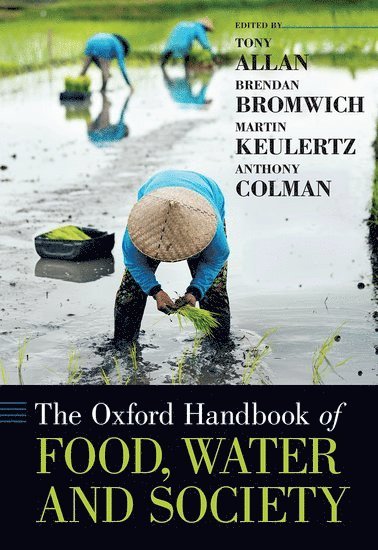
    The Oxford Handbook of Food, Water and Society

    AvTony Allan,Brendan Bromwich

    Inbunden, Engelska, 2019

    Del i serien Oxford Handbooks

    2 810 kr

    Beställningsvara. Skickas inom 5-8 vardagar. Fri frakt över 249 kr.

    Beskrivning

    Food, water and society: what is managed by whom, and with what impacts? Our food supply chains are at risk. Water resources--sometimes scarce, often damaged, and always under-valued--are among the major reasons why food and water security rank high every year in the World Economic Forum's major global risk analysis. A stable and sustainable food system is critical to society's survival. This Handbook shows that keeping the food system stable comes at the expense of the environment, especially of water resources and those who consume and manage them. The way the food system operates reflects hard political realities. Rather than pay for the environmental costs of sustainable production, society expects food at ever lower prices. Governments reflect their electorates in this regard. Given that farm production may account for as little as 10% of the food value chain in wealthy economies, it is striking that governments have been unwilling (or unable) to put in place the essential laws and accountability that would enable famers to ensure both production and stewardship. Corporate food traders, food manufacturers, and retailers on the other hand operate in markets that make profits and pay taxes. But these corporations are not contractually bound to utilize highly nutritious, sustainably produced food commodities. The articles in this Oxford Handbook have been written by water and food system scientists and professionals, including farmers, rarely heard voices who understand the problems of food producers, food manufacturers, and regulating markets and public policy. The articles address the blind spots of society and its public policymakers, demonstrating the importance of informing society about the consequences of its food preferences and the heroic challenges it is beginning to face. The damage we are doing to our water and soil ecosystems is as important as the damage we do to the atmosphere. Impressed by the technical and organizational advances of the past two centuries, the contributors featured in this book also take note of where economic inefficiencies and cultural deadlock in a 4,000 year old system are putting our critical food supply chains at risk.

    Produktinformation

    • Utgivningsdatum:2019-11-27
    • Mått:249 x 175 x 61 mm
    • Vikt:1 769 g
    • Format:Inbunden
    • Språk:Engelska
    • Serie:Oxford Handbooks
    • Antal sidor:944
    • Förlag:OUP USA
    • ISBN:9780190669799

    Utforska kategorier

    • Miljövetenskap och miljöpolitik inom Naturvetenskap och teknik

    Mer om författaren

    Tony Allan, PhD is based at King's College London and SOAS London. He specializes in the analysis of water resources in semi-arid regions and on the role of global systems in ameliorating local and regional water deficits. He pointed out that water short economies achieve water and food security not on the basis of their own water endowments but by importing water intensive food commodities - a concept which he found he had to call "virtual water." For the past decade he has analyzed our very politicized food system, highlighting that how the "broken" food system operates determines how water is managed and mismanaged by farmers.Brendan Bromwich is an environmental engineer with experience of water problems in complex social and political contexts. He has worked in the private sector, NGOs and the UN in Europe, Asia, and Africa with a focus on water infrastructure and on institutional change. His PhD thesis examines institutional change and conflict over natural resources and is based on hisexperience coordinating UN Environment's work in Sudan. He holds degrees in Environmental Engineering from Imperial College and in Geography from King's College London. Martin Keulertz, PhD works as Assistant Professor at the Faculty of Agricultural and Food Sciences at the American University of Beirut, where he chairs AUB's Food Security Program. He previously worked as a post-doctoral research fellow at Purdue University (USA) and Humboldt University Berlin (Germany). He obtained his PhD at King's College London (UK) in 2013, his MSc in Middle East Politics at the School of Oriental and African Studies (University of London) and a BA in Political and Social Sciences at the University of Wales, Bangor in 2007. Martin's research interests center around the water-food-energy nexus with a particular focus on the Arab world, North America, and Sub-Saharan Africa. Moreover, he has published on the global political economy of water and food.Anthony Colman, PhD is Visiting Research Fellow at theUniversity of Cape Town, University of East Anglia and the Columbia Water Center. His current work is on the UNFCCC Koronivia agenda to reduce GHG emissions and ensure the adaptation of agriculture. He is completing a trilogy study of Cape Town, New York City, and London's planning for drinking water. He was the UK MP for Putney from 1997 to 2005. He is a member of the World Future Council. His work brings together the disciplines of academia, political realism, and the private sector.

    Innehållsförteckning

    • ContentsList of ContributorsIntroduction1. Food, Water and Society: An Analytical Framework Brendan Bromwich, Tony Allan, Anthony Colman, Martin KeulertzPart I: Key Concepts2. Green Water Used By Plants And Managed By Farmers: Measurement, Accounting, PolicyDavid Leslie Dent3. Green Water and Food Security Garrison Sposito4. Natural Capital Accounting for Water ResourcesMatthew Agarwala, Michael Brock5. Will Irrigation Technology, Pricing, or Quotas Ensure Sustainable Water Use? Chris Perry6. Global food Trade and Local Water Resources: Can We Bridge the Regulatory Gap?Arjen Hoekstra7. Water Service Requirements for Agriculture: Nature, Nurture and NegotiationCarl Hausmann8. Valuing Water in Supply Chains Peter Brabeck-Letmathe, Christian A. Vousvouras, Samuel Vionnet9. Valuing Water in Food Systems and BeyondAlexis J. Morgan, Stuart Orr, Nathanial Matthews10. Subsidies and the Environment: Impacts of WTO Agricultural Support DisciplinesUlla Kask11. Dietary Patterns that Value People and the PlanetJoanne Burke12. Incentive Programs to Address the Challenges of Hunger, Undernutrition, and Obesity in the United StatesGus Schumacher, Emily Nink13. Farmer-led Water User Associations in Agricultural Water ManagementRami Zurayk, Azza Dirar14. Gender, Poverty and Politics Along the Real-virtual Water SpectrumFloriane Clement, Alan Nicol15. The Feminization of Agriculture: Evidence and Implications for Food and Water SecurityVanya Slavchevska, Susan Kaaria, Sanna Liisa Taivalmaa16. Societal Drivers of Food and Water Systems 1: Material Flows, Household Consumption Styles, and Contending Schools of Engineering ThoughtMichael Thompson, M. Bruce Beck, Dipak Gyawali17. Societal Drivers of Food and Water Systems 2: Applying Plural Rationality to some Wicked ProblemsM. Bruce Beck, Dipak Gyawali, Michael ThompsonPart II: Global Problemsheds18. Water and Food in the American West: Lessons from Recent Droughts in CaliforniaJosué Medellín-Azuara, Jay Lund, Daniel A. Sumner19. Food and Water Security in North America's Transboundary Sonoran Desert: a Water Exporting Dryland America Lutz Ley, Ryan Lee, Yulia Peralta, Christopher Scott20. Water Issues and the Brazilian Agricultural AgendaVanessa Lucena Empinotti21. Water in Australian AgricultureJames Horne22. Circumventing Water Scarcity in the Jordan Basin: Decoupling Trends in Israel and JordanMichael Gilmont, Lara Nassar, Erica Harper, Nadav Tal, Steve Rayner23. Food and Water Management in Northwest AfricaMustapha Besbes, Jamel Chahed, Abdelkader Hamdane24. Food and Water Management in the Mediterranean BasinMichel Petit, Phillipe Le Grusse25. Food and Water Security in West AfricaTim Williams26. Food and Water Management in Southern AfricaPeter Johnston, Arthur Chapman27. Food and Water Security in West AsiaEckart Woertz28. Understanding Pesticides in England and Wales: Pathways, Policies, and Pollution PreventionFrances C. Elwell, Nikolaus J. Clemenz, Nicola J. Nineham29. Cape Town's Contested Hierarchy of Demand for Agricultural and Municipal Water in a Rainfed Economy 2017-18Anthony ColmanPart III: Key Supply Chains30. Global Wheat Value ChainsGhada Ahmed31. Water for CoffeeJohn Schluter32. Water and Rice Production: Looking to the FuturePhil Riddell, Biksham Gujja33. Oil Palm Value Chain ManagementDenis Murphy34. Successes and Problems with Measuring Water Consumption in Beef SystemsMieghan Bruce, Camille Bellet, Jonathan RushtonPart IV: Responding to the Challenge35. The Potential Impact of Improved Water Management to Alleviate Water Scarcity and Hunger: A Global PerspectiveDieter Gerten, Jonas Jägermeyr36. The Global Uptake of Conservation Agriculture and the Impact on Water-related Ecosystem ServicesAmir Kassam, David Coates37. A Farmer's Experience of Conservation Agriculture in the UKAnthony J. Reynolds38. The Variable Rate Irrigation Management ChallengeJames Lowenberg-DeBoer39. The Water Infrastructure Crisis Phil Riddell40. Integrating Multi-Capital Thinking into Business DecisionsJyoti Banerjee41. Modelling Agricultural Controls for Flooding and Soil ErosionRoger Moussa, Bruno Cheviron42. Water Management by FarmersLaurence Smith43. The Role of New and Green Water Resources in Localizing Water and Food Security Under Arid and Semi-Arid ConditionsRabi Mohtar, Amjad Assi44. Disruptive Food Supply Chains: Bringing it all Back HomeTony Beck45. Lab-grown Meat: Can It Change the World?Martin KeulertzConclusions46. Food, Water and the Consequences of Society not Valuing the EnvironmentTony Allan Index