• Fri frakt över 249 kr
  • •
  • Snabba leveranser
  • •
  • Billiga böcker
Kundservice

Du är på sajten för privatpersoner.

Företag, bibliotek eller offentlig verksamhet?

Du handlar på classic.bokus.com, där alla dina funktioner finns intakta.
Till classic.bokus.com
Bokus logotyp. Gå till startsidan.
  • Erbjudanden
  • Nyheter
  • Student
  • Topplistor
  • Barn & ungdom
  • Bokus Play
  • E-böcker
  • Pocketböcker
  • Spel & pussel

10% rabatt på allt med kod: NYSTART10 →

Sidfot

Mina sidor

    Hjälp

    • Kundservice
    • Vanliga frågor och svar
    • Frakt och leverans
    • Retur vid ångerrätt
    • Reklamera vara
    • Betalning
    • Köpvillkor
    • Allmänna villkor
    • Information om webbplatsens tillgänglighet

    Om Bokus

    • Om oss
    • Pressrum
    • För studenter
    • För företag
    • För bibliotek och offentlig verksamhet
    • För leverantörer
    • Hållbarhet

    Populärt

    • Aktuella erbjudanden
    • Presentkort
    • Studentlitteratur
    • Nya böcker
    • Topplistor
    • Signerade böcker
    • Engelska böcker

    Inspiration

    • Boktips
    • BookTok
    • Populära bokserier
    • Barnbokskaraktärer
    • Populära författare
    Logotyp för Bokus
    Följ oss på Facebook (extern länk)Följ oss på Instagram (extern länk)Följ oss på YouTube (extern länk)Följ oss på TikTok (extern länk)
    bokus @ CookiesAnpassa cookiesIntegritetspolicyKöpvillkor
    Till Citymail hemsida (extern länk)Till Budbee hemsida (extern länk)Till Postnord hemsida (extern länk)Till Schenker hemsida (extern länk)Till Early Bird hemsida (extern länk)Till Walleys hemsida (extern länk)
    1. Samhälle och politik
    2. Politik och statsskick
    3. Politisk aktivism

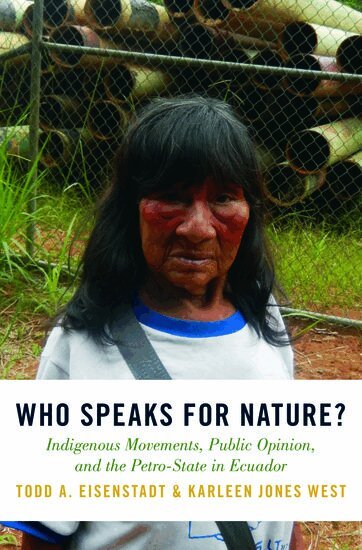
    Who Speaks for Nature?

    Indigenous Movements, Public Opinion, and the Petro-State in Ecuador

    AvTodd A. Eisenstadt,Karleen Jones West

    Inbunden, Engelska, 2019

    Del i serien Studies Comparative Energy and Environ

    1 319 kr

    Beställningsvara. Skickas inom 5-8 vardagar. Fri frakt över 249 kr.

    Beskrivning

    In 2009, Ecuador became the first nation ever to enshrine rights for nature in its constitution. Nature was accorded inalienable rights, and every citizen was granted standing to defend those rights. At the same time, the government advanced a policy of "extractive populism," buying public support for mineral mining by promising that funds from the mining would be used to increase public services.This book, based on a nationwide survey and interviews about environmental attitudes among citizens as well as indigenous, environmental, government, academic, and civil society leaders in Ecuador, offers a theory about when and why individuals will speak for nature, particularly when economic interests are at stake. Parting from conventional social science arguments that political attitudes are determined by ethnicity or social class, the authors argue that environmental dispositions in developing countries are shaped by personal experiences of vulnerability to environmental degradation. Abstract appeals to identity politics, on the other hand, are less effective. Ultimately, this book argues that indigenous groups should be the stewards of nature, but that they must do so by appealing to the concrete, everyday vulnerabilities they face, rather than by turning to the more abstract appeals of ethnic-based movements.

    Produktinformation

    • Utgivningsdatum:2019-06-06
    • Mått:165 x 236 x 30 mm
    • Vikt:522 g
    • Format:Inbunden
    • Språk:Engelska
    • Serie:Studies Comparative Energy and Environ
    • Antal sidor:288
    • Förlag:OUP USA
    • ISBN:9780190908959

    Utforska kategorier

    • Politisk aktivism inom Samhälle och politik
    • Statsvetenskap och politisk teori inom Samhälle och politik

    Mer om författaren

    Todd Eisenstadt is Professor of Government at American University. He has worked on six continents, publishing multiple award-winning books and dozens of articles. He studies development with research that focuses on democratization and environmental politics, as well as the relationship between constitution-making processes and democratization. Karleen West is Assistant Professor of Political Science and International Relations at SUNY Geneseo. She researches how historically marginalized groups gain representation in Latin America and around the world. Her work has been published in the Latin American Research Review, Comparative Political Studies, Legislative Studies Quarterly, Comparative Politics, and Party Politics, among others.

    Recensioner i media

    Based on interviews with 15 gay men from three generations and various ethnic and class backgrounds, this book offers individual stories to humanize existing research on gay male identity formation and health behaviors. The result is an accessible introduction to the lives of gay men and the ways gay coming of age has changed or remained consistent over the course of the last 50 years. The book will be most useful to the general reader or early undergraduate, who can better make sense of existing research with the anecdotal illustrations this book provides. Halkitis emphasizes that identifying oneself as a gay man (that is, coming out) is not a singular act but an ongoing process that, although specific circumstances have changed over time, is consistently necessitated by the dominant society's assumptions that everyone is heterosexual until proven otherwise, and by its macro- and microaggressions against LGBTQ individuals.

    Innehållsförteckning

    • Acknowledgements Chapter 1: Beyond Multiculturalism: Vulnerability Politics and the Environment in Latin America Chapter 2: Multiculturalism Versus Polycentric Pluralism: Vulnerability Challenges Post-Materialist Values on Ecuador's Oil Extraction Frontier Chapter 3: Does Prior Consultation Diminish Extractive Conflict or Channel It to New Venues? Evidence from Ecuador and the Andes Chapter 4: Crude Bargaining: Indigenous Ambivalence Regarding Oil Extraction in the Ecuadorian Amazon Chapter 5: How Science, Religion, and Politics Influence Indigenous Attitudes on Climate Change in Ecuador Chapter 6: Exploring the Contradiction of Extractive Populism between Domestic and International Politics in Ecuador Chapter 7: How to Effectively Speak for Nature? BibliographyIndex