• Fri frakt över 249 kr
  • •
  • Snabba leveranser
  • •
  • Billiga böcker
Kundservice

Du är på sajten för privatpersoner.

Företag, bibliotek eller offentlig verksamhet?

Du handlar på classic.bokus.com, där alla dina funktioner finns intakta.
Till classic.bokus.com
Bokus logotyp. Gå till startsidan.
  • Erbjudanden
  • Student
  • Topplistor
  • Barn & ungdom
  • Bokus Play
  • E-böcker
  • Ljudböcker
  • Pocketböcker
  • Spel och pussel

5% studentrabatt – använd koden KURSBOK27 →

Sidfot

Mina sidor

    Hjälp

    • Kundservice
    • Vanliga frågor och svar
    • Frakt och leverans
    • Retur vid ångerrätt
    • Reklamera vara
    • Betalning
    • Köpvillkor
    • Allmänna villkor
    • Information om webbplatsens tillgänglighet

    Om Bokus

    • Om oss
    • Pressrum
    • För studenter
    • För företag
    • För bibliotek och offentlig verksamhet
    • För leverantörer
    • Hållbarhet

    Populärt

    • Aktuella erbjudanden
    • Presentkort
    • Studentlitteratur
    • Nya böcker
    • Topplistor
    • Signerade böcker
    • Engelska böcker

    Inspiration

    • Boktips
    • BookTok
    • Barnbokskaraktärer
    • Populära författare
    Logotyp för Bokus
    Följ oss på Facebook (extern länk)Följ oss på Instagram (extern länk)Följ oss på YouTube (extern länk)Följ oss på TikTok (extern länk)
    bokus @ CookiesAnpassa cookiesIntegritetspolicyKöpvillkor
    Till Citymail hemsida (extern länk)Till Budbee hemsida (extern länk)Till Postnord hemsida (extern länk)Till Schenker hemsida (extern länk)Till Early Bird hemsida (extern länk)Till Walleys hemsida (extern länk)
    1. Juridik
    2. Särskilda rättsområden
    3. Författningsrätt och förvaltningsrätt
    4. Polisrätt och vapenlagar

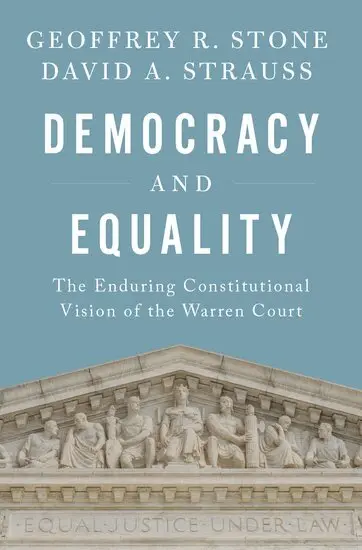
    Democracy and Equality

    The Enduring Constitutional Vision of the Warren Court

    AvGeoffrey R. Stone,David A. Strauss

    Inbunden, Engelska, 2020

    Del i serien Inalienable Rights

    333 kr

    Beställningsvara. Skickas inom 3-6 vardagar. Fri frakt över 249 kr.

    Beskrivning

    From 1953 to 1969, the Supreme Court under Chief Justice Earl Warren brought about many of the proudest achievements of American constitutional law. The Warren declared racial segregation and laws forbidding interracial marriage to be unconstitutional; it expanded the right of citizens to criticize public officials; it held school prayer unconstitutional; and it ruled that people accused of a crime must be given a lawyer even if they can't afford one. Yet, despite those and other achievements, conservative critics have fiercely accused the justices of the Warren Court of abusing their authority by supposedly imposing their own opinions on the nation.As the eminent legal scholars Geoffrey R. Stone and David A. Strauss demonstrate in Democracy and Equality, the Warren Court's approach to the Constitution was consistent with the most basic values of our Constitution and with the most fundamental responsibilities of our judiciary. Stone and Strauss describer the Warren Court's extraordinary achievements by reviewing its jurisprudence across a range of issues addressing our nation's commitment to the values of democracy and equality. In each chapter, they tell the story of a critical decision, exploring the historical and legal context of each case, the Court's reasoning, and how the justices of the Warren Court fulfilled the Court's most important responsibilities. This powerfully argued evaluation of the Warren Court's legacy, in commemoration of the 50th anniversary of the end of the Warren Court, both celebrates and defends the Warren Court's achievements against almost sixty-five years of unrelenting and unwarranted attacks by conservatives. It demonstrates not only why the Warren Court's approach to constitutional interpretation was correct and admirable, but also why the approach of the Warren Court was far superior to that of the increasingly conservative justices who have dominated the Supreme Court over the past half-century.

    Produktinformation

    • Utgivningsdatum:2020-03-02
    • Mått:208 x 147 x 27 mm
    • Vikt:408 g
    • Format:Inbunden
    • Språk:Engelska
    • Serie:Inalienable Rights
    • Antal sidor:240
    • Förlag:OUP USA
    • ISBN:9780190938208

    Utforska kategorier

    • Polisrätt och vapenlagar inom Juridik
    • Rättshistoria inom Juridik

    Mer om författaren

    Geoffrey R. Stone is the Edward H. Levi Distinguished Service Professor at the University of Chicago. He has served as Dean of the University of Chicago Law School and as Provost of the University of Chicago, and is the author of many books on constitutional law, including Sex and the Constitution and Perilous Times.David A. Strauss is the Gerald Ratner Distinguished Service Professor of Law and the Faculty Director of the Supreme Court and Appellate Clinic at the University of Chicago. He the author of many important articles on constitutional law and of the influential book The Living Constitution.

    Recensioner i media

    "A full-throated, lucid, and utterly persuasive defense of the Warren Court and the constitutional principles it established: equality, liberty, dignity, and democracy. Stone and Strauss remind us of what constitutional law does at its best." -- David Cole, National Legal Director, ACLU, and author of Engines of Liberty"Most of what we think about with respect to the Warren Court comes in the size and shapes of legal cartoons. Even some serious scholars on the right and left dismiss the landmark cases that emerged from that court as the work of unmoored ideologues, legislating from the bench. In this eminently readable book, Geoffrey Stone and David Strauss, offer up a primer on the craft and methodology of the jurists who gave us the scaffolding of today's desegregation,criminal justice, voting rights and free speech landscape. They prove that these signal achievements were not rooted in fanciful ideas; they are the very constitutional air we breathe, and they are underthreat, now as never before. Only through this sober and deeply researched understanding of what the Warren Court did and how it was done, can we continue to fight for the vision of equality and fairness that it put into practice."--Dahlia Lithwick, Senior Legal Editor, Slate"In a time when it has become all too fashionable to treat the work of the Warren Court as having diminishing relevance-and to treat that era's legal doctrines as reflecting an unduly ambitious view of the role courts can play in securing justice and protecting representative government-Democracy and Equality offers a breath of fresh air. This eminently readable narrative brilliantly illuminates the possibilities still latent in our founding document byfocusing on a dozen great controversies that the Court under Earl Warren resolved in a humane and progressive way while remaining faithful to the aspirations underlying our founding and animating the rebirthof the republic."--Laurence H. Tribe, Carl M. Loeb University Professor and Professor of Constitutional Law, Harvard Law School"In this wonderfully accessible book, Stone and Strauss take on the perennial claim that the Warren Court represents judicial 'activism' run amok. As they convincingly argue, although the Warren Court completely transformed the American legal landscape, it did so in ways that were entirely consistent with the logic and values of the Constitution and democratic society. Today, as we struggle to realize 'a more perfect Union,' Strauss and Stone's powerfulinsights are both urgent and invaluable."--Melissa Murray, Frederick I. and Grace Stokes Professor of Law, NYU School of Law"A clear and very useful primer for the lay audience, but it is also informative and provocative for the seasoned constitutional lawyer... This is an important and interesting book for all of us."--Law360"An excellent book... a worthy addition to those works that have explored the Supreme Court's history and impact on our country."--Chicago Daily Law Bulletin"Engaging and enlightening."--The American Prospect

    Innehållsförteckning

    • IntroductionChapter 1:Brown v. Board of Education (1954) Chapter 2: Mapp v. Ohio (1961)Chapter 3: Engel v. Vitale (1962)Chapter 4: Gideon v. Wainwright (1963) Chapter 5: New York Times v. Sullivan (1964) Chapter 6: Reynolds v. Sims (1964)Chapter 7: Griswold v. Connecticut (1965)Chapter 8: Miranda v. Arizona (1966)Chapter 9: Loving v. Virginia (1967) Chapter 10: Katz v. United States (1967) Chapter 11: Shapiro v. Thomson (1969)Chapter 12: Brandenburg v. Ohio (1969)NotesBibliography