• Fri frakt över 249 kr
  • •
  • Snabba leveranser
  • •
  • Billiga böcker
Kundservice

Du är på sajten för privatpersoner.

Företag, bibliotek eller offentlig verksamhet?

Du handlar på classic.bokus.com, där alla dina funktioner finns intakta.
Till classic.bokus.com
Bokus logotyp. Gå till startsidan.
  • Erbjudanden
  • Nyheter
  • Student
  • Topplistor
  • Barn & ungdom
  • Bokus Play
  • E-böcker
  • Pocketböcker
  • Spel & pussel

10% studentrabatt med kod TERM26

Sidfot

Mina sidor

    Hjälp

    • Kundservice
    • Vanliga frågor och svar
    • Frakt och leverans
    • Retur vid ångerrätt
    • Reklamera vara
    • Betalning
    • Köpvillkor
    • Allmänna villkor
    • Information om webbplatsens tillgänglighet

    Om Bokus

    • Om oss
    • Pressrum
    • För studenter
    • För företag
    • För bibliotek och offentlig verksamhet
    • För leverantörer
    • Hållbarhet

    Populärt

    • Aktuella erbjudanden
    • Presentkort
    • Studentlitteratur
    • Nya böcker
    • Topplistor
    • Signerade böcker
    • Engelska böcker

    Inspiration

    • Boktips
    • BookTok
    • Populära bokserier
    • Barnbokskaraktärer
    • Populära författare
    Logotyp för Bokus
    Följ oss på Facebook (extern länk)Följ oss på Instagram (extern länk)Följ oss på YouTube (extern länk)Följ oss på TikTok (extern länk)
    bokus @ CookiesAnpassa cookiesIntegritetspolicyKöpvillkor
    Till Citymail hemsida (extern länk)Till Budbee hemsida (extern länk)Till Postnord hemsida (extern länk)Till Schenker hemsida (extern länk)Till Early Bird hemsida (extern länk)Till Walleys hemsida (extern länk)
    1. Ekonomi och Ledarskap
    2. Nationalekonomi
    3. Internationell ekonomi

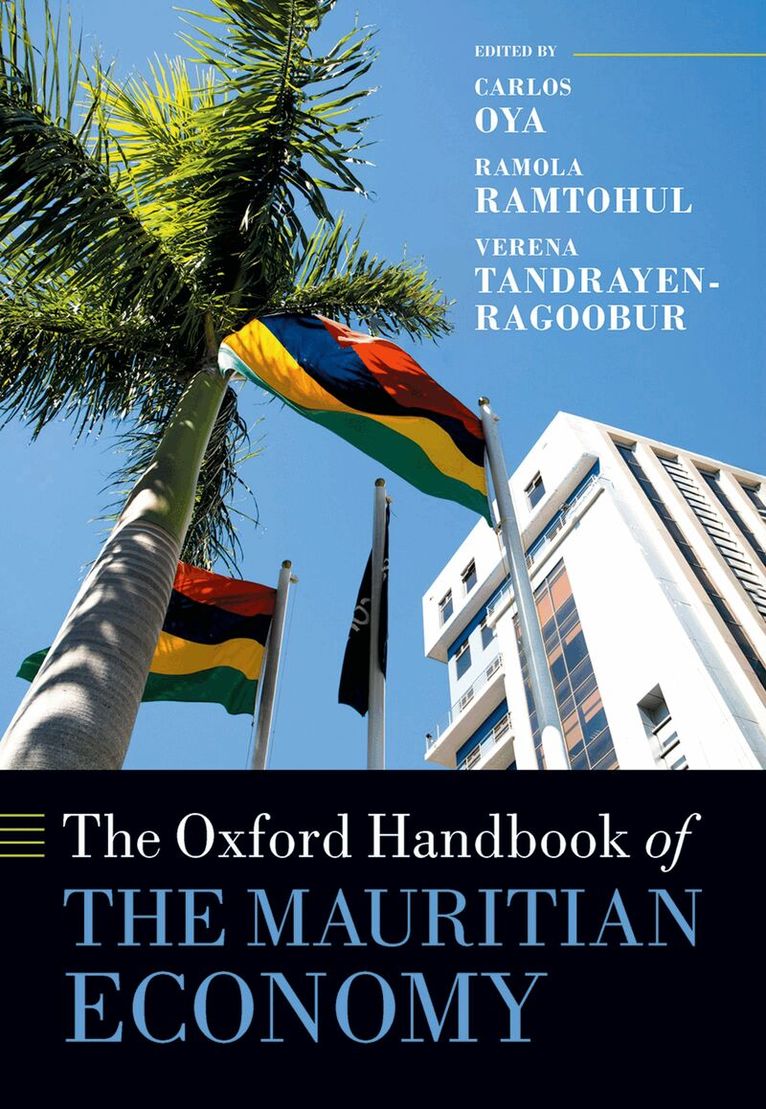
    The Oxford Handbook of the Mauritian Economy

    AvCarlos Oya,Ramola Ramtohul

    Inbunden, Engelska, 2025

    Del i serien Oxford Handbooks

    2 770 kr

    Beställningsvara. Skickas inom 5-8 vardagar. Fri frakt över 249 kr.

    Beskrivning

    The Oxford Handbook on the Mauritian Economy presents a comprehensive analysis of the economic, social, and political landscape of the island, offering a nuanced exploration of its historical evolution, current challenges, and future prospects. Adopting a multidisciplinary lens, the handbook delves into the complexities of the Mauritian economy, addressing the development pathway of the country through a focus on the process of structural transformation, namely the transition from an agrarian-based economy to a diversified one, across sectors like manufacturing, information and communication technology, tourism, and financial services, amongst others. It analyzes the process of economic transformations while encompassing social change and social policies, with particular attention to key issues of inequality, education, health care, social protection, poverty alleviation, and social inclusion, and it delves further into the dynamics of cultural change, demographic shifts, and the role of policies in shaping the social fabric of the island. Amid the perceived success of the Mauritian economy, this handbook confronts the challenges that the island faces in terms of the complexities of globalization, disparities in income and opportunities, and climate change as well as other recent crises that affect its resilience to external shocks. It contributes not only to wider scholarly debates on economic development but also presents a valuable resource for policymakers and practitioners seeking an in-depth understanding of the economic and policy intricacies that define Mauritius' transformative development trajectory.

    Produktinformation

    • Utgivningsdatum:2025-03-19
    • Mått:180 x 252 x 50 mm
    • Vikt:1 542 g
    • Format:Inbunden
    • Språk:Engelska
    • Serie:Oxford Handbooks
    • Antal sidor:816
    • Förlag:OUP OXFORD
    • ISBN:9780192856494

    Utforska kategorier

    • Internationell ekonomi inom Ekonomi och Ledarskap
    • Ekonomisk politik inom Ekonomi och Ledarskap

    Mer om författaren

    Carlos Oya is Professor of Political Economy of Development at SOAS, University of London, and a development economist by training. His work is published in several highly ranked journals in the development studies field, and he has recently led a project on structural transformations and employment outcomes in infrastructure construction and manufacturing sectors in Ethiopia and Angola, with a special focus on Chinese firms.Ramola Ramtohul is Associate Professor in Gender Studies and Sociology at the University of Mauritius. She has a PhD in Gender Studies from the African Gender Institute at the University of Cape Town, and she has published widely on women, gender and politics in Mauritius, intersectionality, diversity, and citizenship. She has received research fellowships from the University of Cape Town, American Association of University Women, University of Cambridge, and University of Pretoria. She is co-editor of the Journal of Contemporary African Studies and the Island Studies Journal and is a member of the editorial board of the journal Small States & Territories.Verena Tandrayen-Ragoobur is Associate Professor in Economics, University of Mauritius. She is currently heading the Pole of Research Excellence in Applied Social and Economic Research Analysis and is the co-chair of the WTO Chairs Programme at the University of Mauritius. She has more than 40 publications in international peer reviewed journals and books, and she is involved in a number of consultancy and research projects with Ministries, public institutions, and international organisations.

    Innehållsförteckning

    • Part 1 CONCEPTS, CONTEXT, AND HISTORY 1: Carlos Oya, Ramola Ramtohul, Verena Tandrayen-Ragoobur: Introduction 2: Liam Campling, Carlos Oya: Why Mauritius? The political economy of structural transformation in a small island: Questions and debates 3: Manisha Dookhony: Political economy of Mauritius: The long run economic history of Mauritius' growth, structural change, and institutions 4: Manorama Akung: Political institutions, democracy, and development in the longue durée Part 2 ECONOMIC DEVELOPMENT AS STRUCTURAL TRANSFORMATION 5: Roshini Brizmohun-Gopaul: Agrarian change and the role of agriculture in structural transformation 6: Riad Sultan, Mialy Andriamahefazafy: The fisheries sector as a pillar for a sustainable future of Blue Economy in Mauritius 7: Vinaye Dey Ancharaz: The rise and fall of light manufacturing: Drivers, Trajectories, and Implications 8: Ali Mansoor: Export competitiveness and industrialisation in Mauritius 9: Oliver Morrissey, Nikhil Treebhoohun: Macroeconomic policy during structural change 10: Sheereen Fauzel, Jeevita Matadeen: Towards a service economy? The role of services and linkages with other sectors 11: Boopen Seetanah, Pierre Dinan: The promise of tourism and its performance 12: Narvada Gopy, Boopen Seetanah, Robin Nunkoo, Viraiyan Teeroovengadum: Evolution of the real estate sector in Mauritius and its contribution to economic development 13: Indranarain Ramlall: The Banking Sector as a catalyst in the transition of the Mauritian economy 14: Rehana Kasenally-Pondor, Roukaya Kasenally: The Mauritius International Financial Centre -A Critical Assessment since Inception 15: Pritish Behuria: From a Miracle Boom to Niche Dependence: How the India DTAA shapes future Offshore Growth in Mauritius 16: Avinash Ramtohul, Kavi Khedo, Avinash Mungur: The ICT sector in Mauritius' quest for economic diversification 17: Harshana Kasseeah: The governance of structural change: Configuration of institutions and <"the entrepreneurial state> " in Mauritius 18: Aleksandra Peeroo, Kate Bayliss: A Political Economy Perspective on Mauritian Water Services 19: Manisha Dookhony: Industrial Policy and Practice: A Practitioners' perspective 20: Arkebe Oqubay: Learning from Mauritius' economic transformation: A policymaker's perspective PART 3: SOCIAL CHANGE AND POLICY 21: Verena Tandrayen-Ragoobur: Employment and Poverty in Mauritius 22: Yiagadeesen Samy, Vanessa. T Tang: Mauritius: The Evolution and Dynamics of Income Inequality in the Context of Structural Transformation 23: Ramola Ramtohul: The gender dimensions of Mauritius' development trajectory 24: Ramola Ramtohul, Roukaya Kasenally: Migration dynamics in Mauritius 25: Myriam Blin: The Political Economy of the Welfare State in Mauritius 26: Zeinab Jannoo, Andrew McKay: Health care provision and health outcomes in Mauritius 27: Sheila Bunwaree: An Analysis of Mauritian Education: Stalling of Social Mobility? 28: Jaime de Melo: Environmentally-friendly trade policies to shape Mauritius' future 29: Riad Sultan: Climate change and sustainable development 30: Prakash Deenapanray, Andrea Bassi: Climate change and decarbonisation: a macroeconomic perspective for Mauritius 31: Streevarsen Pillay Narainen: New Development Pathways for Mauritius