• Fri frakt över 249 kr
  • •
  • Snabba leveranser
  • •
  • Billiga böcker
Kundservice

Du är på sajten för privatpersoner.

Företag, bibliotek eller offentlig verksamhet?

Du handlar på classic.bokus.com, där alla dina funktioner finns intakta.
Till classic.bokus.com
Bokus logotyp. Gå till startsidan.
  • Erbjudanden
  • Nyheter
  • Student
  • Topplistor
  • Barn & ungdom
  • Bokus Play
  • E-böcker
  • Pocketböcker
  • Spel & pussel

10% rabatt på allt med kod NYSTART10 →

Sidfot

Mina sidor

    Hjälp

    • Kundservice
    • Vanliga frågor och svar
    • Frakt och leverans
    • Retur vid ångerrätt
    • Reklamera vara
    • Betalning
    • Köpvillkor
    • Allmänna villkor
    • Information om webbplatsens tillgänglighet

    Om Bokus

    • Om oss
    • Pressrum
    • För studenter
    • För företag
    • För bibliotek och offentlig verksamhet
    • För leverantörer
    • Hållbarhet

    Populärt

    • Aktuella erbjudanden
    • Presentkort
    • Studentlitteratur
    • Nya böcker
    • Topplistor
    • Signerade böcker
    • Engelska böcker

    Inspiration

    • Boktips
    • BookTok
    • Populära bokserier
    • Barnbokskaraktärer
    • Populära författare
    Logotyp för Bokus
    Följ oss på Facebook (extern länk)Följ oss på Instagram (extern länk)Följ oss på YouTube (extern länk)Följ oss på TikTok (extern länk)
    bokus @ CookiesAnpassa cookiesIntegritetspolicyKöpvillkor
    Till Citymail hemsida (extern länk)Till Budbee hemsida (extern länk)Till Postnord hemsida (extern länk)Till Schenker hemsida (extern länk)Till Early Bird hemsida (extern länk)Till Walleys hemsida (extern länk)
    1. Psykologi och pedagogik
    2. Psykologi
    3. Biologisk psykologi och neuropsykologi

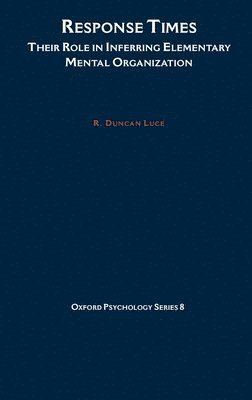
    Response Times

    Their Role in Inferring Elementary Mental Organization

    AvR. Duncan Luce

    Inbunden, Engelska, 1986

    Del 8 i serien Oxford Psychology Series

    3 698 kr

    Beställningsvara. Skickas inom 5-8 vardagar. Fri frakt över 249 kr.

    Fler format och utgåvor

    Häftad

    2 500 kr

    Beskrivning

    Response times are a fascinating source of information on how the mind is organized - the time taken to carry out an action tells us something about the choice process involved. This is a critical but even-handed treatment of the major themes of how response times play a role in our thinking about the mind. Professor Luce provides a comprehensive, clear review of the experimental data, and puts forward the idea of the hazard function - a novel and important approach that he and his colleagues have developed. This function, based on the probability that an reaction is about to occur given that no reaction has occurred so far during a trial, exaggerates the differences that normal analysis methods often obscure. This enables the researcher to rule out more confidently known mechanisms of time delay in human performance.Since measurements of response times are widely used by experimental psychologists as one approach to distinguishing between theories of intellectual functioning, the conceptual arguments that Professor Luce brings to bear on mathematical models of response time are of great relevance to mathematical and experimental psychologists.

    Produktinformation

    • Utgivningsdatum:1986-07-24
    • Mått:164 x 240 x 35 mm
    • Vikt:1 025 g
    • Format:Inbunden
    • Språk:Engelska
    • Serie:Oxford Psychology Series
    • Antal sidor:577
    • Förlag:OUP USA
    • ISBN:9780195036428

    Utforska kategorier

    • Biologisk psykologi och neuropsykologi inom Psykologi och pedagogik
    • Kognitiv psykologi inom Psykologi och pedagogik
    • Tillämpad matematik inom Naturvetenskap och teknik

    Recensioner i media

    An extensive and well presented account...Will certainly remain the basic reference for years to come...The book will be useful to many, whether or not they are theoretically inclined, and will be mandatory reading for anyone dealing with behavioural response times.

    Innehållsförteckning

    • Representing response times as random variables; DETECTION PARADIGMS: Simple reaction times: basic data; Decomposition into decision and residual latencies; Distribution of simple decision latencies; Detection of signals presented at irregular times; IDENTIFICATION PARADIGMS: Two-choice reaction times: basic ideas and data; Mixture models; Stochastic accumulation of information in discrete time; Stochastic accumulation of information in continuous time; Absolute identification of more than two signals; MATCHING PARADIGMS: Memory scanning, visual search, and same-difference designs; Processing stages and strategies; Appendixes; References; Indexes.