• Fri frakt över 249 kr
  • •
  • Snabba leveranser
  • •
  • Billiga böcker
Kundservice

Du är på sajten för privatpersoner.

Företag, bibliotek eller offentlig verksamhet?

Du handlar på classic.bokus.com, där alla dina funktioner finns intakta.
Till classic.bokus.com
Bokus logotyp. Gå till startsidan.
  • Erbjudanden
  • Nyheter
  • Student
  • Topplistor
  • Barn & ungdom
  • Bokus Play
  • E-böcker
  • Pocketböcker
  • Spel & pussel

10% rabatt på allt med kod: NYSTART10 →

Sidfot

Mina sidor

    Hjälp

    • Kundservice
    • Vanliga frågor och svar
    • Frakt och leverans
    • Retur vid ångerrätt
    • Reklamera vara
    • Betalning
    • Köpvillkor
    • Allmänna villkor
    • Information om webbplatsens tillgänglighet

    Om Bokus

    • Om oss
    • Pressrum
    • För studenter
    • För företag
    • För bibliotek och offentlig verksamhet
    • För leverantörer
    • Hållbarhet

    Populärt

    • Aktuella erbjudanden
    • Presentkort
    • Studentlitteratur
    • Nya böcker
    • Topplistor
    • Signerade böcker
    • Engelska böcker

    Inspiration

    • Boktips
    • BookTok
    • Populära bokserier
    • Barnbokskaraktärer
    • Populära författare
    Logotyp för Bokus
    Följ oss på Facebook (extern länk)Följ oss på Instagram (extern länk)Följ oss på YouTube (extern länk)Följ oss på TikTok (extern länk)
    bokus @ CookiesAnpassa cookiesIntegritetspolicyKöpvillkor
    Till Citymail hemsida (extern länk)Till Budbee hemsida (extern länk)Till Postnord hemsida (extern länk)Till Schenker hemsida (extern länk)Till Early Bird hemsida (extern länk)Till Walleys hemsida (extern länk)
    1. Psykologi och pedagogik
    2. Psykologi
    3. Socialpsykologi och gruppsykologi

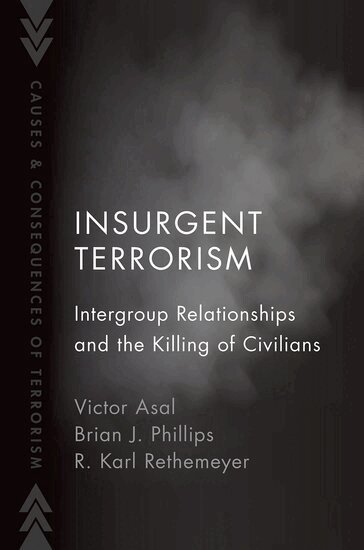
    Insurgent Terrorism

    Intergroup Relationships and the Killing of Civilians

    AvVictor Asal,Brian J. Phillips

    Inbunden, Engelska, 2022

    Del i serien Causes and Consequences of Terrorism

    1 360 kr

    Beställningsvara. Skickas inom 5-8 vardagar. Fri frakt över 249 kr.

    Fler format och utgåvor

    Häftad

    540 kr

    Beskrivning

    Insurgent groups consist of individuals willing to organize and commit acts of terror to achieve their goals. By nature, they depend on public support, yet they sometimes target private civilians in addition to military personnel and government officials. This book examines insurgent embeddedness--the extent to which an insurgent group is enmeshed in relationships with the state, other insurgents, and the public--in order to understand why they attack civilians.Using Big Allied and Dangerous (BAAD) as the dataset, this book drills into civilian attacks in specific contexts, including schools, news media, and nonmilitary/nongovernment spaces designed for the general public. This book goes one step further, presenting in-depth analyses of intergroup alliances and rivalries, their changes and determinants over time, and the implications for several types of bloodshed against civilians.Insurgent Terrorism offers a comprehensive, modern approach for academics, students, and policy practitioners who seek to understand interorganizational relationships between insurgent organizations.

    Produktinformation

    • Utgivningsdatum:2022-04-04
    • Mått:159 x 241 x 18 mm
    • Vikt:481 g
    • Format:Inbunden
    • Språk:Engelska
    • Serie:Causes and Consequences of Terrorism
    • Antal sidor:246
    • Förlag:OUP USA
    • ISBN:9780197607015

    Utforska kategorier

    • Socialpsykologi och gruppsykologi inom Psykologi och pedagogik
    • Politisk aktivism inom Samhälle och politik
    • Grupper och gruppteori inom Naturvetenskap och teknik

    Mer om författaren

    Victor Asal is the Director of the Center for Policy Research and a Professor of Political Science at the University at Albany, SUNY. His research focuses on violent nonstate actors (VNSAs), pedagogy and political discrimination related to ethnicity, gender and sexuality. He has been involved in research projects funded by the Defense Advanced Research Projects Agency, Defense Threat Reduction Agency, The Department of Homeland Security, The National Science Foundation, and The Office of Naval Research. Brian J. Phillips is a Reader in the Department of Government at the University of Essex, and an Affiliated Professor at the Center for Research and Teaching in Economics (CIDE) in Mexico City. His research focuses on subnational violence including terrorism, civil conflict, organized crime, and dynamics of violent groups. His research has been funded by the Department of Homeland Security, the National Science Foundation, and the Mexican Presidency. R. Karl Rethemeyer isthe Dean of the College of Social and Behavioral Sciences (SBS) at the University of Massachusetts Amherst and a faculty member in SBS's School of Public Policy. His research spans terrorism, terrorist organizations, terrorist networks, counterinsurgency/stabilization operations, and the structure and operation of collaborative and policy networks in the public sector.

    Recensioner i media

    In this compelling book, Asal, Phillips, and Rethemeyer provide a much-needed investigation into why armed militant organizations target civilians during conflicts. The authors use both original quantitative data and numerous case references to construct a comprehensive picture of militant group targeting behavior that considers group relations with civilians, state counter-insurgency strategy, inter-group competition, group criminal activity, group ideology and ethnic ties and a host of other factors. The end result is a book that will inform both scholarly and policy audiences alike. A must-read for anyone interested in insurgent group behavior.

    Innehållsförteckning

    • SECTION I. Introduction, Theory, and Initial TestingChapter 1. Introduction Chapter 2. The Embeddedness Theory of Civilian Targeting by Insurgent Groups Chapter 3. Describing the BAAD2 Insurgency Data and Other Data Sources Chapter 4. Testing Primary Hypotheses SECTION II. Empirical Extensions: Types of Civilian TargetingChapter 5. Why Do Some Insurgent Groups Attack Schools? Chapter 6. Why Do Some Insurgent Groups Attack Journalists? Chapter 7. Why Do Some Insurgent Groups Mostly Attack the General Public? SECTION III. Further Analysis of Inter-Group RelationshipsChapter 8. Longitudinal Modelling of Insurgent Alliances Chapter 9. Understanding Insurgent Rivalry Chapter 10. Conclusion