• Fri frakt över 249 kr
  • •
  • Snabba leveranser
  • •
  • Billiga böcker
Kundservice

Du är på sajten för privatpersoner.

Företag, bibliotek eller offentlig verksamhet?

Du handlar på classic.bokus.com, där alla dina funktioner finns intakta.
Till classic.bokus.com
Bokus logotyp. Gå till startsidan.
  • Erbjudanden
  • Student
  • Topplistor
  • Barn & ungdom
  • Bokus Play
  • E-böcker
  • Ljudböcker
  • Pocketböcker
  • Spel och pussel

5% studentrabatt – använd koden KURSBOK27 →

Sidfot

Mina sidor

    Hjälp

    • Kundservice
    • Vanliga frågor och svar
    • Frakt och leverans
    • Retur vid ångerrätt
    • Reklamera vara
    • Betalning
    • Köpvillkor
    • Allmänna villkor
    • Information om webbplatsens tillgänglighet

    Om Bokus

    • Om oss
    • Pressrum
    • För studenter
    • För företag
    • För bibliotek och offentlig verksamhet
    • För leverantörer
    • Hållbarhet

    Populärt

    • Aktuella erbjudanden
    • Presentkort
    • Studentlitteratur
    • Nya böcker
    • Topplistor
    • Signerade böcker
    • Engelska böcker

    Inspiration

    • Boktips
    • BookTok
    • Barnbokskaraktärer
    • Populära författare
    Logotyp för Bokus
    Följ oss på Facebook (extern länk)Följ oss på Instagram (extern länk)Följ oss på YouTube (extern länk)Följ oss på TikTok (extern länk)
    bokus @ CookiesAnpassa cookiesIntegritetspolicyKöpvillkor
    Till Citymail hemsida (extern länk)Till Budbee hemsida (extern länk)Till Postnord hemsida (extern länk)Till Schenker hemsida (extern länk)Till Early Bird hemsida (extern länk)Till Walleys hemsida (extern länk)
    1. Psykologi och pedagogik
    2. Psykologi
    3. Arbetspsykologi

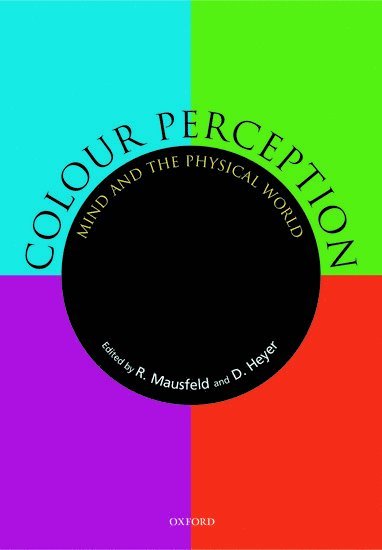
    Colour Perception

    Mind and the physical world

    AvRainer Mausfeld,Dieter Heyer

    Inbunden, Engelska, 2003

    4 354 kr

    Beställningsvara. Skickas inom 7-10 vardagar. Fri frakt över 249 kr.

    Beskrivning

    Colour has long been a source of fascination to both scientists and philosophers. In one sense, colours are in the mind of the beholder, in another sense they belong to the external world. Colours appear to lie on the boundary where we have divided the world into 'objective' and 'subjective' events. They represent, more than any other attribute of our visual experience, a place where both physical and mental properties are interwoven in an intimate and enigmatic way.The last few decades have brought fascinating changes in the way that we think about 'colour' and the role 'colour' plays in our perceptual architecture. In Colour Perception: Mind and the physical world, leading scholars from cognitive psychology, philosophy, neurophysiology, and computational vision provide an overview of the contemporary developments in our understanding of colours and of the relationship between the 'mental' and the 'physical'. With each chapter followed by critical commentaries, the volume presents a lively and accessible picture of the intellectual traditions which have shaped research into colour perception.Written in a non-technical style and accessible to an interdisciplinary audience, the book will provide an invaluable resource for researchers in colour perception and the cognitive sciences.

    Produktinformation

    • Utgivningsdatum:2003-11-06
    • Mått:176 x 247 x 33 mm
    • Vikt:1 205 g
    • Format:Inbunden
    • Språk:Engelska
    • Antal sidor:538
    • Förlag:OUP OXFORD
    • ISBN:9780198505006

    Utforska kategorier

    • Arbetspsykologi inom Psykologi och pedagogik
    • Kognitiv psykologi inom Psykologi och pedagogik
    • Oftalmologi inom Medicin

    Recensioner i media

    . . . a scholarly and erudite publication that will no doubt prove to be a useful reference source . . . a thought-provoking book that provides an ambitious and broad perspective on how and why our nervous systems might construct colour.

    Innehållsförteckning

    • Preface ; 1. Perspectives on colour space ; Commentaries: ; From physics to perception through colorimetry: a bridge too far? ; Colorimetry fortified ; 2. Light adaptation, contrast adaptation, and human colour vision ; Commentary: ; Adaptation and the ambiguity of response measures with respect to internal structure ; 3. Contrast colours ; Commentaries: ; A background to colour vision ; Contrast coding and what else? ; 4. Colour and the processing of chromatic information ; Commentary: ; The processing of chromatic information ; 5. The pleistochrome: optimal opponent codes for natural colours ; Commentary: ; Thinking outside the black box ; 6. Objectivity and subjectivity revisited: colour as a psychobiological property ; Commentary: ; Why is this game still being played? ; 7. A computational analysis of colour constancy ; Commentary: ; The importance of realistic models of surface and light in the study of human colour vision ; 8. Backgrounds and illuminants: the yin and yang of colour constancy ; Commentaries: ; Colour construction ; Fitting linear models to data ; 9. Surface colour perception and environmental constraints ; Commentaries: ; On the function of colour vision ; Intrinsic colours - and what it is like to see them ; 10. Colour constancy: developing empirical tests of computational models ; Commentaries: ; Surface colour perception and its environments ; Comparing the behaviour of machine vision algorithms and human observers ; 11. The illuminant estimation hypothesis and surface colour perception ; Commentary: ; Surface colour appearance in nearly natural images ; 12. The interaction of colour and motion ; Commentary: ; The interaction of perceived colour and perceived motion ; 13. 'Colour' as part of the format of different perceptual primitives: The dual coding of colour ; Commentaries: ; Phenomenology and mechanism ; An internalist account of colour ; 14. The importance of errors in perception ; 15. Avoiding errors about error ; Commentaries: ; Deconstructing the concept of error? ; Talking across the divide ; On the veridicality of lightness perception ; 16. The place of colour in nature ; Commentaries: ; Asking about the nature of colour ; Who dictates what is real ; Index