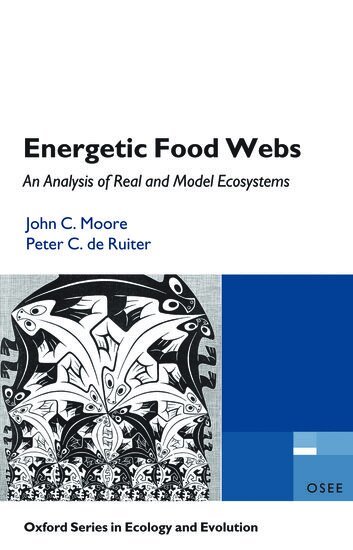
Häftad, Engelska, 2012
Energetic Food Webs
An analysis of real and model ecosystems
Av John C. Moore, Peter C. de Ruiter
Del i serien Oxford Series in Ecology and Evolution
1072 kr
Beställningsvara. Skickas inom 7-10 vardagar. Fri frakt över 249 kr.
Beskrivning
Produktinformation
- Utgivningsdatum: 2012-05-31
- Mått: 157 x 233 x 17 mm
- Vikt: 598 g
- Format: Häftad
- Språk: Engelska
- Serie: Oxford Series in Ecology and Evolution
- Antal sidor: 344
- Förlag: OUP OXFORD
- ISBN: 9780198566199
Utforska kategorier
Mer om författaren
John Moore studied zoology and ecology at the University of California at Santa Barbara, and received an MS in zoology at Michigan State University and an MS in Statistics at Colorado State University. His PhD focused on trophic interactions and food web analyses in natural and agricultural ecosystems. From 1991-2006 he was a faculty member at the University of Northern Colorado (UNC) and as the director of the UNC Mathematics and Science Teaching Institute (2001-2006). In 2006 he was appointed as director of the Natural Resource Ecology Laboratory at Colorado State University, and in 2010 as founding department head for the new Department of Ecosystem Science and Sustainability within the Warner College of Natural Resources. His research interests are in the fields of soil ecology, ecosystem ecology, mathematical/theoretical ecology, and the application of the theory of complex adaptive systems to teaching and learning. Peter de Ruiter studied Biology and Mathematics at the Utrecht University. His PhD was a theoretical-empirical analysis of predator prey interactions in forest floor layers. Since then he has worked for 10 years at the DLO-Institute for Soil Fertility (Haren, NL), 10 years as chair-holder Environmental Sciences at the Utrecht University and, since 2006, as head of the Wageningen University Centre of Soil Science. In 2008 Peter de Ruiter was appointed as a 'personal professor' in the Wageningen University Biometris Institute that focuses on mathematical approaches in the life sciences. His main research interests are in the field of soil sciences, ecology, and mathematical/theoretical ecology. He is a member of various national and international scientific committees and research councils, including the Dutch Governmental Advisory Committee on Soil Protection.
Recensioner i media
The authors present a coherent, comprehensive case for the study of food webs through energetics. They show that many of the patterns and results found in the literature can be interpreted in this unified framework
Betyg & recensioner
0 recensioner
Inga recensioner tillgängliga.