• Fri frakt över 249 kr
  • •
  • Snabba leveranser
  • •
  • Billiga böcker
Kundservice

Du är på sajten för privatpersoner.

Företag, bibliotek eller offentlig verksamhet?

Du handlar på classic.bokus.com, där alla dina funktioner finns intakta.
Till classic.bokus.com
Bokus logotyp. Gå till startsidan.
  • Erbjudanden
  • Nyheter
  • Student
  • Topplistor
  • Barn & ungdom
  • Bokus Play
  • E-böcker
  • Pocketböcker
  • Spel & pussel

10% rabatt på allt med kod NYSTART10 →

Sidfot

Mina sidor

    Hjälp

    • Kundservice
    • Vanliga frågor och svar
    • Frakt och leverans
    • Retur vid ångerrätt
    • Reklamera vara
    • Betalning
    • Köpvillkor
    • Allmänna villkor
    • Information om webbplatsens tillgänglighet

    Om Bokus

    • Om oss
    • Pressrum
    • För studenter
    • För företag
    • För bibliotek och offentlig verksamhet
    • För leverantörer
    • Hållbarhet

    Populärt

    • Aktuella erbjudanden
    • Presentkort
    • Studentlitteratur
    • Nya böcker
    • Topplistor
    • Signerade böcker
    • Engelska böcker

    Inspiration

    • Boktips
    • BookTok
    • Populära bokserier
    • Barnbokskaraktärer
    • Populära författare
    Logotyp för Bokus
    Följ oss på Facebook (extern länk)Följ oss på Instagram (extern länk)Följ oss på YouTube (extern länk)Följ oss på TikTok (extern länk)
    bokus @ CookiesAnpassa cookiesIntegritetspolicyKöpvillkor
    Till Citymail hemsida (extern länk)Till Budbee hemsida (extern länk)Till Postnord hemsida (extern länk)Till Schenker hemsida (extern länk)Till Early Bird hemsida (extern länk)Till Walleys hemsida (extern länk)
    1. Psykologi och pedagogik
    2. Psykologi
    3. Biologisk psykologi och neuropsykologi

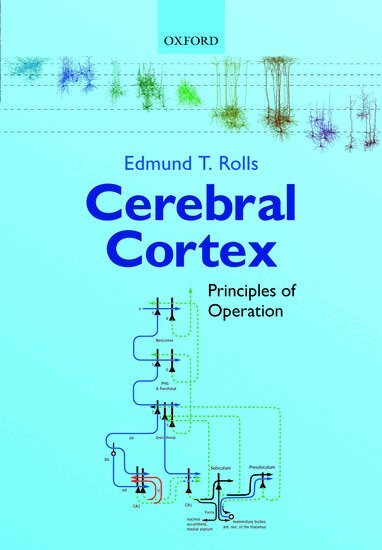
    Cerebral Cortex

    Principles of Operation

    AvEdmund T. Rolls

    Häftad, Engelska, 2017

    822 kr

    Beställningsvara. Skickas inom 7-10 vardagar. Fri frakt över 249 kr.

    Fler format och utgåvor

    E-bok

    535 kr

    E-bok

    535 kr

    Beskrivning

    The aim of this book is to provide insight into the principles of operation of the cerebral cortex. These principles are key to understanding how we, as humans, function.There have been few previous attempts to set out some of the important principles of operation of the cortex, and this book is pioneering. The book goes beyond separate connectional neuroanatomical, neurophysiological, neuroimaging, neuropsychiatric, and computational neuroscience approaches, by combining evidence from all these areas to formulate hypotheses about how and what the cerebral cortex computes. As clear hypotheses are needed in this most important area of 21st century science, how our brains work, I have formulated a set of hypotheses about the principles of cortical operation to guide thinking and future research.The book focusses on the principles of operation of the cerebral cortex, because at this time it is possible to propose and describe many principles, and many are likely to stand the test of time, and provide a foundation for further developments, even if some need to be changed. In this context, I have not attempted to produce an overall theory of operation of the cerebral cortex, because at this stage of our understanding, such a theory would be incorrect or incomplete. However, many of the principles described will provide the foundations for more complete theories of the operation of the cerebral cortex. This book is intended to provide a foundation for future understanding, and it is hoped that future work will develop and add to these principles of operation of the cerebral cortex.The book includes Appendices on the operation of many of the neuronal networks described in the book, together with simulation software written in Matlab.

    Produktinformation

    • Utgivningsdatum:2017-11-30
    • Mått:171 x 247 x 36 mm
    • Vikt:1 434 g
    • Format:Häftad
    • Språk:Engelska
    • Antal sidor:992
    • Förlag:OUP OXFORD
    • ISBN:9780198820345

    Utforska kategorier

    • Biologisk psykologi och neuropsykologi inom Psykologi och pedagogik
    • Psykologi: känslor inom Psykologi och pedagogik
    • Arbetspsykologi inom Psykologi och pedagogik

    Mer om författaren

    Professor Edmund T. Rolls performs full-time research at the Oxford Centre for Computational Neuroscience, and is professor of Computational Neuroscience at the University of Warwick, and has acted as Professor of Experimental Psychology at the University of Oxford, and as Fellow and Tutor of Corpus Christi College, Oxford. His research links neurophysiological and computational neuroscience approaches to human functional neuroimaging and neuropsychological studies in order to provide a fundamental basis for understanding human brain function and its disorders.

    Recensioner i media

    I recommend this book to the neuroscience community for its thorough review and proposed models. It is a comprehensive yet accessible text for anyone seeking to understand the deep mechanics of how we think. I commend Professor Rolls for this and his other excellent contributions to the field.

    Innehållsförteckning

    • 1: Introduction 2: Hierarchical Organization 3: Localization of Function 4: Recurrent Collateral Connections and Attractor Networks 5: The Noisy Cortex: Stochastic dynamics, decisions, and memory 6: Attention, Short-term Memory, and Biased Competition 7: Diluted Connectivity 8: Coding Principles 9: Synaptic Modification for Learning 10: Synaptic and Neuronal Adaptation and Facilitation 11: Backprojections in the Neocortex 12: Memory and the Hippocampus 13: Limited Neurogenesis in the Adult Cortex 14: Invariance Learning and Vision 15: Emotion, Motivation, Reward Value, Pleasure, and their Mechanisms 16: Noise in the Cortex, Stability, Psychiatric Disease, and Aging 17: Syntax and Language 18: Evolutionary Trends in Cortical Design and Principles of Operation 19: Genetics and Self-Organization Build the Cortex 20: Cortex versus Basal Ganglia Design for Selection 21: Sleep and Dreaming 22: Which Cortical Computations Underlie Consciousness? 23: Cerebellar Cortex 24: The Hippocampus and Memory 25: Invariant Visual Object Recognition Learning 26: Synthesis Introduction to Linear Algebra for Neural Networks Neural Network Models Information Theory and Neuronal Encoding Simulation Software for Neuronal Network Models References Index