• Fri frakt över 249 kr
  • •
  • Snabba leveranser
  • •
  • Billiga böcker
Kundservice

Du är på sajten för privatpersoner.

Företag, bibliotek eller offentlig verksamhet?

Du handlar på classic.bokus.com, där alla dina funktioner finns intakta.
Till classic.bokus.com
Bokus logotyp. Gå till startsidan.
  • Erbjudanden
  • Nyheter
  • Student
  • Topplistor
  • Barn & ungdom
  • Bokus Play
  • E-böcker
  • Pocketböcker
  • Spel & pussel

10% rabatt på allt med kod: NYSTART10 →

Sidfot

Mina sidor

    Hjälp

    • Kundservice
    • Vanliga frågor och svar
    • Frakt och leverans
    • Retur vid ångerrätt
    • Reklamera vara
    • Betalning
    • Köpvillkor
    • Allmänna villkor
    • Information om webbplatsens tillgänglighet

    Om Bokus

    • Om oss
    • Pressrum
    • För studenter
    • För företag
    • För bibliotek och offentlig verksamhet
    • För leverantörer
    • Hållbarhet

    Populärt

    • Aktuella erbjudanden
    • Presentkort
    • Studentlitteratur
    • Nya böcker
    • Topplistor
    • Signerade böcker
    • Engelska böcker

    Inspiration

    • Boktips
    • BookTok
    • Populära bokserier
    • Barnbokskaraktärer
    • Populära författare
    Logotyp för Bokus
    Följ oss på Facebook (extern länk)Följ oss på Instagram (extern länk)Följ oss på YouTube (extern länk)Följ oss på TikTok (extern länk)
    bokus @ CookiesAnpassa cookiesIntegritetspolicyKöpvillkor
    Till Citymail hemsida (extern länk)Till Budbee hemsida (extern länk)Till Postnord hemsida (extern länk)Till Schenker hemsida (extern länk)Till Early Bird hemsida (extern länk)Till Walleys hemsida (extern länk)
    1. Historia och arkeologi
    2. Historia
    3. Militärhistoria
    4. Forntida militärhistoria

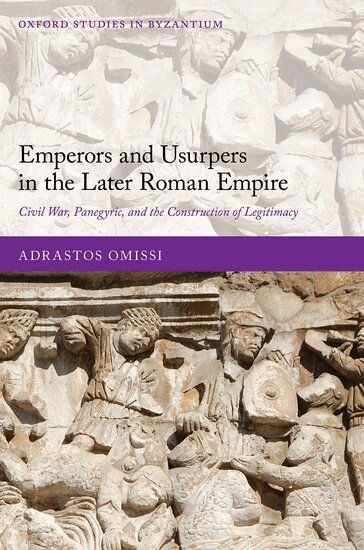
    Emperors and Usurpers in the Later Roman Empire

    Civil War, Panegyric, and the Construction of Legitimacy

    AvAdrastos Omissi

    Inbunden, Engelska, 2018

    Del i serien Oxford Studies in Byzantium

    2 437 kr

    Beställningsvara. Skickas inom 5-8 vardagar. Fri frakt över 249 kr.

    Fler format och utgåvor

    E-bok

    449 kr

    E-bok

    449 kr

    Häftad

    618 kr

    Beskrivning

    One of the great maxims of history is that it is written by the victors, and nowhere does this find greater support than in the later Roman Empire. Between 284 and 395 AD, no fewer than 37 men claimed imperial power, though today we recognize barely half of these men as 'legitimate' rulers and more than two thirds died at their subjects' hands. Once established in power, a new ruler needed to publicly legitimate himself and to discredit his predecessor: overt criticism of the new regime became high treason, with historians supressing their accounts for fear of reprisals and the very names of defeated emperors chiselled from public inscriptions and deleted from official records. In a period of such chaos, how can we ever hope to record in any fair or objective way the history of the Roman state? Emperors and Usurpers in the Later Roman Empire is the first history of civil war in the later Roman Empire to be written in English and aims to address this question by focusing on the various ways in which successive imperial dynasties attempted to legitimate themselves and to counter the threat of almost perpetual internal challenge to their rule. Panegyric in particular emerges as a crucial tool for understanding the rapidly changing political world of the third and fourth centuries, providing direct evidence of how, in the wake of civil wars, emperors attempted to publish their legitimacy and to delegitimize their enemies. The ceremony and oratory surrounding imperial courts too was of great significance: used aggressively to dramatize and constantly recall the events of recent civil wars, the narratives produced by the court in this context also went on to have enormous influence on the messages and narratives found within contemporary historical texts. In its exploration of the ways in which successive imperial courts sought to communicate with their subjects, this volume offers a thoroughly original reworking of late Roman domestic politics, and demonstrates not only how history could be erased, rewritten, and repurposed, but also how civil war, and indeed usurpation, became endemic to the later Empire.

    Produktinformation

    • Utgivningsdatum:2018-07-17
    • Mått:163 x 238 x 26 mm
    • Vikt:688 g
    • Format:Inbunden
    • Språk:Engelska
    • Serie:Oxford Studies in Byzantium
    • Antal sidor:370
    • Förlag:OUP OXFORD
    • ISBN:9780198824824

    Utforska kategorier

    • Forntida militärhistoria inom Historia och arkeologi
    • Forntidens historia inom Historia och arkeologi
    • Tal inom Biografier

    Mer om författaren

    Adrastos Omissi grew up in Jersey, in the Channel Islands. From 2005, he studied at St John's College, Oxford, where he received his BA, MSt, and DPhil. After working for some years in the charities and green energy sector, he returned to Oxford in 2014 to take up a British Academy Postdoctoral Fellowship and a Junior Research Fellowship in Classics and Ancient History at Oriel College. He then spent a brief period as Lecturer in Ancient History both at Oriel and at Jesus College, during which time he was awarded a prestigious Humanities Division Teaching Award, before moving to the University of Glasgow in September 2017, where he is currently Lecturer in Latin Literature. He has authored a number of articles, in both specialist and non-specialist publications, on Roman history, linguistics, and Renaissance art.

    Recensioner i media

    The book aims to grapple with the question of how imperial legitimacy was constructed in the late Roman world, using the genre of panegyric as the primary lens through which to shed light on the issue. The result is an illuminating study which will be required reading for anyone wanting to understand the political dynamics of the period and the role of panegyric in it.

    Innehållsförteckning

    • Frontmatter List of Figures List of Abbreviations Typographical Note PART I I: Usurpation, Legitimacy, and the Roman Empire I.1: Why usurpation?: the problem of the imperial succession I.2: 'This litany of manifest usurpers and rebellious generals': why had the imperial succession become so unstable by the third century? I.3: 'The difference between a tyrant and a king is one of deeds, not of name': how was usurpation understood in the late Roman Empire? I.4: 'Let these things go unspoken': usurpation and modern research II: Usurpation, Legitimacy, and Panegyric II.1: Known unknowns, and unknown unknowns: how to use panegyric as a source II.2: 'In which I would tell many lies': who dictated the content of panegyric? II.3: 'And would be viewed with favour by those who knew them to be such': panegyric, audience, and influence II.4: Propaganda and power PART II III: A House Divided Against Itself IV: 'At last Roman, at last restored to the true light of Empire': Dyarchy, Tetrarchy, and the Fall of the British Empire of Carausius IV.1: Birthing the late Roman state: dyarchs, tetrarchs, and a new language of power IV.2: Emperors and bandits: the British Empire under Carausius and Allectus V: Tyranny and Betrayal: Constantine, Maximian, Maxentius, and Licinius V.1: Constantine's usurpation: Constantine, Galerius, and Maximian V.2: The tyrannus: Maxentius and the rewards of civil war V.3: Notable by his absence: Licinius and the rise of the Constantinian dynasty VI: Tyranny and Blood: Constantius, Constans, Magnentius, and Vetranio VI.1: Smiling for the cameras: the sons of Constantine, 337-50 VI.2: The son of the father: Constantius the tyrant-slayer VII: Usurper, Propaganda, History: The Emperor Julian VII.1: The voice of a usurper: Julian's rise to power VII.2: Bleaching the stains: Julian's sole rule VIII: Panegyric and Apology: The Accession of Jovian and the Usurpation of Procopius VIII.1: The need for victory: Jovian and the demands of imperial rhetoric VIII.2: The enemy inside: Valentinian, Valens, and Procopius VIII.3: 'He who sought rule for himself behind the cloak of a little boy': the usurpation of Valentinian II IX: Dismembering the House of Valentinian: The Usurpation of Theodosius and the War with Magnus Maximus IX.1: 'And nobly he made the vote his own': the usurpation of Theodosius IX.2: Divided loyalties: the usurpation of Magnus Maximus X: Crisis and Transformation: Imperial Power in the Fifth Century XI: Conclusion: Those Made Tyrants by the Victory of Others Appendix I: The Panegyrics Appendix II: Quantifying Usurpation: Notes to Accompany Figure I.2 Endmatter Bibliography Index