• Fri frakt över 249 kr
  • •
  • Snabba leveranser
  • •
  • Billiga böcker
Kundservice

Du är på sajten för privatpersoner.

Företag, bibliotek eller offentlig verksamhet?

Du handlar på classic.bokus.com, där alla dina funktioner finns intakta.
Till classic.bokus.com
Bokus logotyp. Gå till startsidan.
  • Erbjudanden
  • Nyheter
  • Student
  • Topplistor
  • Barn & ungdom
  • Bokus Play
  • E-böcker
  • Pocketböcker
  • Spel & pussel

10% rabatt på allt med kod NYSTART10 →

Sidfot

Mina sidor

    Hjälp

    • Kundservice
    • Vanliga frågor och svar
    • Frakt och leverans
    • Retur vid ångerrätt
    • Reklamera vara
    • Betalning
    • Köpvillkor
    • Allmänna villkor
    • Information om webbplatsens tillgänglighet

    Om Bokus

    • Om oss
    • Pressrum
    • För studenter
    • För företag
    • För bibliotek och offentlig verksamhet
    • För leverantörer
    • Hållbarhet

    Populärt

    • Aktuella erbjudanden
    • Presentkort
    • Studentlitteratur
    • Nya böcker
    • Topplistor
    • Signerade böcker
    • Engelska böcker

    Inspiration

    • Boktips
    • BookTok
    • Populära bokserier
    • Barnbokskaraktärer
    • Populära författare
    Logotyp för Bokus
    Följ oss på Facebook (extern länk)Följ oss på Instagram (extern länk)Följ oss på YouTube (extern länk)Följ oss på TikTok (extern länk)
    bokus @ CookiesAnpassa cookiesIntegritetspolicyKöpvillkor
    Till Citymail hemsida (extern länk)Till Budbee hemsida (extern länk)Till Postnord hemsida (extern länk)Till Schenker hemsida (extern länk)Till Early Bird hemsida (extern länk)Till Walleys hemsida (extern länk)
    1. Samhälle och politik
    2. Politik och statsskick
    3. Politiska partier

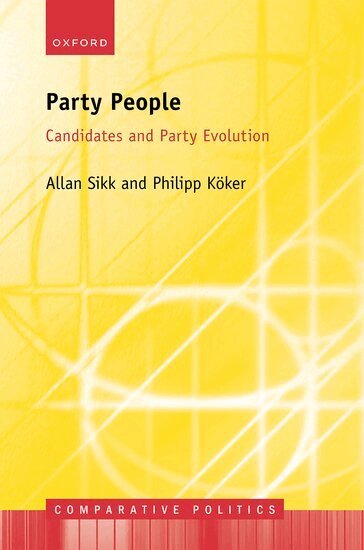
    Party People

    Candidates and Party Evolution

    AvAllan Sikk,Philipp Köker

    Inbunden, Engelska, 2023

    Del i serien Comparative Politics

    1 291 kr

    Beställningsvara. Skickas inom 5-8 vardagar. Fri frakt över 249 kr.

    Beskrivning

    Political parties are nothing without their people and candidates are essential to parties' core functions - contesting elections, filling political offices, and shaping policy. Candidates are the literal 'face' of parties, yet they are not wedded to them permanently: candidates can enter or leave politics, switch parties, move along or stay behind when parties split or merge. Even in parties that look stable, candidate change happens below the surface, ultimately altering what the parties stand for. Inspired by evolutionary theories, Party People: Candidates and Party Evolution conceptualizes candidates as 'party genes' and develops a candidate-based approach to party evolution. Tracking candidates between elections and parties opens up new perspectives on party development in complex and dynamic settings in Central and Eastern Europe (CEE) and beyond. Based on a new database of 200,000 electoral candidates from over 60 elections across nine CEE democracies, this book presents a groundbreaking study of party evolution using candidate change as an indicator of party change. Allan Sikk and Philipp Köker offer a series of methodological and conceptual advances for the measurement of candidate turnover, party fission and fusion, programmatic change, and party leadership change; the resulting analyses make a significant contribution to the study of CEE party politics as well as to the general scholarship on elections, parties, and political change.Comparative Politics is a series for researchers, teachers, and students of political science that deals with contemporary government and politics. Global in scope, books in the series are characterized by a stress on comparative analysis and strong methodological rigour. The series is published in association with the European Consortium for Political Research. For more information visit: www.ecprnet.eu.The series is edited by Nicole Bolleyer, Chair of Comparative Political Science, Geschwister Scholl Institut, LMU Munich and Jonathan Slapin, Professor of Political Institutions and European Politics, Department of Political Science, University of Zurich.

    Produktinformation

    • Utgivningsdatum:2023-10-19
    • Mått:165 x 242 x 22 mm
    • Vikt:568 g
    • Format:Inbunden
    • Språk:Engelska
    • Serie:Comparative Politics
    • Antal sidor:272
    • Förlag:OUP OXFORD
    • ISBN:9780198868125

    Utforska kategorier

    • Politiska partier inom Samhälle och politik
    • Statsvetenskap och politisk teori inom Samhälle och politik
    • Val och folkomröstningar inom Samhälle och politik

    Mer om författaren

    Allan Sikk is an Associate Professor in Comparative Politics at the School of Slavonic and East European Studies, University College London. His research focuses on European electoral and party politics, research methods, and political and social transformation in Central and Eastern Europe. His work has been published in journals including the European Journal of Political Research and Party Politics, and in edited volumes from Oxford University Press and Routledge.Philipp Köker is a Lecturer and Research Fellow in the Department of Political Science, Leibniz University Hannover. His research focuses on presidential politics, political parties and elections, and comparative constitutional law. He is the author of Presidential Activism and Veto Power in Central and Eastern Europe (Palgrave, 2017) and of contributions to Democratization, East European Politics, Party Politics, the Review of Central and East European Law, and The Oxford Handbook of Polish Politics, among others.

    Recensioner i media

    Featuring a new database, an innovative theoretical framework, and fascinating findings that may well change the way we think about parties, old and new, this is a great book-and one that will repay reading by scholars of Western and Eastern Europe alike.

    Innehållsförteckning

    • Preface and acknowledgements 1: Introduction: Candidates and party evolution 2: A conceptual model of candidate and party change 3: Measures matter: New concepts, methods, and big data 4: Determinants of candidate change 5: Old, new, and partially new parties 6: Getting volatility right 7: Fission and fusion 8: Leadership change 9: Programmatic change 10: Conclusion Bibliography Index