• Fri frakt över 249 kr
  • •
  • Snabba leveranser
  • •
  • Billiga böcker
Kundservice

Du är på sajten för privatpersoner.

Företag, bibliotek eller offentlig verksamhet?

Du handlar på classic.bokus.com, där alla dina funktioner finns intakta.
Till classic.bokus.com
Bokus logotyp. Gå till startsidan.
  • Erbjudanden
  • Nyheter
  • Student
  • Topplistor
  • Barn & ungdom
  • Bokus Play
  • E-böcker
  • Pocketböcker
  • Spel & pussel

10% rabatt på allt med kod NYSTART10 →

Sidfot

Mina sidor

    Hjälp

    • Kundservice
    • Vanliga frågor och svar
    • Frakt och leverans
    • Retur vid ångerrätt
    • Reklamera vara
    • Betalning
    • Köpvillkor
    • Allmänna villkor
    • Information om webbplatsens tillgänglighet

    Om Bokus

    • Om oss
    • Pressrum
    • För studenter
    • För företag
    • För bibliotek och offentlig verksamhet
    • För leverantörer
    • Hållbarhet

    Populärt

    • Aktuella erbjudanden
    • Presentkort
    • Studentlitteratur
    • Nya böcker
    • Topplistor
    • Signerade böcker
    • Engelska böcker

    Inspiration

    • Boktips
    • BookTok
    • Populära bokserier
    • Barnbokskaraktärer
    • Populära författare
    Logotyp för Bokus
    Följ oss på Facebook (extern länk)Följ oss på Instagram (extern länk)Följ oss på YouTube (extern länk)Följ oss på TikTok (extern länk)
    bokus @ CookiesAnpassa cookiesIntegritetspolicyKöpvillkor
    Till Citymail hemsida (extern länk)Till Budbee hemsida (extern länk)Till Postnord hemsida (extern länk)Till Schenker hemsida (extern länk)Till Early Bird hemsida (extern länk)Till Walleys hemsida (extern länk)
    1. Naturvetenskap och teknik
    2. Matematik och naturvetenskap
    3. Biologi
    4. Biovetenskap

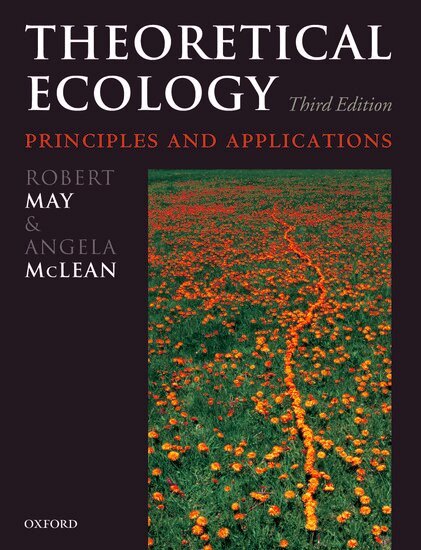
    Theoretical Ecology

    Principles and Applications

    AvRobert May,Angela R. McLean

    Häftad, Engelska, 2007

    1 179 kr

    Beställningsvara. Skickas inom 7-10 vardagar. Fri frakt över 249 kr.

    Beskrivning

    Robert May's seminal book has played a central role in the development of ecological science. Originally published in 1976, this influential text has overseen the transition of ecology from an observational and descriptive subject to one with a solid conceptual core. Indeed, it is a testament to its influence that a great deal of the novel material presented in the earlier editions has now been incorporated into standard undergraduate textbooks. It is now a quarter of a century since the publication of the second edition, and a thorough revision is timely. Theoretical Ecology provides a succinct, up-to-date overview of the field set in the context of applications, thereby bridging the traditional division of theory and practice. It describes the recent advances in our understanding of how interacting populations of plants and animals change over time and space, in response to natural or human-created disturbance. In an integrated way, initial chapters give an account of the basic principles governing the structure, function, and temporal and spatial dynamics of populations and communities of plants and animals. Later chapters outline applications of these ideas to practical issues including fisheries, infectious diseases, tomorrow's food supplies, climate change, and conservation biology. Throughout the book, emphasis is placed on questions which as yet remain unanswered.The editors have invited the top scientists in the field to collaborate with the next generation of theoretical ecologists. The result is an accessible, advanced textbook suitable for senior undergraduate and graduate level students as well as researchers in the fields of ecology, mathematical biology, environment and resources management. It will also be of interest to the general reader seeking a better understanding of a range of global environmental problems.

    Produktinformation

    • Utgivningsdatum:2007-02-15
    • Mått:188 x 245 x 16 mm
    • Vikt:592 g
    • Format:Häftad
    • Språk:Engelska
    • Antal sidor:267
    • Upplaga:33
    • Förlag:OUP OXFORD
    • ISBN:9780199209996

    Utforska kategorier

    • Biovetenskap inom Naturvetenskap och teknik
    • Zoologi inom Naturvetenskap och teknik
    • Djurböcker inom Djur och Natur

    Mer om författaren

    Robert May is Professor of Zoology at the University of Oxford and Imperial College London. His research, first at Princeton University and since 1988 at Oxford University, has dealt with the ways in which plant and animal populations - either singly or in interacting communities - change over time, especially in response to natural or human-created disturbance. His work on chaos, on how infectious diseases can influence the numerical abundance or geographical distribution of populations (including applications to humans and HIV/AIDS), on estimating species' numbers and rates of extinction, and more generally on conservation biology have been recognised by several major International Prizes (Crafoord, Balzan, Blue Planet). He has been Chief Scientific Adviser to the UK Government (1995-2000), President of the Royal Society (2000-2005), and in 2001 was one of the first appointees to the UK Upper House by the Independent House of Lords Appointments Commission.Angela McLean is Professor of Mathematical Biology in the Department of Zoology and Director of the Institute for Emergent Infections of Humans in the James Martin 21st Century School. Her research interests lie in the use of mathematical models to aid our understanding of the evolution and spread of infectious agents. This encompasses modelling of the dynamics of infections and immune responses within individual hosts as well as models of the spread of infections from one host to another

    Recensioner i media

    I would recommend this book to those seeking an overview of modern theoretical ecology and those seeking an easy access point to any one of the main topics covered. British Ecological Society bulletin 2008 39:1

    Innehållsförteckning

    • 1. Introduction ; 2. How Populations Cohere: Five Rules for Cooperation ; 3. Single species dynamics ; 4. Metapopulations and Their Spatial Dynamics ; 5. Predator Prey Interactions ; 6. Plant Population dynamics ; 7. Interspecific Competition and Multispecies Coexistence ; 8. Diversity and stability in ecological communities ; 9. Community: Patterns ; 10. Dynamics of Infectious Diseases ; 11. Fisheries ; 12. A Doubly Green Revolution ; 13. Conservation Biology ; 14. Climate Change and Conservation Biology ; 15. Unanswered Questions and why they Matter