• Fri frakt över 249 kr
  • •
  • Snabba leveranser
  • •
  • Billiga böcker
Kundservice

Du är på sajten för privatpersoner.

Företag, bibliotek eller offentlig verksamhet?

Du handlar på classic.bokus.com, där alla dina funktioner finns intakta.
Till classic.bokus.com
Bokus logotyp. Gå till startsidan.
  • Erbjudanden
  • Nyheter
  • Student
  • Topplistor
  • Barn & ungdom
  • Bokus Play
  • E-böcker
  • Pocketböcker
  • Spel & pussel

10% rabatt på allt med kod: NYSTART10 →

Sidfot

Mina sidor

    Hjälp

    • Kundservice
    • Vanliga frågor och svar
    • Frakt och leverans
    • Retur vid ångerrätt
    • Reklamera vara
    • Betalning
    • Köpvillkor
    • Allmänna villkor
    • Information om webbplatsens tillgänglighet

    Om Bokus

    • Om oss
    • Pressrum
    • För studenter
    • För företag
    • För bibliotek och offentlig verksamhet
    • För leverantörer
    • Hållbarhet

    Populärt

    • Aktuella erbjudanden
    • Presentkort
    • Studentlitteratur
    • Nya böcker
    • Topplistor
    • Signerade böcker
    • Engelska böcker

    Inspiration

    • Boktips
    • BookTok
    • Populära bokserier
    • Barnbokskaraktärer
    • Populära författare
    Logotyp för Bokus
    Följ oss på Facebook (extern länk)Följ oss på Instagram (extern länk)Följ oss på YouTube (extern länk)Följ oss på TikTok (extern länk)
    bokus @ CookiesAnpassa cookiesIntegritetspolicyKöpvillkor
    Till Citymail hemsida (extern länk)Till Budbee hemsida (extern länk)Till Postnord hemsida (extern länk)Till Schenker hemsida (extern länk)Till Early Bird hemsida (extern länk)Till Walleys hemsida (extern länk)
    1. Ekonomi och Ledarskap
    2. Nationalekonomi
    3. Ekonomisk historia

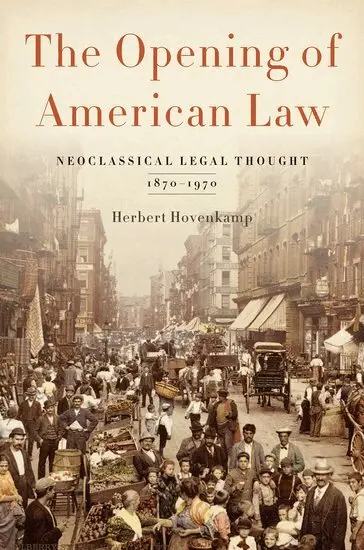
    The Opening of American Law

    Neoclassical Legal Thought, 1870-1970

    AvHerbert Hovenkamp

    Inbunden, Engelska, 2014

    1 291 kr

    Beställningsvara. Skickas inom 5-8 vardagar. Fri frakt över 249 kr.

    Beskrivning

    Two Victorian Era intellectual movements changed the course of American legal thought: Darwinian natural selection and marginalist economics. The two movements rested on fundamentally inconsistent premises. Darwinism emphasized instinct, random selection, and determinism. Marginalism emphasized rational choice. Legal theory managed to accommodate both, although to different degrees in different disciplines. The two movements also developed mutually exclusive scientific methodologies. Darwinism emphasizing external indicators of welfare such as productivity, education or health, while marginalists emphasized market choice. Historians have generally exaggerated the role of Darwinism in American legal thought, while understating the role of marginalist economics. This book explores these issues in several legal disciplines. One is Progressive Era movements for redistributive policies about taxation and public goods. Darwinian science also dominated the law of race relations, while criminal law reflected an inconsistent mixture of Darwinian and marginalist incentive-based theories. The common law, including family law, contract, property, and tort, moved from emphasis on correction of past harms to management of ongoing risk and relationship. A chapter on Legal Realism emphasizes the Realists' indebtedness to institutional economics, a movement that powerfully influenced American legal theory long after it fell out of favor with economists. Five chapters on the corporation, innovation and competition policy show how marginalist economics transformed business policy. The ironic exception was patent law, which developed in relative insulation from economic concerns about innovation policy. The book concludes with three chapters on public law, emphasizing the role of institutionalist economics in policy making during and after the New Deal. A lengthy epilogue then explores the variety of postwar attempts to reconstruct a defensible and more market-oriented rule of law after the decline of Legal Realism and the New Deal.

    Produktinformation

    • Utgivningsdatum:2014-11-13
    • Mått:165 x 240 x 35 mm
    • Vikt:762 g
    • Format:Inbunden
    • Språk:Engelska
    • Antal sidor:472
    • Förlag:OUP USA
    • ISBN:9780199331307

    Utforska kategorier

    • Ekonomisk historia inom Ekonomi och Ledarskap
    • Lag och samhälle inom Juridik
    • Rättshistoria inom Juridik

    Mer om författaren

    Herbert Hovenkamp is the Ben V. & Dorothy Willie Professor of Law and History, University of Iowa, where he teaches antitrust, torts, American legal history, and innovation policy. He has written numerous books in the these areas, and is the author of Antitrust Law, the leading resource in that field. He is a fellow of the American Academy of Arts and Sciences.

    Recensioner i media

    The main reason why I found The Opening of American Law fascinating and worth reading is that it clearly demonstrates the strength and resilience of classical political economy in affecting American law, even long after the approach had been challenged, and eventually displaced, by alternative theoretical paradigms.

    Innehållsförteckning

    • Introduction ; Part I Human Nature and the Sources of Law ; Chap. 1. Scarcity, Biology and the Rational Actor ; Chap. 2. Natural Selection, Deterrence and Mental Defect ; Chap. 3. The Science and Law of Race ; Part II. Neoclassical Legal Thought ; Chap. 4. Economics and Law in the Progressive Era ; Chap. 5. Social Value, Taxation and Public Finance ; Chap. 6. From Institutionalism to Legal Realism ; Chap. 7. Recasting the Common Law: the Management of Risk and Relationship ; Part III. The Neoclassical Firm and the Formation of Modern Business Policy ; Chap. 8. The Revolution in Corporate Finance ; Chap. 9. The Separation of Ownership and Control ; Chap. 10. The Twisted Path to Innovation Policy ; Chap. 11. Structuralism in Competition Policy ; Chap. 12. Distribution and Vertical Control ; Part IV. Neoclassical Public Law ; Chap. 13. The Substantive Due Process Triumvirate: Health, Safety and Morals ; Chap. 14. The Waning of Classical Labor Policy ; Chap. 15. The Regulatory State and Federalism ; Epilogue: The New Deal at Bay