• Fri frakt över 249 kr
  • •
  • Snabba leveranser
  • •
  • Billiga böcker
Kundservice

Du är på sajten för privatpersoner.

Företag, bibliotek eller offentlig verksamhet?

Du handlar på classic.bokus.com, där alla dina funktioner finns intakta.
Till classic.bokus.com
Bokus logotyp. Gå till startsidan.
  • Erbjudanden
  • Nyheter
  • Student
  • Topplistor
  • Barn & ungdom
  • Bokus Play
  • E-böcker
  • Pocketböcker
  • Spel & pussel

10% rabatt på allt med kod: NYSTART10 →

Sidfot

Mina sidor

    Hjälp

    • Kundservice
    • Vanliga frågor och svar
    • Frakt och leverans
    • Retur vid ångerrätt
    • Reklamera vara
    • Betalning
    • Köpvillkor
    • Allmänna villkor
    • Information om webbplatsens tillgänglighet

    Om Bokus

    • Om oss
    • Pressrum
    • För studenter
    • För företag
    • För bibliotek och offentlig verksamhet
    • För leverantörer
    • Hållbarhet

    Populärt

    • Aktuella erbjudanden
    • Presentkort
    • Studentlitteratur
    • Nya böcker
    • Topplistor
    • Signerade böcker
    • Engelska böcker

    Inspiration

    • Boktips
    • BookTok
    • Populära bokserier
    • Barnbokskaraktärer
    • Populära författare
    Logotyp för Bokus
    Följ oss på Facebook (extern länk)Följ oss på Instagram (extern länk)Följ oss på YouTube (extern länk)Följ oss på TikTok (extern länk)
    bokus @ CookiesAnpassa cookiesIntegritetspolicyKöpvillkor
    Till Citymail hemsida (extern länk)Till Budbee hemsida (extern länk)Till Postnord hemsida (extern länk)Till Schenker hemsida (extern länk)Till Early Bird hemsida (extern länk)Till Walleys hemsida (extern länk)
    1. Samhälle och politik
    2. Sociologi och antropologi
    3. Antropologi

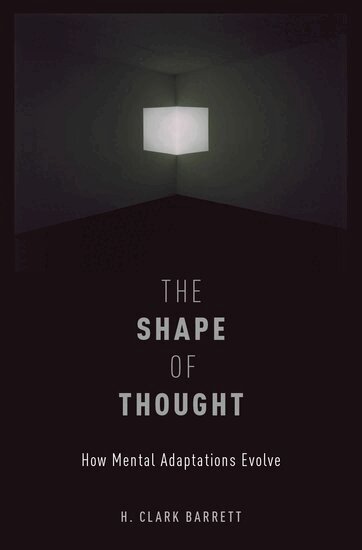
    The Shape of Thought

    How Mental Adaptations Evolve

    AvH. Clark Barrett

    Inbunden, Engelska, 2015

    Del i serien Evolution and Cognition Series

    2 544 kr

    Beställningsvara. Skickas inom 5-8 vardagar. Fri frakt över 249 kr.

    Fler format och utgåvor

    Häftad

    791 kr

    Beskrivning

    This is an open access title. It is available to read and download as a free PDF version on Oxford Academic and is made available under a Creative Commons Attribution-NonCommercial-NoDerivatives 4.0 International licence. The Shape of Thought: How Mental Adaptations Evolve presents a road map for an evolutionary psychology of the twenty-first century. It brings together theory from biology and cognitive science to show how the brain can be composed of specialized adaptations, and yet also an organ of plasticity. Although mental adaptations have typically been seen as monolithic, hard-wired components frozen in the evolutionary past, The Shape of Thought presents a new view of mental adaptations as diverse and variable, with distinct functions and evolutionary histories that shape how they develop, what information they use, and what they do with that information. The book describes how advances in evolutionary developmental biology can be applied to the brain by focusing on the design of the d

    Produktinformation

    • Utgivningsdatum:2015-02-19
    • Mått:239 x 160 x 27 mm
    • Vikt:703 g
    • Format:Inbunden
    • Språk:Engelska
    • Serie:Evolution and Cognition Series
    • Antal sidor:416
    • Förlag:OUP USA
    • ISBN:9780199348305

    Utforska kategorier

    • Antropologi inom Samhälle och politik
    • Kognitiv psykologi inom Psykologi och pedagogik
    • Människans biologi inom Naturvetenskap och teknik

    Mer om författaren

    H. Clark Barrett is an evolutionary anthropologist who studies the evolution of cognition. For the past fifteen years he has conducted field work in the Amazon region of Ecuador, and uses experimental cognitive tasks across cultures to test hypotheses about the evolution of the mind. He is now Professor of Anthropology at the University of California, Los Angeles.

    Recensioner i media

    Rich and thoughtful, this book lays out why, if we want to understand human psychology, neural plasticity, cultural differences and cognitive development, we need evolutionary theory, and an understanding of how humans evolved. In Barrett's hands, the pernicious dichotomy that divides "learning" from "innate" explanations crumbles, leaving only evolutionary explanations, which may involve different types of developmental processes. In setting the house back in order, Barrett synthesizes insights and findings from psychology, culture-gene coevolutionary theory, anthropology, developmental biology and philosophy. He delivers Evolutionary Psychology 2.0.

    Innehållsförteckning

    • Acknowledgments ; Introduction: The problem ; Part 1. Evolution ; 1 - Additivism ; 2 - Hill-climbing ; Part 2. Information ; 3 - Adding value ; 4 - Social ontology ; 5 - Minds ; Part 3. Development ; 6 - Development ; 7 - Open ends ; Part 4. Culture ; 8 - Moving targets ; 9 - Culture ; 10 - Accumulation ; Part 5. Architecture ; 11 - Parts ; 12 - Wholes ; 13 - Us ; Conclusion: Possibilities ; References ; Index