• Fri frakt över 249 kr
  • •
  • Snabba leveranser
  • •
  • Billiga böcker
Kundservice

Du är på sajten för privatpersoner.

Företag, bibliotek eller offentlig verksamhet?

Du handlar på classic.bokus.com, där alla dina funktioner finns intakta.
Till classic.bokus.com
Bokus logotyp. Gå till startsidan.
  • Erbjudanden
  • Student
  • Topplistor
  • Barn & ungdom
  • Bokus Play
  • E-böcker
  • Ljudböcker
  • Pocketböcker
  • Spel och pussel

Pocketfynda! Hundratals böcker för 49 kr/st →

Sidfot

Mina sidor

    Hjälp

    • Kundservice
    • Vanliga frågor och svar
    • Frakt och leverans
    • Retur vid ångerrätt
    • Reklamera vara
    • Betalning
    • Köpvillkor
    • Allmänna villkor
    • Information om webbplatsens tillgänglighet

    Om Bokus

    • Om oss
    • Pressrum
    • För studenter
    • För företag
    • För bibliotek och offentlig verksamhet
    • För leverantörer
    • Hållbarhet

    Populärt

    • Aktuella erbjudanden
    • Presentkort
    • Studentlitteratur
    • Nya böcker
    • Topplistor
    • Signerade böcker
    • Engelska böcker

    Inspiration

    • Boktips
    • BookTok
    • Barnbokskaraktärer
    • Populära författare
    Logotyp för Bokus
    Följ oss på Facebook (extern länk)Följ oss på Instagram (extern länk)Följ oss på YouTube (extern länk)Följ oss på TikTok (extern länk)
    bokus @ CookiesAnpassa cookiesIntegritetspolicyKöpvillkor
    Till Citymail hemsida (extern länk)Till Budbee hemsida (extern länk)Till Postnord hemsida (extern länk)Till Schenker hemsida (extern länk)Till Early Bird hemsida (extern länk)Till Walleys hemsida (extern länk)
    1. Samhälle och politik
    2. Sociologi och antropologi
    3. Antropologi

    Twenty Years After Communism

    AvMichael Bernhard,Jan Kubik

    Häftad, Engelska, 2014

    1 133 kr

    Beställningsvara. Skickas inom 5-8 vardagar. Fri frakt över 249 kr.

    Beskrivning

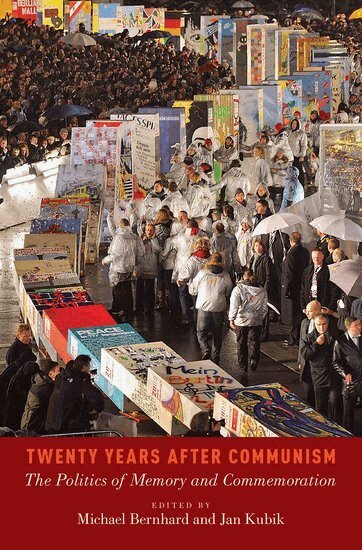
    While the fall of the Berlin Wall is positively commemorated in the West, the intervening years have shown that the former Soviet Bloc has a more complicated view of its legacy. In post-communist Eastern Europe, the way people remember state socialism is closely intertwined with the manner in which they envision historical justice. Twenty Years After Communism is concerned with the explosion of a politics of memory triggered by the fall of state socialism in Eastern Europe, and it takes a comparative look at the ways that communism and its demise have been commemorated (or not commemorated) by major political actors across the region. The book is built on three premises. The first is that political actors always strive to come to terms with the history of their communities in order to generate a sense of order in their personal and collective lives. Second, new leaders sometimes find it advantageous to mete out justice on the politicians of abolished regimes, and whether and how they do so depends heavily on their interpretation and assessment of the collective past. Finally, remembering the past, particularly collectively, is always a political process, thus the politics of memory and commemoration needs to be studied as an integral part of the establishment of new collective identities and new principles of political legitimacy. Each chapter takes a detailed look at the commemorative ceremony of a different country of the former Soviet Bloc. Collectively the book looks at patterns of extrication from state socialism, patterns of ethnic and class conflict, the strategies of communist successor parties, and the cultural traditions of a given country that influence the way official collective memory is constructed.Twenty Years After Communism develops a new analytical and explanatory framework that helps readers to understand the utility of historical memory as an important and understudied part of democratization.

    Produktinformation

    • Utgivningsdatum:2014-08-21
    • Mått:155 x 249 x 25 mm
    • Vikt:522 g
    • Format:Häftad
    • Språk:Engelska
    • Antal sidor:384
    • Förlag:OUP USA
    • ISBN:9780199375141

    Utforska kategorier

    • Antropologi inom Samhälle och politik
    • Filosofiska discipliner inom Filosofi och religion
    • Kognitiv psykologi inom Psykologi och pedagogik

    Mer om författaren

    Michael Bernhard is Raymond and Miriam Ehrlich Chair of Political Science at the University of Florida. Jan Kubik is Professor and Chair of Political Science at Rutgers University.

    Recensioner i media

    Remembering a nation's past shapes its future. We should know this in our bones, but thanks to Bernhard, Kubik, and their contributors, we have both theory and method to approach it analytically across the world, and inspired empirical studies of the post-communist world. One of the best volumes I have read in years. It is required reading for those who want to understand how cultural politics matter.

    Innehållsförteckning

    • List of Figures and Tables ; List of Pictures ; Acknowledgments ; Contributor list ; Introduction - Michael Bernhard and Jan Kubik ; Chapter 1: A Theory of the Politics of Memory - Jan Kubik and Michael Bernhard ; Part I: Fractured Memory Regimes ; Chapter 2: Revolutionary Road: 1956 and the Fracturing of Hungarian Historical Memory - Anna Seleny ; Chapter 3: Roundtable Discord: The Contested Legacy of 1989 in Poland - Michael Bernhard and Jan Kubik ; Chapter 4: Romania Twenty Years after 1989: The Bizarre Echoes of a Contested Revolution - Grigore Pop-Eleches ; Chapter 5: I Ignored Your Revolution, but You Forgot My Anniversary: Party Competition in Slovakia and the Construction of Recollection - Carol Skalnik Leff, Kevin Deegan-Krause, and Sharon L. Wolchik ; Chapter 6: Remembering the Revolution: Contested Pasts in the Baltic Countries - Daina S. Eglitis and Laura Ardava ; Chapter 7: Memories of the Past and Visions of the Future: Remembering the Soviet Era and its End in Ukraine - Oxana Shevel ; Part II: Pillarized Memory Regimes ; Chapter 8: Remembering, Not Commemorating, 1989: The 20-Year Anniversary of the Velvet Revolution in the Czech Republic - Conor O'Dwyer ; Part III: Unified Memory Regimes ; Chapter 9: Making Room for November 9, 1989? The Fall of the Berlin Wall in German Politics and Memory - David Art ; Chapter 10: The Inescapable Past: The Politics of Memory in Postcommunist Bulgaria - Venelin I. Ganev ; Chapter 11: Lives of Others: Commemorating 1989 in the Former Yugoslavia - Aida A. Hozi? ; Part IV: Conclusions ; The Politics and Culture of Memory Regimes: A Comparative Analysis - Michael Bernhard and Jan Kubik ; Appendices ; Bibliography ; Index