• Fri frakt över 249 kr
  • •
  • Snabba leveranser
  • •
  • Billiga böcker
Kundservice

Du är på sajten för privatpersoner.

Företag, bibliotek eller offentlig verksamhet?

Du handlar på classic.bokus.com, där alla dina funktioner finns intakta.
Till classic.bokus.com
Bokus logotyp. Gå till startsidan.
  • Erbjudanden
  • Nyheter
  • Student
  • Topplistor
  • Barn & ungdom
  • Bokus Play
  • E-böcker
  • Pocketböcker
  • Spel & pussel

10% rabatt på allt med kod NYSTART10 →

Sidfot

Mina sidor

    Hjälp

    • Kundservice
    • Vanliga frågor och svar
    • Frakt och leverans
    • Retur vid ångerrätt
    • Reklamera vara
    • Betalning
    • Köpvillkor
    • Allmänna villkor
    • Information om webbplatsens tillgänglighet

    Om Bokus

    • Om oss
    • Pressrum
    • För studenter
    • För företag
    • För bibliotek och offentlig verksamhet
    • För leverantörer
    • Hållbarhet

    Populärt

    • Aktuella erbjudanden
    • Presentkort
    • Studentlitteratur
    • Nya böcker
    • Topplistor
    • Signerade böcker
    • Engelska böcker

    Inspiration

    • Boktips
    • BookTok
    • Populära bokserier
    • Barnbokskaraktärer
    • Populära författare
    Logotyp för Bokus
    Följ oss på Facebook (extern länk)Följ oss på Instagram (extern länk)Följ oss på YouTube (extern länk)Följ oss på TikTok (extern länk)
    bokus @ CookiesAnpassa cookiesIntegritetspolicyKöpvillkor
    Till Citymail hemsida (extern länk)Till Budbee hemsida (extern länk)Till Postnord hemsida (extern länk)Till Schenker hemsida (extern länk)Till Early Bird hemsida (extern länk)Till Walleys hemsida (extern länk)
    1. Psykologi och pedagogik
    2. Pedagogik
    3. Pedagogisk psykologi

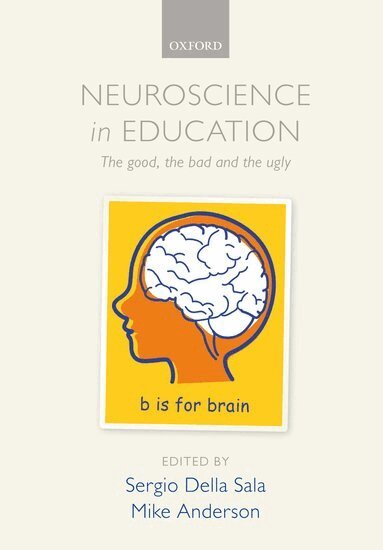
    Neuroscience in Education

    The good, the bad, and the ugly

    AvSergio Della Sala,Mike Anderson

    Häftad, Engelska, 2012

    1 099 kr

    Beställningsvara. Skickas inom 7-10 vardagar. Fri frakt över 249 kr.

    Beskrivning

    In the past ten years, there has been growing interest in applying our knowledge of the functioning of the human brain to the field of education-including reading, learning, language and mathematics. This has resulted in the development of a number of new practices in education-some good, some bad and some just crazy. The 'good' is nearly always sound cognitive research that has clear implications for educational practice. The 'bad' is the use of neuroscience jargon to lure the unwary and to give an apparent scientific aura to flawed educational programs with no evidence base and which no reputable neuroscientist would endorse. The 'ugly' is simplistic interpretation and misapplication of cognitive theories leading to errors in their application. More and better could be done if neuroscientists and educationalists acknowledge the limits of their disciplines and start listening to each other.Neuroscience in Education brings together an international group of leading psychologists, neuroscientists, educationalists and geneticists to critically review some of these new developments, examining the science behind these practices, the validity of the theories on which they are based, and whether they work. It will be fascinating reading for anyone involved in education, including teachers, psychologists, neuroscientists, and policy makers as well as interested parents.

    Produktinformation

    • Utgivningsdatum:2012-04-05
    • Mått:171 x 246 x 22 mm
    • Vikt:716 g
    • Format:Häftad
    • Språk:Engelska
    • Antal sidor:408
    • Förlag:OUP OXFORD
    • ISBN:9780199600496

    Utforska kategorier

    • Pedagogisk psykologi inom Psykologi och pedagogik
    • Utbildningsstrategier och utbildningspolitik inom Psykologi och pedagogik
    • Biovetenskap inom Naturvetenskap och teknik

    Mer om författaren

    Sergio Della Sala is a trained Clinical Neurologist, Professor of Human Cognitive Neuroscience in the Psychology Department at the University of Edinburgh, UK and is holding an adjunct chair at the Psychology Department of the University of Western Australia. He is a Fellow of the British Psychological Society, of the Association for Psychological Science and of the Royal Society of Edinburgh, and Editor of Cortex. His research focuses on memory and memory impairments and on the cognitive deficits associated with brain damage. Mike Anderson is a Professor of Psychology and Director of the Neurocognitive Development Unit in the School of Psychology at the University of Western Australia. His research is based around his theory of intelligence and development and focuses most recently on the influence of the developing brain on intellectual functions in children.

    Innehållsförteckning

    • INTRODUCTIONS ; 1. Neuroscience in Education: An (opinionated) Introduction ; 2. Understanding the neuroscience and education connection: Themes emerging from a review of the literature ; THEORETICAL APPROACHES FOR DEVELOPING THE GOOD, REMOVING THE BAD AND GIVING THE UGLY A MAKEOVER IN NEUROSCIENCE AND EDUCATION ; 3. Constructing connection: the evolving field of mind, brain, and education ; 4. Principles of Learning, Implications for Teaching? Cognitive Neuroscience and the Classroom ; THE CONTRIBUTION OF COGNITIVE NEUROSCIENCE TO UNDERSTANDING DOMAINS OF LEARNING ; 5. Reading in alphabetic writing systems: Evidence from cognitive neuroscience ; 6. Can teachers count on mathematical neurosciences? ; 7. Working Memory: The seat of learning and comprehension ; 8. Applications of cognitive science to education ; THE INFLUENCE OF NEUROGENETICS ON EDUCATION ; 9. Genetics and genomics: Good, bad and ugly ; 10. Genetic sciences for developmentalists: An example of reading ability and disability ; 11. Genetically-informed models for school and teaching ; MISUSE OF NEUROSCIENCE IN THE CLASSROOM ; 12. Neuroscience, education and educational efficacy research ; 13. Educational double-think ; 14. Rose-tinted? The use of coloured filters to treat reading difficulties ; 15. Don't try this at school: The attraction of 'alternative' educational techniques ; CURRENT CONJECTURES FROM EDUCATIONAL NEUROSCIENCE ; 16. Bridging between brain science and educational practice with Design Patterns ; 17. Assuring successful lifelong learning - can neuroscience provide the key? ; EDUCATIONAL COGNITIVE NEUROSCIENCE: DESIGNING AUTISM-FRIENDLY METHODS TO TEACH EMOTION RECOGNITION ; 18. Educational cognitive neuroscience: Designing autism-friendly methods to teach emotion recognition ; 19. Schools and the new ecology of the human mind ; 20. Brain-Science and Education in Japan ; FINAL REMARKS ; 21. The good, the bad and the ugly in neuroscience and education - an educator's perspective ; 22. Of all the conferences in all the towns in all the world, what in heaven's name brought us to neuroeducation?