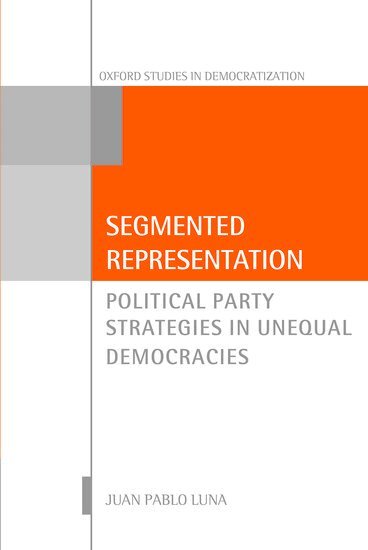
Inbunden, Engelska, 2014
Segmented Representation
Political Party Strategies in Unequal Democracies
Del i serien Oxford Studies in Democratization
2025 kr
Beställningsvara. Skickas inom 10-15 vardagar. Fri frakt över 249 kr.
Fler format och utgåvor
Beskrivning
Produktinformation
- Utgivningsdatum: 2014-04-17
- Mått: 162 x 239 x 29 mm
- Vikt: 744 g
- Format: Inbunden
- Språk: Engelska
- Serie: Oxford Studies in Democratization
- Antal sidor: 402
- Förlag: OUP OXFORD
- ISBN: 9780199642649
- Utmärkelser: Carlos Real de Azúa Award for Best Book by a Senior Scholar of the Uruguayan Political Science Association
Utforska kategorier
Mer om författaren
Juan Pablo Luna Farina is interested in the analysis of political parties and democratic representation, the political effects of inequality, and the nature of state institutions. In 2010 he co-authored the book Latin American Party Systems (Cambridge University Press). His dissertation research was awarded the 2008 Juan Linz Best Dissertation Award by the Comparative Democratization Section of APSA. His work has appeared in Comparative Political Studies, Política y Gobierno, Revista de Ciencia Política, Latin American Politics and Society, International Political Science Review, Third World Quarterly, Journal of Latin American Studies, the Journal of Democracy, Perfiles Latinoamericanos, and Democratization. He has held visiting positions at Princeton University (2008), Brown University (2011), and Harvard University (2013). He is Associate Professor, Instituto de Ciencia Política, PUC-Chile.
Recensioner i media
This is a path-breaking study of democratic representation in highly unequal societies. Juan Pablo Luna convincingly demonstrates that segmented societies create both incentives and opportunities for political parties'-on both the left and the right-to use different types of electoral appeals to attract distinct groups of voters. Drawing from survey data and field research in Chile and Uruguay, Luna shows how parties craft electoral strategies that combine programmatic, clientelistic, and personalistic linkages to voters, allowing them to generate support among heterogeneous but socially segmented constituencies. The result is a masterful analysis of how inequality structures democratic representation-and, ultimately, how democracy can reproduce social inequality.
Betyg & recensioner
0 recensioner
Inga recensioner tillgängliga.