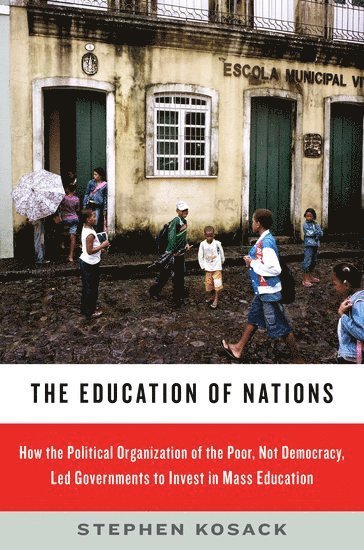
Häftad, Engelska, 2012
The Education of Nations
How the Political Organization of the Poor, Not Democracy, Led Governments to Invest in Mass Education
528 kr
Beställningsvara. Skickas inom 7-10 vardagar. Fri frakt över 249 kr.
Beskrivning
Produktinformation
- Utgivningsdatum: 2012-08-16
- Mått: 234 x 155 x 27 mm
- Vikt: 499 g
- Format: Häftad
- Språk: Engelska
- Antal sidor: 384
- Förlag: OUP USA
- ISBN: 9780199841677
Utforska kategorier
Mer om författaren
Assistant Professor of Government, Harvard University, Kennedy School of Government
Recensioner i media
Democratization leads to the expansion of education in developing nations. Or so conventional wisdom would have it. But in this innovative book, Stephen Kosack argues that conventional wisdom is often quite wrong. He develops a new theory that, by going beyond regime type to consider the logic of politics, puts the explanatory emphasis not on whether the poor are simply allowed to vote, but rather on whether political entrepreneurs have been able to organize them as a powerful constituency . His three, well-chosen case studies provide empirical support, adding illuminating detail about real education systems, their politics, and their development. This is a provocative argument destined to stimulate debate, new thinking, and new research on a topic of great importance.
Betyg & recensioner
0 recensioner
Inga recensioner tillgängliga.