• Fri frakt över 249 kr
  • •
  • Snabba leveranser
  • •
  • Billiga böcker
Kundservice

Du är på sajten för privatpersoner.

Företag, bibliotek eller offentlig verksamhet?

Du handlar på classic.bokus.com, där alla dina funktioner finns intakta.
Till classic.bokus.com
Bokus logotyp. Gå till startsidan.
  • Erbjudanden
  • Nyheter
  • Student
  • Topplistor
  • Barn & ungdom
  • Bokus Play
  • E-böcker
  • Pocketböcker
  • Spel & pussel

Må bättre, för mindre! Upp till 50% rabatt på hälsoböcker

Sidfot

Mina sidor

    Hjälp

    • Kundservice
    • Vanliga frågor och svar
    • Frakt och leverans
    • Retur vid ångerrätt
    • Reklamera vara
    • Betalning
    • Köpvillkor
    • Allmänna villkor
    • Information om webbplatsens tillgänglighet

    Om Bokus

    • Om oss
    • Pressrum
    • För studenter
    • För företag
    • För bibliotek och offentlig verksamhet
    • För leverantörer
    • Hållbarhet

    Populärt

    • Aktuella erbjudanden
    • Presentkort
    • Studentlitteratur
    • Nya böcker
    • Topplistor
    • Signerade böcker
    • Engelska böcker

    Inspiration

    • Boktips
    • BookTok
    • Populära bokserier
    • Barnbokskaraktärer
    • Populära författare
    Logotyp för Bokus
    Följ oss på Facebook (extern länk)Följ oss på Instagram (extern länk)Följ oss på YouTube (extern länk)Följ oss på TikTok (extern länk)
    bokus @ CookiesAnpassa cookiesIntegritetspolicyKöpvillkor
    Till Citymail hemsida (extern länk)Till Budbee hemsida (extern länk)Till Postnord hemsida (extern länk)Till Schenker hemsida (extern länk)Till Early Bird hemsida (extern länk)Till Walleys hemsida (extern länk)
    1. Samhälle och politik
    2. Samhälle och kultur
    3. Kultur och medier
    4. Referensverk och tvärvetenskap

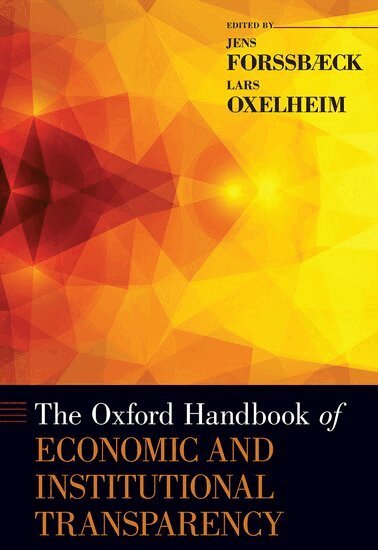
    The Oxford Handbook of Economic and Institutional Transparency

    AvJens Forssbaeck,Lars Oxelheim

    Inbunden, Engelska, 2014

    Del i serien Oxford Handbooks

    3 012 kr

    Beställningsvara. Skickas inom 3-6 vardagar. Fri frakt över 249 kr.

    Beskrivning

    In recent years, the term 'transparency' has emerged as one of the most popular and keenly-touted concepts around. In the economic-political debate, the principle of transparency is often advocated as a prerequisite for accountability, legitimacy, policy efficiency, and good governance, as well as a universal remedy against corruption, corporate and political scandals, financial crises, and a host of other problems.But transparency is more than a mere catch-phrase. Increased transparency is a bearing ideal behind regulatory reform in many areas, including financial reporting and banking regulation. Individual governments as well as multilateral bodies have launched broad-based initiatives to enhance transparency in both economic and other policy domains. Parallel to these developments, the concept of transparency has seeped its way into academic research in a wide range of social science disciplines, including the economic sciences.This increased importance of transparency in economics and business studies has called for a reference work that surveys existing research on transparency and explores its meaning and significance in different areas. The Oxford Handbook of Economic and Institutional Transparency is such a reference. Comprised of authoritative yet accessible contributions by leading scholars, this Handbook addresses questions such as: What is transparency? What is the rationale for transparency? What are the determinants and the effects of transparency? And is transparency always beneficial, or can it also be detrimental (if so, when)?The chapters are presented in three sections that correspond to three broad themes. The first section addresses transparency in different areas of economic policy. The second section covers institutional transparency and explores the role of transparency in market integration and regulation. Finally, the third section focuses on corporate transparency. Taken together, this volume offers an up-to-date account of existing work on and approaches to transparency in economic research, discusses open questions, and provides guidance for future research, all from a blend of disciplinary perspectives.

    Produktinformation

    • Utgivningsdatum:2014-10-09
    • Mått:178 x 249 x 40 mm
    • Vikt:1 202 g
    • Format:Inbunden
    • Språk:Engelska
    • Serie:Oxford Handbooks
    • Antal sidor:614
    • Förlag:OUP USA
    • ISBN:9780199917693

    Utforska kategorier

    • Referensverk och tvärvetenskap inom Samhälle och politik
    • Internationell ekonomi inom Ekonomi och Ledarskap

    Mer om författaren

    Jens Forssbæck is an Associate Professor of Finance at Lund University School of Economics and Management and a fellow of the Knut Wicksell Centre for Financial Studies in Lund, Sweden. He holds a PhD in Finance from Copenhagen Business School and has held visiting positions at universities in France, the Netherlands, and the United Kingdom. His research lies mainly in the areas of international finance and financial intermediation, and he has been widely published in international scientific journals and in book form.Lars Oxelheim is Professor of International Business and Finance at Lund University School of Economics and Management (LUSEM), Lund, Sweden. He is affiliated with the Research Institute of Industrial Economics (IFN), Stockholm, Sweden and the School of Business and Law, University of Agder, Kristiansand, Norway. He is Honorary Professor at the Fudan University, Shanghai and the founding chairman of the Swedish Network for European Studies in Economics and Business (SNEE). Professor Oxelheim has published approximately 40 books and numerous scientific articles. He is an active member of several international research networks and serves on the editorial board of a number of journals.

    Innehållsförteckning

    • PART 1: INTRODUCTION ; 1. The Multi-Faceted Concept of Transparency ; Jens Forssbaeck and Lars Oxelheim ; PART 2: POLICY TRANSPARENCY ; 2. Constitutional Transparency ; Richard J. Sweeney ; 3. Monetary Policy Transparency ; Petra M. Geraats ; 4. Fiscal Policy Transparency ; Iain Begg ; 5. Transparent and Unique Sovereign Default Risk Assessment ; Edward I. Altman and Herbert Rijken ; 6. Transparency and Competition Policy in an Imperfectly Competitive World ; Philippe Gugler ; 7. Transparency in International Trade Policy ; Michael G. Plummer and Alissa Tafti ; 8. Transparency of Climate Change Policies, Markets, and Corporate Practices ; Thomas L. Brewer and Michael Mehling ; 9. Transparency of Human Resource Policy ; Erik Mellander ; 10. Transparency of Innovation Policy ; Bo Carlsson ; PART 3: INSTITUTIONAL, MARKET AND REGULATORY TRANSPARENCY ; 11. Labor Market Transparency ; Eskil Wadensjo ; 12. Transparency in Financial Regulation ; James R. Barth, Apanard (Penny) Prabha, and Clas Wihlborg ; 13. Price Transparency and International Market Integration ; Richard Friberg ; 14. Transparency of Inward Investment Incentives ; Frederick Lehmann and Ana Teresa Lehmann ; 15. Transparency and Corruption ; Alvaro Cuervo-Cazurra ; PART 4: CORPORATE TRANSPARENCY ; 16. Multinational Corporations' Relationship with Political Actors: Transparency versus Opacity ; Pervez N. Ghauri, Amjad Hadjikhani, and Cecilia Pahlberg ; 17. Corporate Governance and Optimal Transparency ; Tom Berglund ; 18. Transparency Differences at the Top of the Organization: Market-Pull versus Strategic Hoarding Forces ; Winfried Ruigrok, Dimitrios Georgakakis, and Peder Greve ; 19 . Governance Transparency and the Institutions of Capitalism: Implications for Finance ; Raj Aggarwal and John Goodell ; 20. Transparency and Executive Compensation ; Raghavendra Rau ; 21. Transparency and Disclosure in the Global Microfinance Industry ; Leif Atle Beisland, Roy Mersland, and Trond Randoy ; 22. Accounting Transparency and International Standard-Setting ; Sidney J. Gray and Helen Kang ; 23. Transparency of Fair Value Accounting and Tax ; Eva Eberhartinger and Soojin Lee ; 24. Transparency of Corporate Risk Management and Performance ; Peter McKay ; 25. Stress Testing, Transparency and Uncertainty in European Banking: What impacts? ; Rym Ayadi and Willem Pieter De Groen